
Automated SEO content briefs that writers can actually use
A useful automated brief is a reproducible page contract, not a list of keywords copied from ranking pages. It explains the page's job, the evidence available, the topics and decisions readers need, what must not be claimed, how the page connects to the site, and what qualifies it for release.
What is an automated SEO content brief?
An automated SEO content brief is a structured page specification assembled from repeatable evidence such as a site crawl, page ownership map, business profile, search intent, entity research, internal links, and editorial rules. Automation prepares the package; an accountable reviewer decides whether the proposed page and requirements are correct.
The difference between automation and generic generation is traceability. A writer should be able to see why the page exists, which existing URL owns adjacent intent, which source supports a claim, and where the page must link. A reviewer should be able to reject the brief before prose is generated.
Rank Titan stores briefs separately from drafts. That separation protects the strategy decision: approving an idea or brief does not silently approve words that do not yet exist.
What inputs should generate the brief?
Use the current site's indexable inventory, canonical page ownership, business and audience facts, approved opportunities, relevant query and SERP evidence, product or local proof, internal-link graph, destination constraints, and a page-type recipe. Missing evidence should become a visible requirement, not fabricated copy.
- Current URLs: status, canonical, robots, title, H1, page type, topic, depth, and incoming links.
- Page ownership: primary intent, parent pillar, support role, competing pages, exclusions, and proposed canonical URL.
- Business truth: offers, audience, locations, process, proof, policies, differentiators, tone, and forbidden claims.
- Search evidence: query family, intent, recurring subtopics, page formats, freshness needs, and unresolved audience questions.
- Destination: CMS, post type, editor or builder, metadata adapter, media rules, publishing permissions, and rollback needs.
What belongs in a complete SEO brief?
A complete brief defines purpose, audience task, intent, page type, required sections and entities, decision points, proof and trust signals, conversion path, exclusions, internal links, schema and image recommendations, fact checks, acceptance criteria, and an expected depth based on the job rather than a copied word count.
Outline headings should describe the decisions the reader needs to make. Entities and questions help check coverage, but they are not instructions to repeat phrases. Include a direct-answer expectation for definition and process questions, and specify where examples, screenshots, tables, calculations, or first-party evidence are necessary.
Hard vetoes deserve their own field. They can prohibit invented testimonials, unsupported performance claims, fake local experience, outdated pricing, unverified integrations, or language that contradicts legal and brand policy.
How should the brief handle links, schema, and images?
Specify each asset by purpose. Internal links need a source or target, natural anchor intent, and reason. Structured data needs a supported type and visible-content requirements. Images need a planned subject, placement, source, caption, and alternative text rather than a decorative image quota.
A support page should normally link to its pillar and relevant commercial owner, while the pillar provides a discoverable path back to important support pages. Link instructions must use actual stable URLs; guessed slugs create broken paths and hide ownership mistakes.
Schema recommendations are not a license to mark up invisible or unsupported claims. Article, BreadcrumbList, FAQ, Product, LocalBusiness, and other types have different eligibility rules. Validate JSON-LD and confirm that the rendered page visibly supports it. Product screenshots should show the relevant tool state, protect credentials, use descriptive alt text, and remain legible on mobile.
How do acceptance criteria make briefs operational?
Turn subjective quality into observable checks without pretending judgment can be fully reduced to a score. Acceptance criteria should cover factual sourcing, intent satisfaction, unique value, structure, metadata, links, images, schema, accessibility, conversion path, destination compatibility, and rendered verification.
- Every consequential claim is supported by an approved first-party fact or a retained credible source.
- The page answers its primary question early and does not compete with the documented owner of adjacent intent.
- Required entities and decision points are covered naturally, with examples or evidence where readers need them.
- Metadata, canonical, robots direction, H1, headings, links, images, and structured data pass rendered checks.
- The CTA matches the reader's stage, and no internal workflow language leaks into public copy.
- A responsible reviewer records approval or a bounded revision request before destination delivery.
What should automation decide, and what needs human review?
Automation can collect inputs, normalize fields, suggest structure, match existing URLs, identify missing requirements, assemble prompts, and run deterministic checks. People should retain page ownership, evidence quality, risky claims, brand judgment, consolidation, publication, and performance decisions.
A brief generator should fail visibly when the site profile lacks proof or when two URLs appear to own the same intent. Quietly filling gaps with plausible text makes the document look complete while transferring risk to the writer and client.
Version the brief and retain the prompt package or rule set used to assemble it. When a draft changes, reviewers can then distinguish a strategy change from an editorial revision and reproduce the requirements for future refreshes.
Keyword template versus operational SEO brief
| Brief element | Keyword template | Operational brief |
|---|---|---|
| Reason to exist | Target phrase | Audience task, gap evidence, owner, and business outcome |
| Structure | Suggested headings | Required decisions, entities, evidence, examples, and exclusions |
| Site relationship | Related keywords | Pillar, competing URLs, inbound and outbound link targets |
| Assets | Optional image notes | Screenshots, placement, source, caption, alt text, and schema rules |
| Quality | Word count and readability | Factual, editorial, SEO, accessibility, destination, and rendered checks |
| Approval | Comment in a document | Versioned gate before draft generation and publication |
Implementation checklist
- Confirm the proposed page does not duplicate an existing canonical owner.
- Record the audience task, search intent, page type, cluster role, URL, and CTA.
- Include required sections, entities, questions, decision points, proof, and sources.
- Write explicit hard vetoes for unsupported claims and off-scope intent.
- Name exact internal-link targets and explain why each link helps the reader.
- Specify schema, screenshots or images, captions, alt text, and destination constraints.
- Define observable acceptance criteria for the draft and rendered route.
- Version and approve the brief before generation, then retain it with the release evidence.
Frequently asked questions
Can AI generate an SEO content brief?
Yes, when it is grounded in the current site, business facts, page ownership, search evidence, and explicit rules. A generated brief still needs review for strategy, sources, and claims.
How long should an SEO brief be?
Long enough to remove consequential ambiguity. A focused support page may need a compact brief, while a regulated service page or pillar may require extensive evidence, exclusions, links, and destination instructions.
Should a brief include a word count?
It can include an expected range for planning, but the page should be as complete as the audience task requires. Copying the average length of ranking pages is not a quality strategy.
Does approving a brief approve the final article?
No. Brief approval confirms the page plan. The resulting draft, factual review, SEO QA, and publication should remain separate decisions.
Primary sources and further reading
See the Rank Titan tools used in this workflow
These are current captures from the working Rank Titan application—not conceptual dashboard mockups.
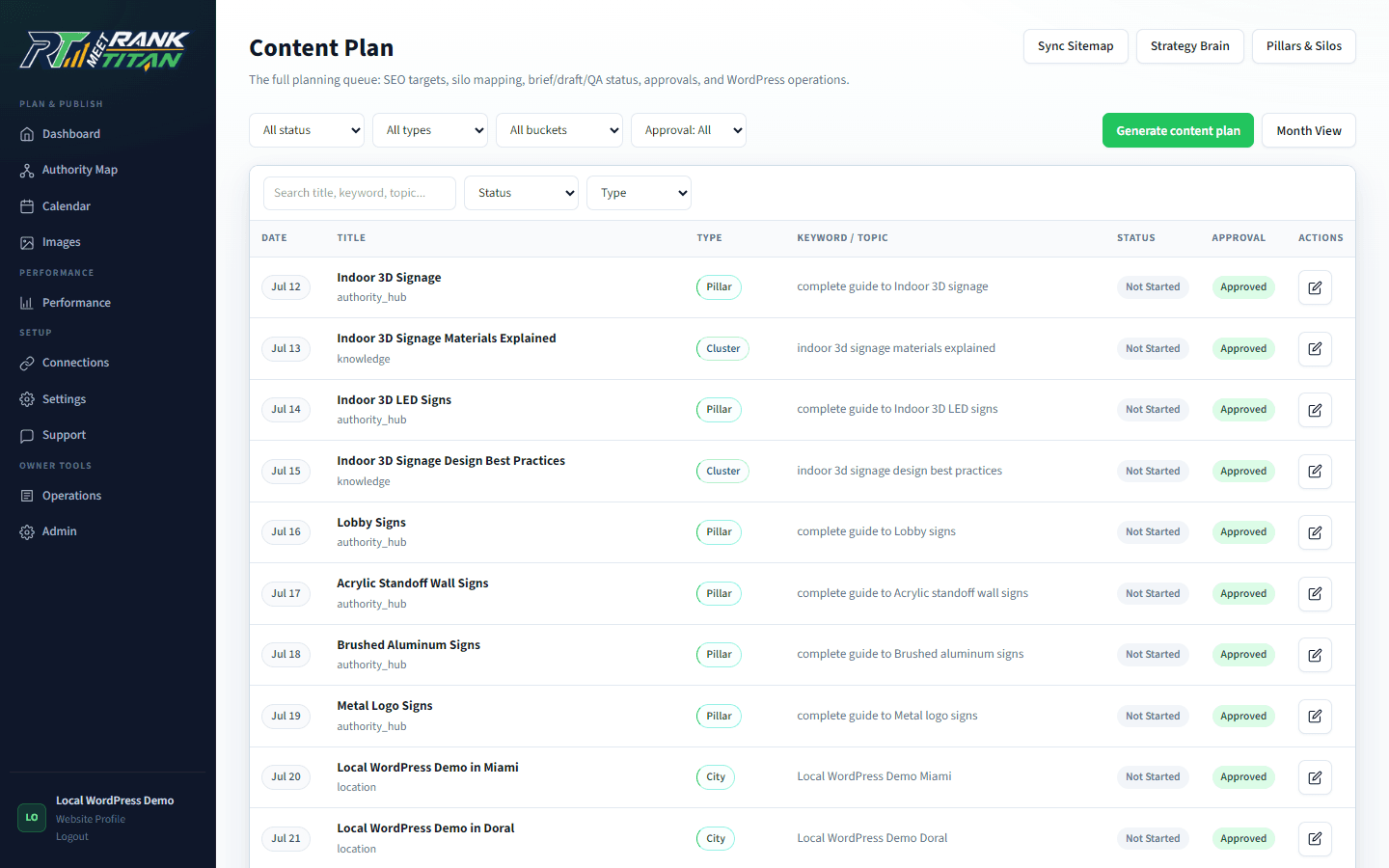
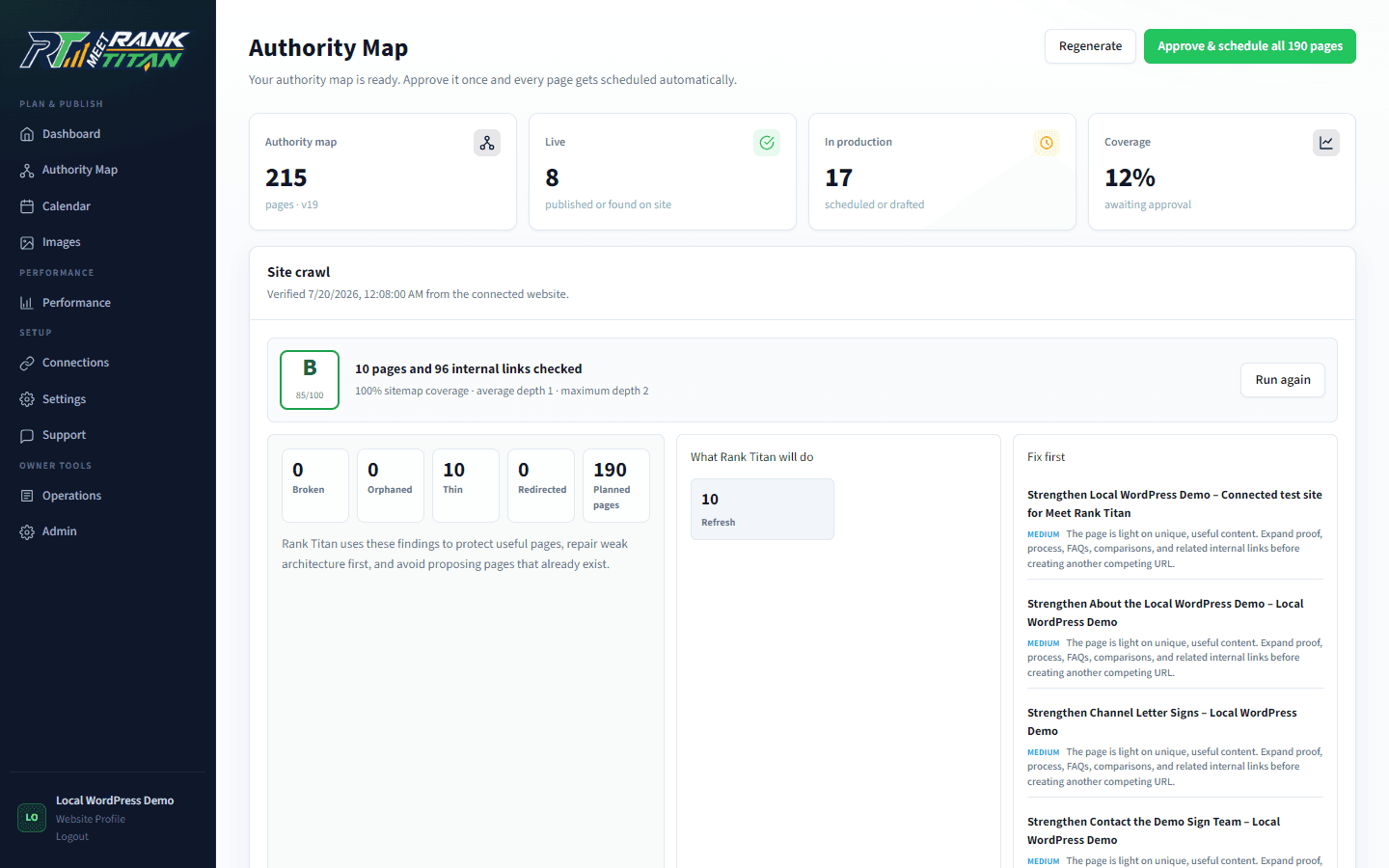
Map the site before generating the next page.
Rank Titan connects crawl evidence, topical architecture, briefs, QA, internal links, and draft-safe publishing in one reviewable workflow.