
SEO content operations: from site evidence to measured releases
SEO content operations is the system behind consistent organic growth: deciding which page should exist, recording why, assembling everything a writer and reviewer need, controlling publication, and learning from the result. The calendar is useful only when it represents that full chain.
What are SEO content operations?
SEO content operations is the documented workflow, data, ownership, and quality control that moves a search opportunity from evidence to a reviewed, published, and measured page. It connects technical site truth, content strategy, editorial production, CMS delivery, and reporting rather than treating writing as an isolated task.
For an agency, the operating system must work across multiple clients without erasing what makes each client accurate. The reusable parts are the stages, acceptance criteria, status vocabulary, and audit trail. Offers, locations, expertise, proof, forbidden claims, brand voice, and conversion paths remain site-specific source truth.
A dependable operation also distinguishes a proposal from a deliverable. A keyword in a spreadsheet is not a page brief. A draft is not an approved page. A successful CMS request is not a verified live route. An indexed URL is not proof that it attracts qualified demand.
What stages belong in an agency SEO content workflow?
Use visible gates: profile and evidence, crawl and inventory, opportunity and page ownership, plan approval, brief, draft package, editorial and SEO QA, destination approval, rendered verification, and performance review. Each gate should have an owner, required inputs, a pass condition, and a recoverable next action.
- Evidence gate: confirm services, audiences, locations, proof, policies, competitors, analytics access, and prohibited claims.
- Architecture gate: classify existing URLs, choose canonical owners, map pillars and support pages, and record dependencies.
- Production gate: approve the idea before generating a brief, then approve the brief or acceptance criteria before writing.
- Quality gate: review facts, intent coverage, originality, entities, internal links, metadata, schema, images, accessibility, and conversion path.
- Release gate: send a draft or approved update through a destination-aware connector, then verify the exact rendered route.
- Learning gate: track crawl, index, query, conversion, and AI-answer observations separately and feed decisions back into the plan.
How does page ownership prevent duplicate work and cannibalization?
Assign one canonical owner URL to each primary intent before production begins. The owner record should include the query family, audience task, funnel role, page type, parent topic, competing URLs, exclusions, proof requirements, internal-link targets, CTA, and measurement plan.
Ownership turns research into a release decision. If an existing page already satisfies the intent, refresh or consolidate it instead of commissioning another article. If the proposed page serves a genuinely different decision, document the distinction in the brief so the writer does not drift back into the parent page's job.
Rank Titan's crawl and Authority Map provide the evidence layer, while the Content Plan carries page type, keyword, intent, strategic bucket, priority, schedule, and approval state into production. The relationship matters more than the tool labels: every queued item should trace back to a reason and an owner.
What should move through the content operation as one package?
Move the brief, draft, metadata, suggested slug, schema, image plan, alt text, internal links, sources, QA report, approval state, destination settings, and release evidence together. Splitting them across unrelated documents makes omissions and conflicting revisions much more likely.
The current Rank Titan data model stores a brief with purpose, intent, required entities, decision points, trust and conversion signals, vetoes, links, schema, images, fact checks, and a word target. Draft versions can retain metadata, HTML, schema, image and link plans, model provenance, QA results, and revision snapshots.
That package gives each reviewer the context to make a bounded decision. A client can approve the idea without approving a generated article. An editor can request a revision without silently changing page ownership. A publisher can see whether the requested destination state is draft, scheduled, or live.
Who should own each decision in a scaled workflow?
Give strategy, subject-matter truth, editorial quality, technical release, and performance decisions named owners even when one person fills several roles. Automation can prepare evidence and perform repeatable checks, but it should not hide who approved a consequential claim or live-site change.
- SEO strategist: page ownership, intent, cluster role, priority, consolidation, and measurement hypothesis.
- Client or subject expert: proprietary facts, examples, policies, differentiators, regulated claims, and final factual approval.
- Editor: clarity, voice, usefulness, originality, sourcing, and whether the page deserves to exist.
- SEO reviewer: metadata, entities, links, structured data, canonical and robots instructions, and cannibalization check.
- Publisher: CMS compatibility, permissions, status, layout, media, rollback reference, and rendered-route proof.
- Account owner: deadline, approval follow-up, outcome reporting, and the next action when a gate fails.
How should an agency measure content operations?
Measure flow quality and search outcomes separately. Operational metrics reveal whether the system ships accurate work predictably; search and business metrics reveal whether those releases earn discovery and contribute to demand. Neither category can substitute for the other.
Useful operating measures include cycle time by stage, revision rate, briefs returned for missing proof, QA failures, publish errors, rollback events, overdue approvals, pages shipped with complete packages, and rendered defects caught before release.
Outcome measures include indexed owner URLs, non-brand query coverage, impressions, qualified organic visits, assisted and direct conversions, cluster completion, internal-link contribution, citations or mentions in relevant AI answers, and pages consolidated or retired after review. Record the deployment date so performance changes are not attributed to work that is still only local or planned.
Editorial calendar versus SEO content operating system
| Control | Editorial calendar | SEO content operations |
|---|---|---|
| Starting point | Ideas and dates | Crawl evidence, source truth, and page ownership |
| Work item | Title or assignment | Brief, draft package, QA, destination, and measurement |
| Approvals | Often one review status | Separate strategy, factual, editorial, and publication gates |
| Links and schema | Added during editing | Specified in the brief and verified in rendered output |
| Publishing | Marked complete when posted | CMS action, live route, index state, and rollback kept distinct |
| Reporting | Volume and deadlines | Flow health, search outcomes, conversions, and corrective actions |
Implementation checklist
- Create a site-specific source-of-truth profile before assigning content.
- Crawl and classify existing URLs, redirects, canonicals, indexability, and internal links.
- Assign one canonical owner and one audience task to each primary query family.
- Require approval of the plan before briefs or drafts consume budget.
- Move the brief, content, metadata, schema, media, links, sources, and QA as one package.
- Name the person accountable for strategy, facts, editorial quality, and publication.
- Verify the destination record and rendered route after every consequential release.
- Review operational failures and search outcomes on a fixed cadence, then update the plan.
Frequently asked questions
Is SEO content operations just a content calendar?
No. A calendar schedules work. Content operations also defines evidence, page ownership, handoffs, approval gates, complete deliverables, release controls, verification, and performance feedback.
Can a small agency use this workflow?
Yes. One person may fill several roles, but the gates and evidence should remain explicit. A lightweight system is still safer than relying on memory and disconnected documents.
What should agencies automate first?
Start with read-only crawl inventory, consistent page briefs, package completeness checks, and status reporting. Add generation and CMS actions only after approval rules and rollback paths are clear.
Does Rank Titan automatically publish every approved item?
No. Plan approval, draft generation, draft approval, and publishing are separate states. Scheduled or automatic actions depend on site settings and destination permissions.
Primary sources and further reading
See the Rank Titan tools used in this workflow
These are current captures from the working Rank Titan application—not conceptual dashboard mockups.
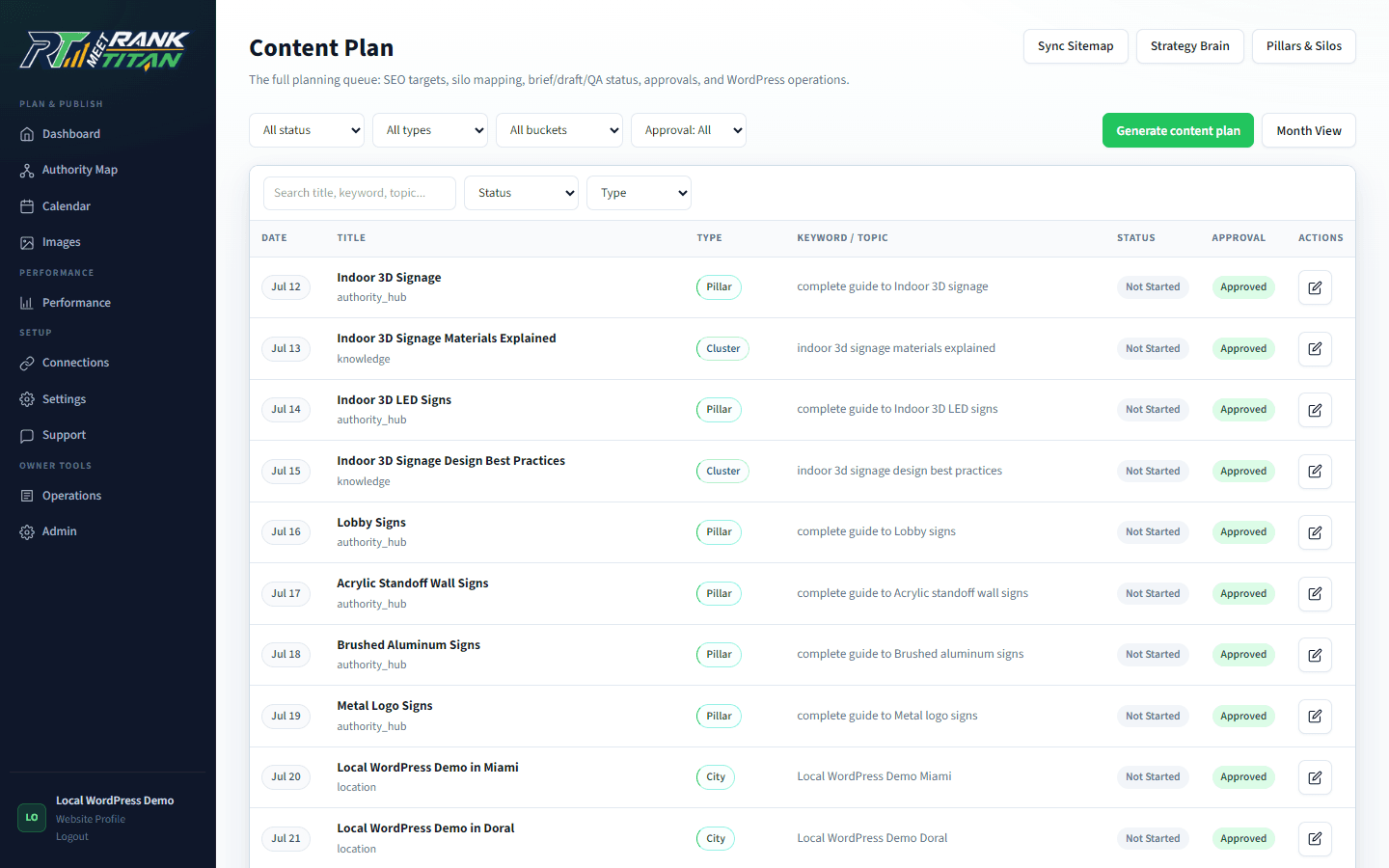
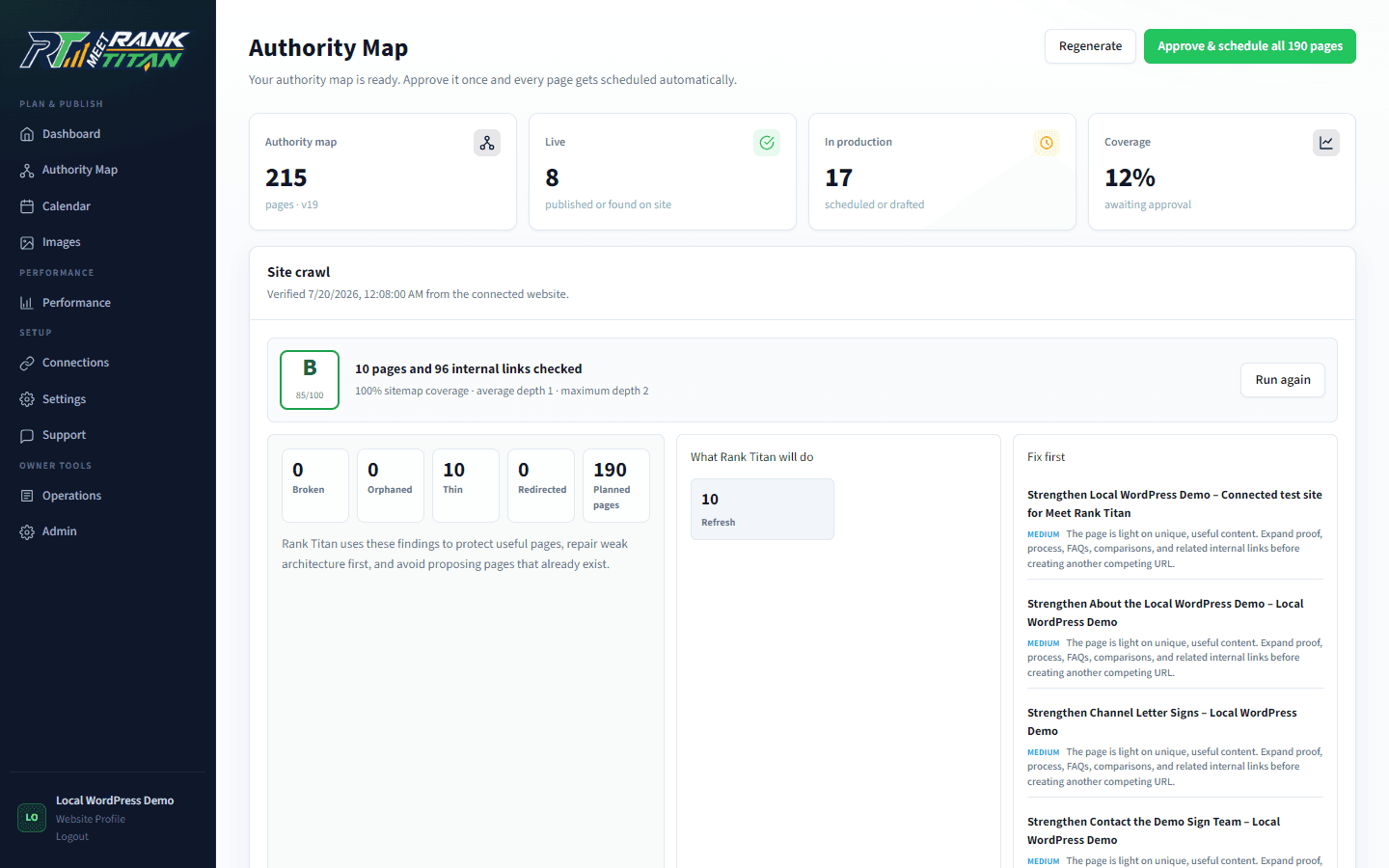
Map the site before generating the next page.
Rank Titan connects crawl evidence, topical architecture, briefs, QA, internal links, and draft-safe publishing in one reviewable workflow.