
How to build topic clusters step by step
A topic cluster is useful only when its pages solve distinct problems and connect naturally. This process begins with the current site, not a blank keyword export, and ends with a measurable publishing and refresh plan.
What is a topic cluster?
A topic cluster is a group of intentionally interlinked pages built around one broad subject. A pillar page explains the subject and routes readers to deeper answers, while each support page owns a narrower intent and links back to the pillar that gives it context.
The model is also called hub-and-spoke content architecture. It is an editorial framework, not a special Google feature or guaranteed ranking mechanism. Its practical value is clearer: it helps a team assign page ownership, prevent random publishing, create crawlable paths, and cover a customer problem at the level of detail each question deserves.
A cluster is not defined by a fixed page count. It may contain four pages or forty, depending on the distinct needs the business can answer with real expertise. Adding weak pages to reach an arbitrary number makes the architecture larger without making it more useful.
Step 1: inventory the pages you already have
Crawl the canonical site and classify every relevant URL before creating the cluster. Record its intent, page type, topic, status, depth, inbound links, performance, and content condition so existing owners are refreshed rather than duplicated.
Start with the sitemap, but do not assume it represents the full site. Compare sitemap URLs with crawl discoveries, navigation links, Search Console landing pages, and CMS records. Normalize protocol, host, path, trailing slash, and parameters before deciding that two records represent two pages.
Label each page as retain, refresh, consolidate, redirect candidate, noindex candidate, or unrelated. Do not execute destructive changes during mapping. The output of this step is source truth for later page ownership, not a bulk cleanup command.
Step 2: choose a business-relevant core topic
Choose a broad problem your product or expertise can credibly solve, then define the audience and conversion path. A topic is not a good pillar merely because it has volume; it must connect to the business and support several genuinely distinct reader tasks.
- Name the audience and the situation that makes the topic important to them.
- Identify the product, service, or next action the pillar can naturally support.
- List the proof, examples, data, and expert knowledge the team can provide.
- Write explicit exclusions so adjacent subjects do not expand the cluster indefinitely.
- Check whether an existing product or guide page already owns the broad intent.
Step 3: group demand by intent, not wording
Group queries when the same page can satisfy the same user task; split them when the expected answer, format, audience, evidence, or conversion path changes. Similar words can represent different intents, and different words can represent the same intent.
Use Search Console, customer questions, SERP results, related searches, competitor coverage, and keyword tools as evidence. Compare the actual result types: a definition guide, template, product page, calculator, comparison, or troubleshooting article may require a different owner even when the vocabulary overlaps.
Record one primary query family and supporting variants for each group. Do not manufacture a page for every phrase. If two groups consistently return the same useful results and need the same answer, combining them usually creates a stronger owner and a simpler site.
Step 4: assign one URL owner to every intent
Create a page-ownership table that names the intent, page role, existing or proposed URL, parent pillar, required evidence, conversion destination, and topics owned elsewhere. No draft should begin until this record passes a cannibalization review.
- Pillar: broad orientation, decision framework, and routes to specialized answers.
- Support guide: one procedure, question, risk, comparison, template, or implementation problem.
- Commercial owner: product, service, use-case, or pricing page for evaluation intent.
- Evidence asset: original research, methodology, benchmark, case study, or expert analysis.
- Refresh: an existing URL that already owns the intent but needs better proof, structure, or links.
Step 5: brief every page as part of the cluster
A cluster brief must describe both the page and its relationships. Include the direct answer, entities, outline, proof ledger, images, metadata, schema, parent and lateral links, conversion link, exclusions, and acceptance criteria.
Write answer-first headings based on the reader's questions, then identify which statements require sources and which require first-hand business proof. Screenshots, diagrams, templates, and examples should be planned as evidence or utility rather than decoration.
The exclusions are as important as the outline. They keep a support page from expanding into its pillar or stealing the focus of a sibling page. A brief should say, for example, that a step-by-step cluster guide explains implementation while the topical-map pillar owns the broader planning framework.
Step 6: design the internal links before publication
Every support page should link upward to its pillar, and the pillar should link down when a reader benefits from the deeper answer. Add lateral and commercial links only when they represent a useful next step, using descriptive crawlable anchors.
Google's link documentation says links help it discover pages and understand their relevance. This makes internal links part of architecture, not a decorative post-publication task. Include the source section, destination URL, anchor intent, and reason for each priority link in the brief.
Avoid automatic all-to-all linking. It creates repeated anchors, dilutes useful paths, and makes every page look equally related. After implementation, crawl the graph and verify that no new page is orphaned, important pages are not needlessly deep, and links do not route through redirects.
Step 7: publish in dependency order and measure the cluster
Repair critical crawl and canonical problems first, then publish the pillar, the most useful support pages, and the links that connect them. Measure the architecture, individual pages, and business outcomes instead of declaring the cluster complete when the drafts exist.
- Release proof: exact URL, status, canonical, robots, title, description, H1, schema, images, links, and CMS state.
- Discovery proof: sitemap presence, crawl discovery, Search Console inspection, and indexing status.
- Coverage proof: impressions and queries across the intended intent groups, including non-brand demand.
- Graph proof: inbound links, click depth, broken links, redirect hops, and orphan count.
- Business proof: qualified visits, conversion paths, assisted actions, and content that improves sales or support work.
Strong topic cluster versus page collection
| Test | Loose page collection | Intentional topic cluster |
|---|---|---|
| Starting point | Keyword export | Business truth plus current-site inventory |
| Page decision | One page per phrase | One owner per distinct user task |
| Pillar role | Longest article | Broad orientation and routing page |
| Support role | Any related post | A focused answer with explicit exclusions |
| Links | Added in bulk later | Planned upward, downward, lateral, and commercial paths |
| Completion | Drafts published | Routes verified, discovered, measured, and refreshed |
Implementation checklist
- Crawl and normalize the canonical site before proposing pages.
- Choose a core topic that connects expertise, audience needs, and a conversion path.
- Group queries by shared intent and expected result format.
- Assign one existing or proposed URL owner to each group.
- Brief the page, evidence, exclusions, schema, images, links, and CTA together.
- Link support pages to the pillar and add lateral links only when useful.
- Publish in dependency order and verify the rendered routes.
- Track discovery, indexing, coverage, conversions, and refresh decisions separately.
Frequently asked questions
How many pages should be in a topic cluster?
There is no required number. Build only the pages that satisfy distinct, relevant user needs with enough expertise and evidence to deserve separate URLs.
Should the pillar page be published before cluster pages?
Usually yes when it provides the navigation and context the support pages need, but an existing commercial or guide page may already serve as the pillar. Dependency and usefulness matter more than a rigid launch order.
Do topic clusters guarantee topical authority or rankings?
No. They can improve site organization, coverage, and internal links, but ranking outcomes also depend on usefulness, competition, authority, technical accessibility, and demand.
How do you prevent topic-cluster cannibalization?
Give every primary intent one canonical owner, combine query variants with the same expected answer, document exclusions in every brief, and review existing URLs before creating a new one.
Primary sources and further reading
See the Rank Titan tools used in this workflow
These are current captures from the working Rank Titan application—not conceptual dashboard mockups.
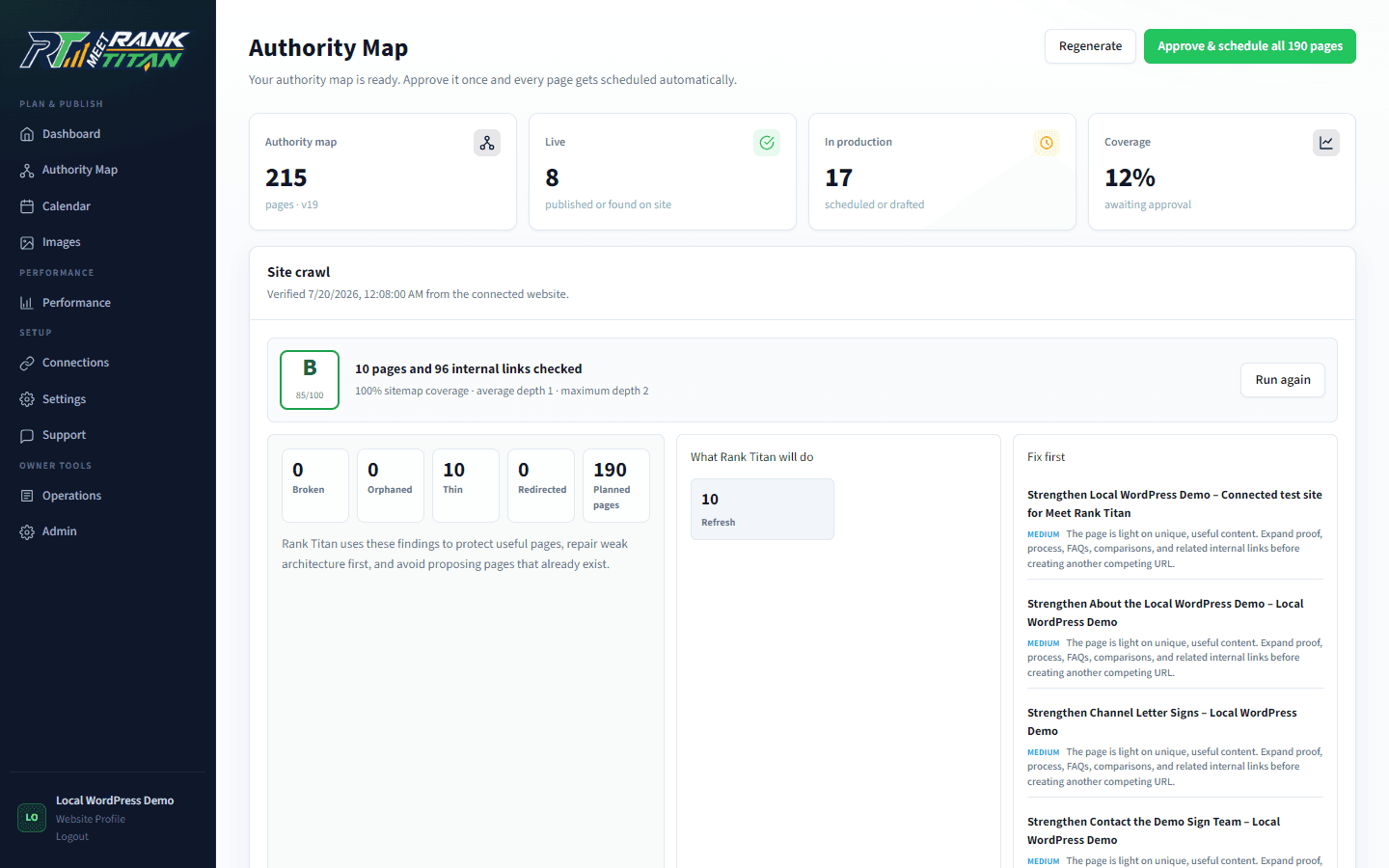
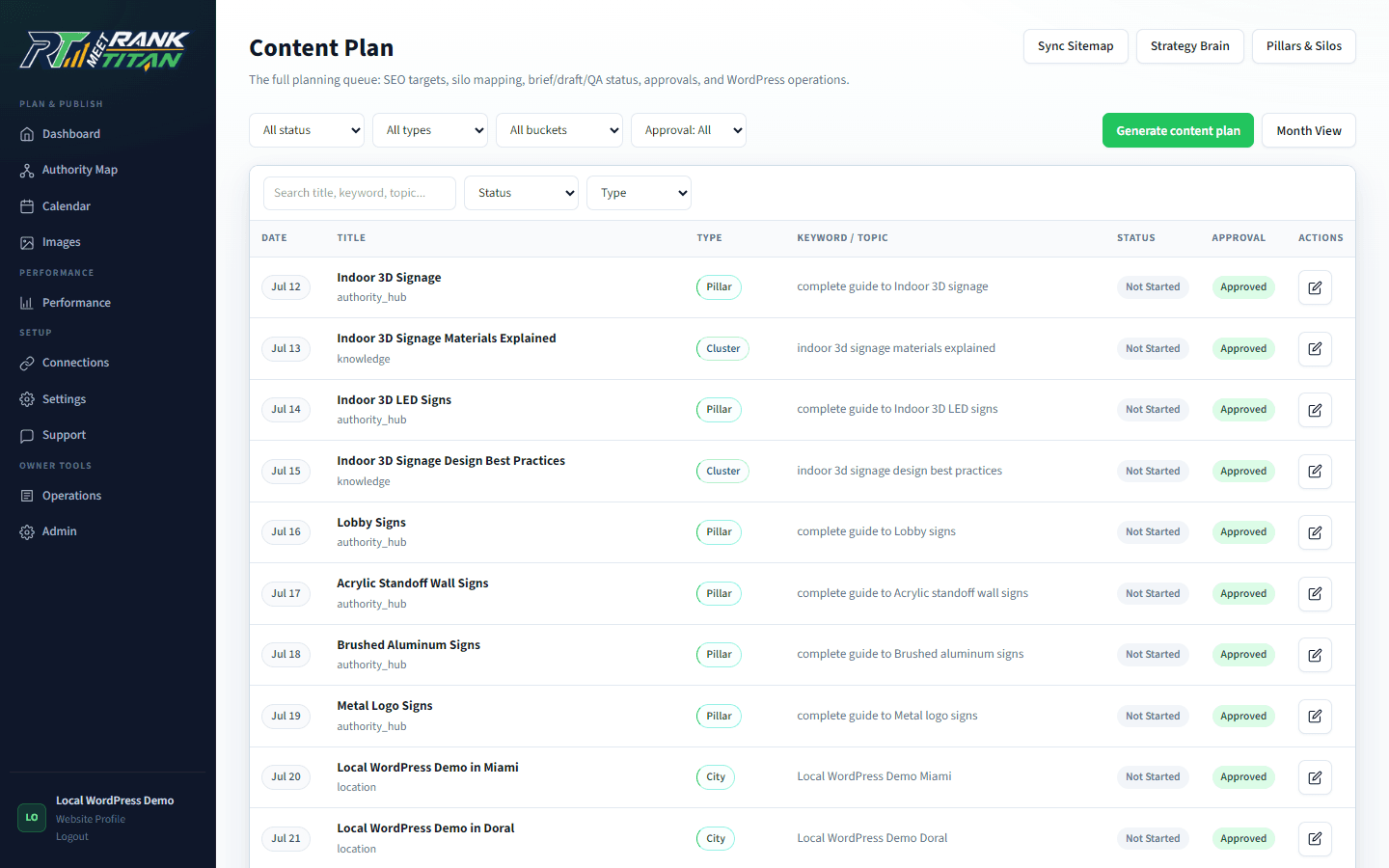
Map the site before generating the next page.
Rank Titan connects crawl evidence, topical architecture, briefs, QA, internal links, and draft-safe publishing in one reviewable workflow.