
Move approved SEO work into WordPress without handing AI the keys.
Rank Titan prepares the strategy, page package, and QA first. Its connector then uses signed requests and WordPress-side permissions to create drafts, move media and metadata, respect builders, and report the exact result.
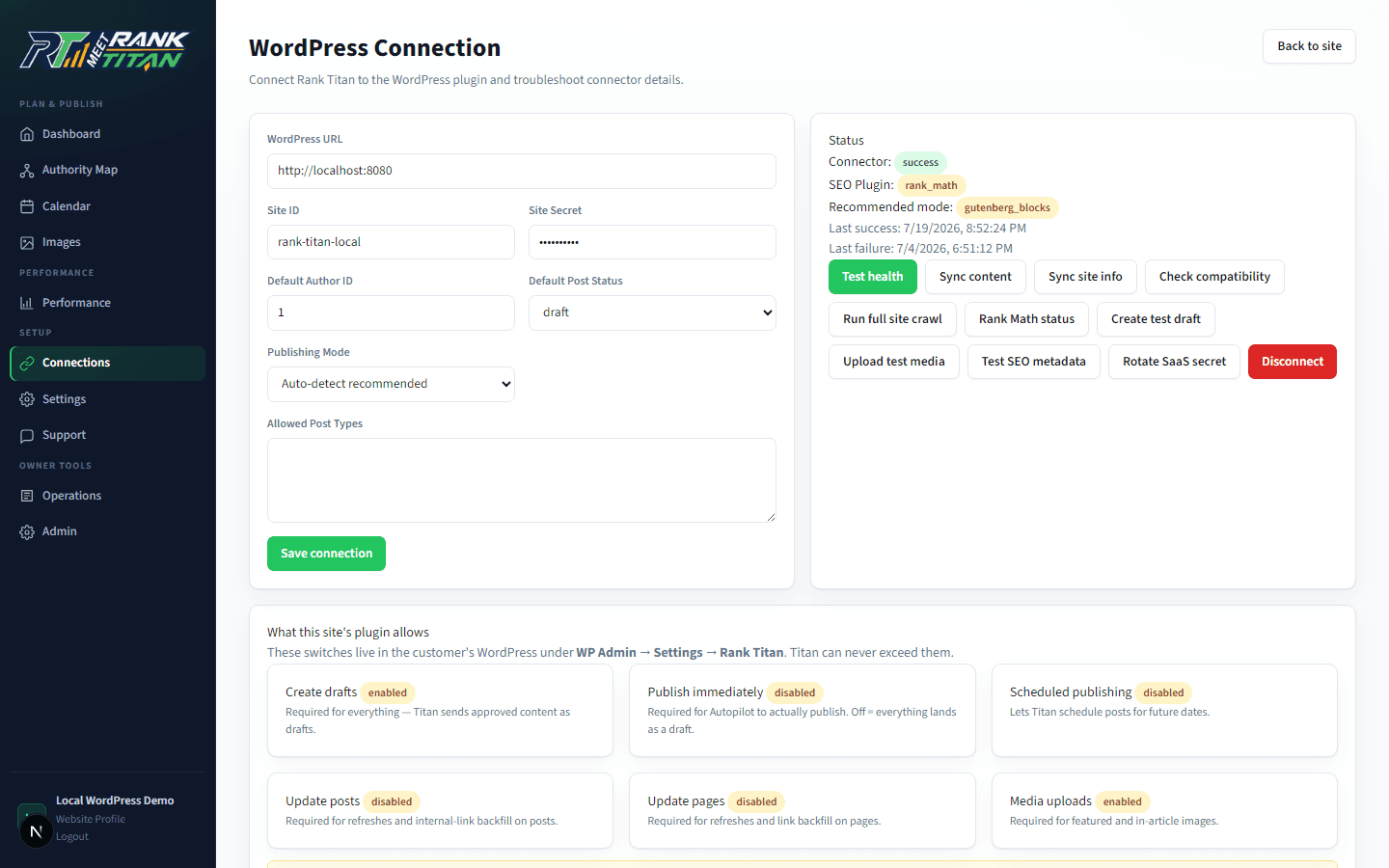
The connector can never exceed what the WordPress site allows.
Approval in Rank Titan is one gate. WordPress retains a second hard boundary for the actions the destination will accept.
Signed and replay-resistant
Requests use HMAC SHA-256 over the timestamp, unique request ID, and raw body. The plugin rejects missing headers, wrong site IDs, stale timestamps, reused request IDs, insecure secrets, invalid signatures, oversized bodies, and excessive request rates.
Draft-first status controls
Draft creation, immediate publishing, scheduled publishing, post updates, page updates, and media uploads are separate WordPress-side capabilities. A publish request falls back to a draft when immediate publishing is not allowed.
Builder-aware delivery
The connection reports an editor mode and protects builder-managed pages from blind overwrites. Gutenberg, classic HTML, limited WPBakery handling, and Elementor-safe draft behavior are treated as different destination conditions.
Auditable outcomes
Connector status, recent successes and failures, compatibility checks, publishing mode, adapter decisions, warnings, WordPress record IDs, and edit URLs remain inspectable rather than disappearing behind a generic success message.
Move the SEO context with the page.
A WordPress draft should not arrive as body copy with the important work scattered across another document.
Content and page ownership
Title, slug, post type, author, status, structured body, excerpt, cluster role, and the approved intent stay connected.
SEO metadata adapters
Rank Math, Yoast SEO, All in One SEO, and SEOPress are detected with capability-specific fields and honest fallback behavior.
Schema separated from body content
Validated JSON-LD is stored and emitted separately so WordPress does not leave raw structured-data text inside a REST-created post.
Media and accessibility
Destination permissions govern uploads, while filenames, captions, featured-image intent, and meaningful alternative text travel with the package.
Internal-link updates
Link work targets stable WordPress records and runs only when the site permits source-page updates; the resulting routes still require a crawl check.
Rendered-route verification
A connector response, WordPress record, public URL, index state, and search performance remain separate states with separate proof.
WordPress automation controls
Does the Rank Titan WordPress connector publish immediately?
Draft creation is the review-first default. Immediate and scheduled publishing require separate capabilities enabled by the site owner inside WordPress.
Are AI provider keys stored in WordPress?
No. The connector stores its Rank Titan site identifier and shared connector secret. AI provider keys, prompts, strategy, and QA logic remain in the SaaS application.
Which SEO plugins can Rank Titan detect?
The current connector detects Rank Math, Yoast SEO, All in One SEO, and SEOPress. The compatibility report identifies supported, partial, or fallback fields for the destination.
How are page builders protected?
Rank Titan detects editor conditions and uses destination-aware modes. Existing builder-managed pages are protected from generic overwrites unless the site owner explicitly permits the operation.
Plan first. Review the package. Deliver to WordPress safely.
See the full workflow or connect a demonstration site before granting production publishing permissions.