
How to build a topical authority map without creating cannibalization
A useful topical map is not a long keyword spreadsheet. It is a publishing architecture that assigns each search need to one page, shows how those pages support the business, and defines the links that help people and crawlers move through the subject.
What is a topical authority map?
A topical authority map is a structured plan that connects a business-relevant subject to its pillars, supporting questions, entities, search intents, page types, URL owners, internal links, proof requirements, and conversion paths. Its job is to prevent random publishing and make every proposed page accountable to a distinct user need.
SEO teams often use the phrase topical authority to describe the trust and relevance a site may earn by covering a subject deeply and coherently. It is a useful planning concept, but it is not a public Google score that can be measured directly. Treat any tool that presents a precise topical-authority number as a model or proxy, not a confirmed ranking-system output.
The map therefore should not promise rankings. It should create testable improvements: clearer page ownership, fewer duplicate intents, better crawl paths, stronger contextual links, broader useful coverage, and an editorial backlog tied to products, audiences, and evidence.
What evidence belongs in a topical map?
Start with the current site and the business, then add search evidence. A map built only from keyword exports can recommend pages the company cannot substantiate, duplicate pages that already exist, or chase traffic that will never become a customer.
- Business source truth: offers, audiences, locations, differentiators, conversion actions, proof, and forbidden claims.
- Site inventory: canonical URL, status, title, page type, intent, depth, inbound links, schema, performance, and content condition.
- First-party demand: Search Console queries, landing pages, conversions, sales questions, support questions, and internal search.
- Market demand: SERP formats, related questions, competitor coverage, query variants, entities, seasonality, and credible volume data.
- Operational constraints: publishing capacity, expert access, required reviews, CMS limitations, and refresh ownership.
How do you assign one search intent to one page?
Create a page-ownership record before drafting. It should name the primary query family, the user's task, the page type that satisfies it, the existing or proposed URL, the conversion role, and the topics that explicitly belong elsewhere.
Two phrases do not need separate pages merely because a keyword tool lists them separately. If the same search results satisfy both phrases and the reader expects the same answer, combine them under one strong URL. Split the work only when intent, audience, page format, evidence, or conversion path is meaningfully different.
For example, an AI SEO automation guide can explain the category, while a WordPress SEO automation product page can own integration and purchase intent. Publishing separate definition pages for 'AI SEO automation,' 'automated AI SEO,' and 'SEO automation with AI' would create artificial boundaries and likely force the pages to compete.
What is the difference between keyword clustering and topic clustering?
Keyword clustering groups query variants that one page can satisfy; topic clustering organizes several distinct page owners around a broader subject. The first decision is many queries to one URL. The second is many complementary URLs to one navigable authority system.
For example, 'topical authority map,' 'SEO topical map,' and 'topical map for SEO' can belong to this one guide because the expected task and result set substantially overlap. The topic cluster then includes separate owners for building clusters, preventing cannibalization, using a planning template, and studying worked examples.
Term similarity alone is not enough. Compare user task, result overlap, required format, audience, proof, and conversion path. A clustering tool can suggest a group, but the site owner must decide whether one page can answer it naturally and document the exclusion when a separate URL is justified.
- Keyword cluster output: related queries mapped to one canonical owner URL.
- Topic cluster output: a pillar, distinct support owners, contextual links, and a commercial or next-action path.
- Keyword-cluster failure: one thin page for every wording variant.
- Topic-cluster failure: several pages that compete for the same audience task.
- Validation: use current result overlap, site evidence, business need, and later Search Console query-to-page stability.
How should pillar and cluster pages be structured?
The pillar orients the reader across a broad problem; each cluster page resolves one narrower task in greater depth. The pillar links to the support page when the reader needs detail, and the support page links back to the pillar so its place in the subject is unambiguous.
- Pillar: broad category definition, decision framework, major subtopics, and routes to deeper answers.
- Commercial owner: feature, service, use-case, or product page that explains the solution and conversion path.
- Support guide: one focused question, workflow, comparison, template, risk, or implementation problem.
- Evidence page: original research, benchmark, case study, methodology, or expert analysis worth citing.
- Refresh target: an existing URL that already owns the intent but needs better depth, proof, freshness, or links.
How do internal links make the map usable?
Internal links express hierarchy and next steps. Every important page needs at least one crawlable link from another relevant page, and the anchor should describe the destination clearly enough to make sense without surrounding interface labels.
Google documents that links help it discover pages and understand relevance, and recommends concise, descriptive anchor text. A topical map should therefore include link targets and anchor intent in the brief rather than relying on a bulk linking pass after publication.
Use three link directions: upward from support page to pillar, downward from pillar to useful support, and sideways between related support pages when the connection advances the reader's task. Add a commercial or conversion link where it is a natural next step. Avoid templated exact-match grids that exist only to increase link counts.
Which pages should be built first?
Prioritize the pages that combine verified demand, business value, missing or weak coverage, evidence availability, and a clear place in the link graph. A lower-volume commercial gap can be more valuable than a high-volume topic far from the product.
- Protect existing winners first: repair broken canonicals, indexing conflicts, orphaning, and content decay.
- Build missing commercial anchors before publishing large amounts of top-of-funnel support content.
- Publish a pillar when it can immediately connect several existing or ready support pages.
- Choose support pages with distinct intent, credible sources, and a real path to the product or next answer.
- Defer pages that require unavailable proof, duplicate a current owner, or exist only because a tool suggested a keyword.
How do you measure a topical map?
Measure map quality, cluster completion, search visibility, and business outcomes separately. A cluster can be fully published yet undiscovered; a ranking page can attract the wrong audience; and a productive page may assist conversions without owning the final click.
- Architecture: percent of priority URLs within target depth, orphan count, broken links, and crawlable hub-to-support coverage.
- Ownership: duplicate-intent candidates, canonical conflicts, competing landing pages, and query-to-URL stability.
- Coverage: approved pages implemented, evidence requirements satisfied, and priority entity/questions answered.
- Search: indexed priority URLs, query breadth, impressions, click-through rate, average position, and SERP-feature presence.
- Business: qualified signup paths, assisted conversions, sales use, and content that shortens evaluation or support work.
Keyword list versus topical authority map
| Planning decision | Keyword list | Topical authority map |
|---|---|---|
| Primary unit | A phrase and its metrics | A distinct user need assigned to a URL |
| Existing content | Often reviewed later | Inventoried before new pages are proposed |
| Intent overlap | Similar terms may become separate rows | Similar terms are consolidated under one owner |
| Business fit | Inferred from keyword relevance | Mapped to offer, audience, proof, and conversion |
| Internal links | Usually a later optimization | Specified as part of page architecture |
| Publishing order | Frequently sorted by volume or difficulty | Balances technical risk, value, evidence, and dependencies |
| Success | Keyword rank | Architecture, visibility, qualified traffic, and outcomes |
Implementation checklist
- Crawl and classify the current canonical site before proposing new URLs.
- Define the business entities, offers, audiences, proof, and conversion actions.
- Group queries by shared intent and SERP outcome, not wording alone.
- Assign one canonical owner URL and page type to every primary query family.
- Label pillars, commercial owners, support guides, evidence assets, and refreshes.
- Specify upward, downward, lateral, and conversion links for every priority page.
- Record sources, expert inputs, schema, images, and claim risks in each brief.
- Re-crawl after implementation and compare index, query, and conversion evidence over time.
Frequently asked questions
Is topical authority a Google ranking score?
Google does not publish a topical-authority score for websites. SEO tools may calculate their own proxies. Use topical authority as a planning framework and judge it through observable architecture, coverage, links, search performance, and business outcomes.
How many pages should a topic cluster contain?
There is no universal number. A cluster should contain only the pages needed to satisfy distinct, relevant intents with enough depth and evidence to deserve separate URLs. Five strong pages can be more useful than fifty thin variants.
Should every support page link to every other page in the cluster?
No. Every support page should have a clear relationship to its pillar, but lateral links should be added only when they help the reader continue a related task. Mechanical all-to-all linking creates noise.
How does Rank Titan build topical maps?
Rank Titan starts with the site's crawl, sitemap, content inventory, business profile, and approved research. It organizes gaps and refreshes into page owners, pillars, supporting clusters, internal links, and a reviewable production plan before drafting.
Primary sources and further reading
See the Rank Titan tools used in this workflow
These are current captures from the working Rank Titan application—not conceptual dashboard mockups.
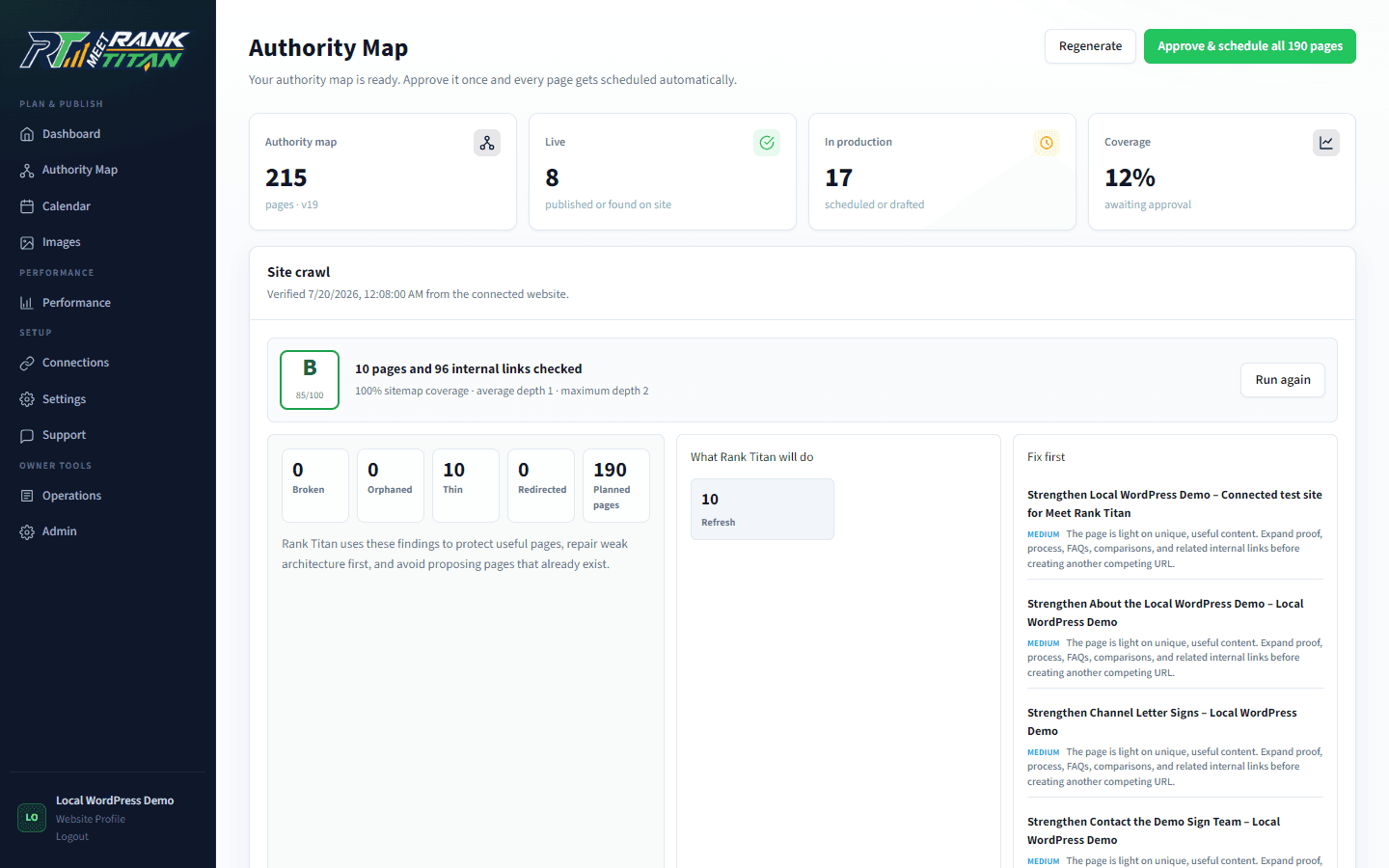
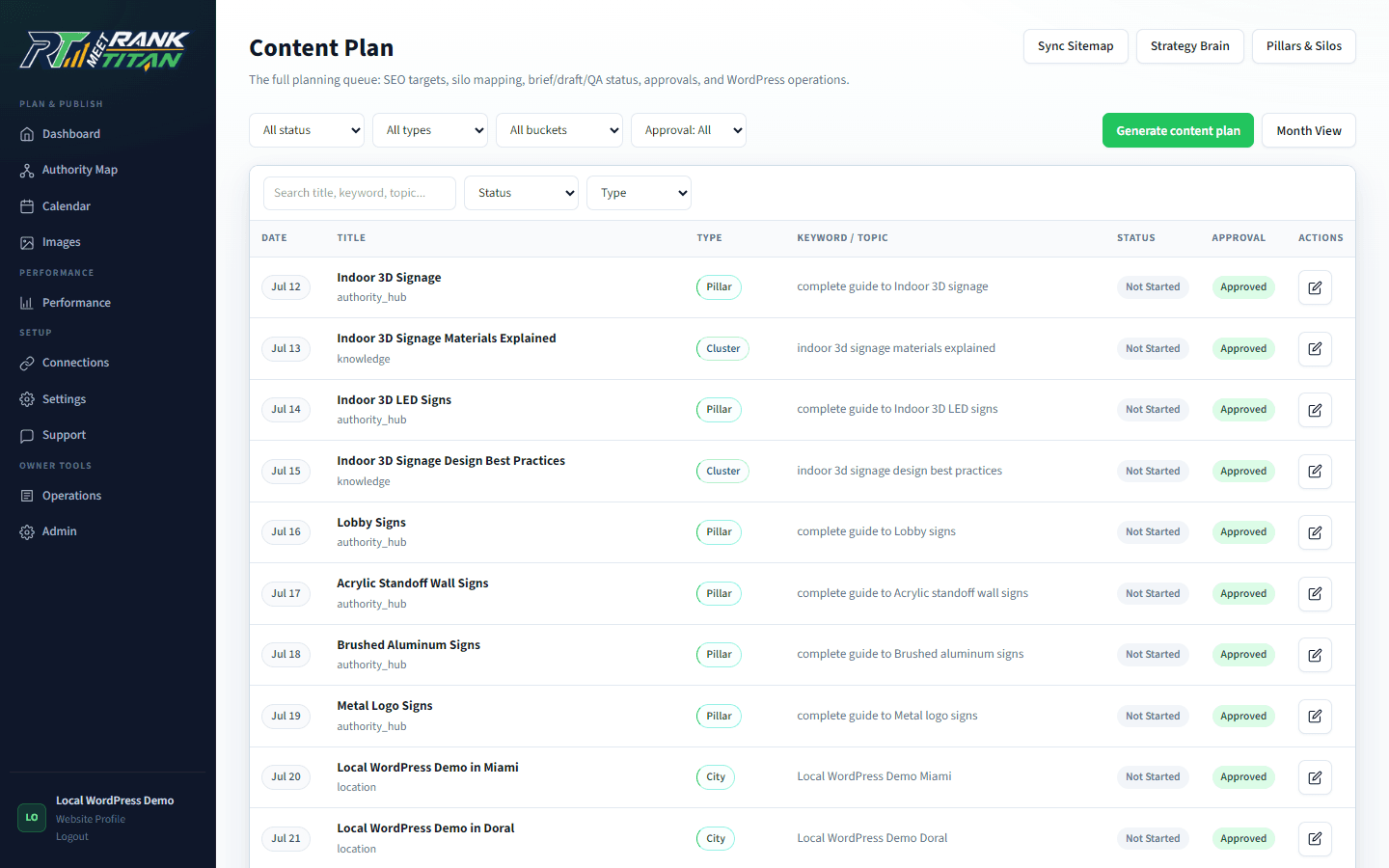
Map the site before generating the next page.
Rank Titan connects crawl evidence, topical architecture, briefs, QA, internal links, and draft-safe publishing in one reviewable workflow.