
What is AI SEO automation, and what should it actually automate?
AI SEO automation is more than asking a language model for articles. A dependable system connects repeatable research, architecture, briefing, production, quality checks, publishing controls, and measurement while preserving accountable human decisions.
What is AI SEO automation?
AI SEO automation is the controlled use of software and AI models to accelerate repeatable search-optimization work. It can collect and classify evidence, assemble briefs and draft packages, run defined quality checks, and prepare CMS actions, while people remain responsible for strategy, truth, approval, and performance decisions.
The definition matters because an AI writer and an SEO operating system solve different problems. A writer produces text from a prompt. An operating system starts with the website, assigns each search need to a page, preserves the research behind a draft, connects that page to the rest of the site, and records whether the work is proposed, approved, published, indexed, or performing.
Google's guidance does not make automation itself the deciding issue. Its public documentation emphasizes accuracy, quality, relevance, and usefulness, while its spam policy warns about scaled production that exists primarily to manipulate rankings. The safe dividing line is therefore not human versus machine; it is accountable value versus unreviewed output.
What information does an AI SEO system need before it writes?
A reliable system needs business source truth, a current site inventory, search evidence, page ownership, approved claims, and conversion goals. Without those inputs, even fluent content can target the wrong intent, repeat an existing page, or make a claim the business cannot support.
- Business facts: products, services, audiences, locations, differentiators, proof, and prohibited claims.
- Site evidence: crawlable URLs, canonical status, page type, content depth, metadata, schema, internal links, and known technical problems.
- Demand evidence: Search Console queries, sales and support questions, current SERP formats, related entities, and credible keyword data where available.
- Page ownership: one primary query family, one user task, one intended URL, and a list of nearby topics that belong on other pages.
- Release rules: required reviewers, destination CMS, allowed content types, publishing status, rollback method, and post-release checks.
Which SEO tasks are good automation candidates?
The best candidates are frequent tasks with explicit inputs, inspectable outputs, and clear failure rules. Automation is especially useful for inventories, classification, normalization, gap detection, draft assembly, and repeatable QA because each result can be checked against stored evidence.
A crawler can normalize sitemap URLs, identify redirects, find missing titles, count internal links, and expose orphan candidates faster than a manual spreadsheet. A planning system can then group related demand, compare it with existing pages, and produce a review queue. Models can summarize sources, propose outlines, draft metadata, and format structured data when the source ledger stays attached.
Automation is also valuable after writing. It can verify headings, link destinations, schema syntax, image alt text, required disclosures, prohibited phrases, and destination settings. These checks do not prove that a page deserves to rank, but they reduce avoidable release errors and give the reviewer a smaller, clearer decision.
Which SEO decisions should not be delegated to AI?
Do not delegate decisions whose failure could misrepresent the business, damage an established URL, publish unsupported claims, or change a live site irreversibly. AI can prepare evidence and recommendations, but an accountable person should own the final decision.
- Whether a proposed topic belongs in the business strategy or merely has search volume.
- Whether two existing pages should be merged, redirected, canonicalized, or retired.
- Whether first-hand experience, customer evidence, legal claims, prices, or competitor statements are accurate and publishable.
- Whether generated content adds information or utility beyond the pages already available to searchers.
- Whether a final page, schema change, internal-link rewrite, or CMS action should reach production.
How does AI SEO automation work from crawl to publication?
A complete workflow uses gates rather than one long prompt: establish source truth, crawl the canonical site, map opportunities, approve page ownership, prepare the page package, review the output, publish safely, and measure the result. Each gate should preserve the evidence and status needed by the next one.
The crawl prevents the system from treating every keyword as a new URL. The authority map identifies gaps, refreshes, and conflicts. The brief defines intent, entities, sources, links, images, metadata, schema, CTA, and acceptance criteria. Drafting then fills an approved structure rather than inventing the structure while writing.
Before publication, a reviewer checks facts, usefulness, voice, links, metadata, accessibility, and destination behavior. After publication, deployment, indexing, ranking, conversions, and AI citations remain separate states. A successful API response is evidence of delivery, not evidence that Google indexed the page or that the page achieved its goal.
What quality controls prevent scaled AI content problems?
Use a value gate before production, an evidence gate during drafting, and a release gate before publication. Reject pages that duplicate an existing intent, lack credible proof, offer no distinct utility, or exist only because a keyword variant appeared in a tool.
- Require a distinct user task and canonical page owner before a draft can start.
- Preserve primary sources and mark uncertain statements instead of silently filling gaps.
- Check claims, examples, dates, author context, and business-specific facts with a responsible reviewer.
- Detect templated repetition, location-name swaps, empty comparison language, and unsupported superlatives.
- Verify the rendered route, links, images, metadata, schema, robots directives, and CMS status before release.
How do you know whether AI SEO automation is working?
Measure operational reliability and search outcomes separately. Faster production with fewer preventable errors can prove the workflow improved; discovery, indexing, qualified impressions, conversions, and citations show whether the published pages earned useful visibility.
Operational measures include review time, QA failures, revision count, publish failures, rollback count, and the percentage of pages with complete evidence and internal links. Architecture measures include orphan pages, crawl depth, duplicate intent, cluster coverage, and the balance between new pages and useful refreshes.
Search measures should come from the canonical Search Console property and analytics stream: impressions, clicks, landing-page engagement, assisted conversions, and query coverage. AI visibility requires a stable question set, named platforms, dates, cited URLs, competitor mentions, and description accuracy. Do not convert any of these into a made-up authority score.
Task automation versus decision automation
| Area | Safe to automate | Keep accountable to people |
|---|---|---|
| Site audit | Crawl, normalize, classify, and flag | Decide what is genuinely harmful or worth changing |
| Research | Collect, group, summarize, and retain sources | Choose strategy and judge evidence quality |
| Content | Assemble briefs, drafts, metadata, and QA reports | Add experience, approve claims, and accept the final page |
| Links | Find gaps, suggest anchors, and validate destinations | Approve large rewrites and consolidation decisions |
| Publishing | Prepare signed, destination-aware draft actions | Authorize live publication and irreversible changes |
| Measurement | Collect stable metrics and compare periods | Explain causality and decide the next investment |
Implementation checklist
- Define the business facts, proof, prohibited claims, and conversion actions.
- Crawl the canonical site before proposing net-new pages.
- Assign each primary intent to one existing or proposed URL.
- Attach sources, entities, links, images, schema, and QA rules to every brief.
- Use explicit approval states before drafting and before publishing.
- Verify the rendered output and destination status, not only the API response.
- Track operations, indexing, search performance, conversions, and citations separately.
Frequently asked questions
Is AI SEO automation the same as AI content generation?
No. Content generation is one possible task. SEO automation can also cover crawling, opportunity classification, page ownership, briefs, metadata, schema, internal links, QA, CMS delivery, and measurement.
Does AI SEO automation guarantee rankings?
No. It can improve consistency, coverage, and release quality, but rankings depend on usefulness, competition, authority, technical accessibility, search demand, and many other factors outside an automation workflow.
Can a small team use AI SEO automation safely?
Yes, if it starts with read-only evidence, limits page production to approved intents, preserves sources, and keeps publication and consequential site changes behind review.
Where should a team start?
Start with a canonical-domain check, sitemap and crawl inventory, page classification, missing metadata, internal-link gaps, and a small approved cluster. These tasks create evidence without requiring bulk publication.
Primary sources and further reading
See the Rank Titan tools used in this workflow
These are current captures from the working Rank Titan application—not conceptual dashboard mockups.
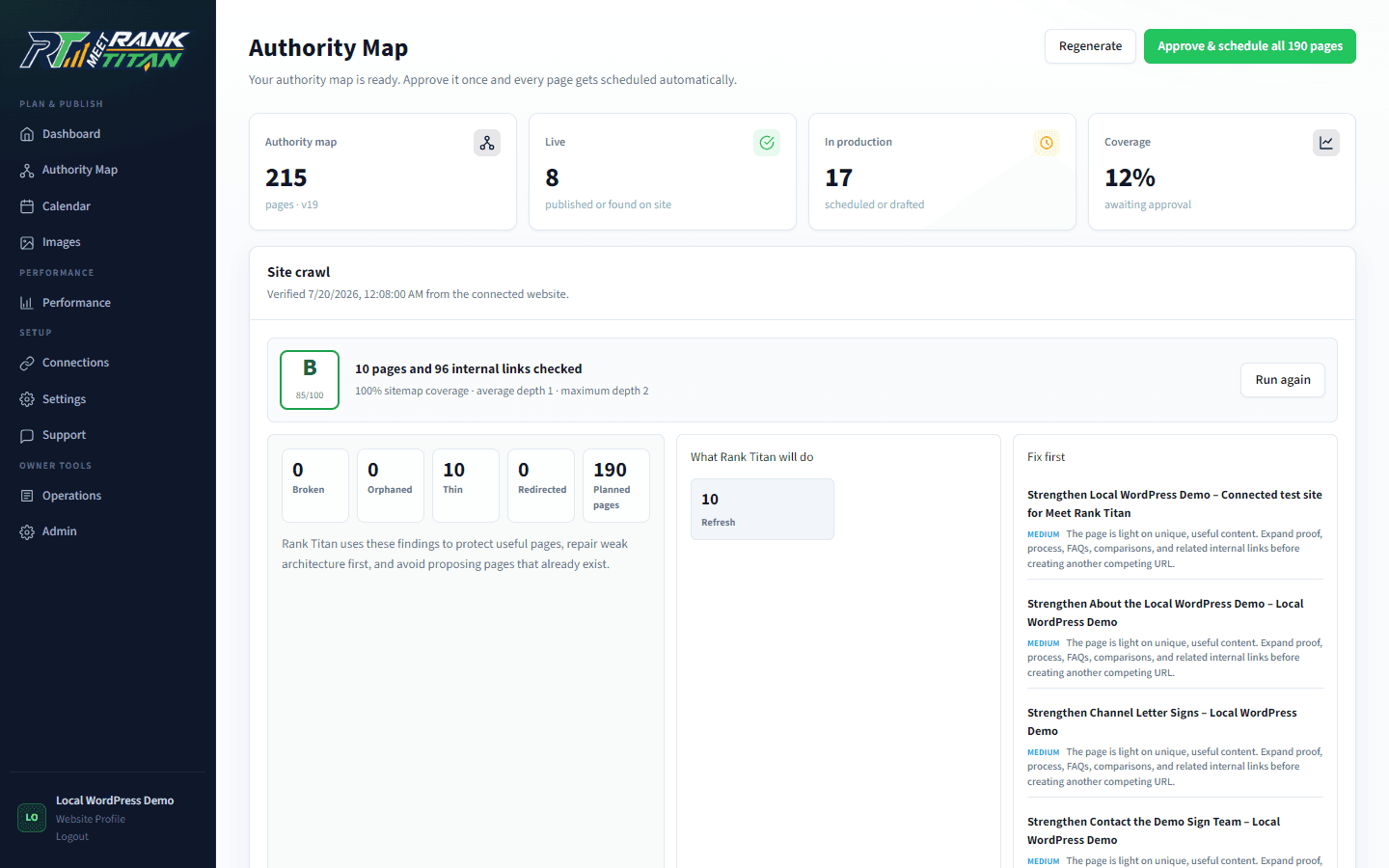
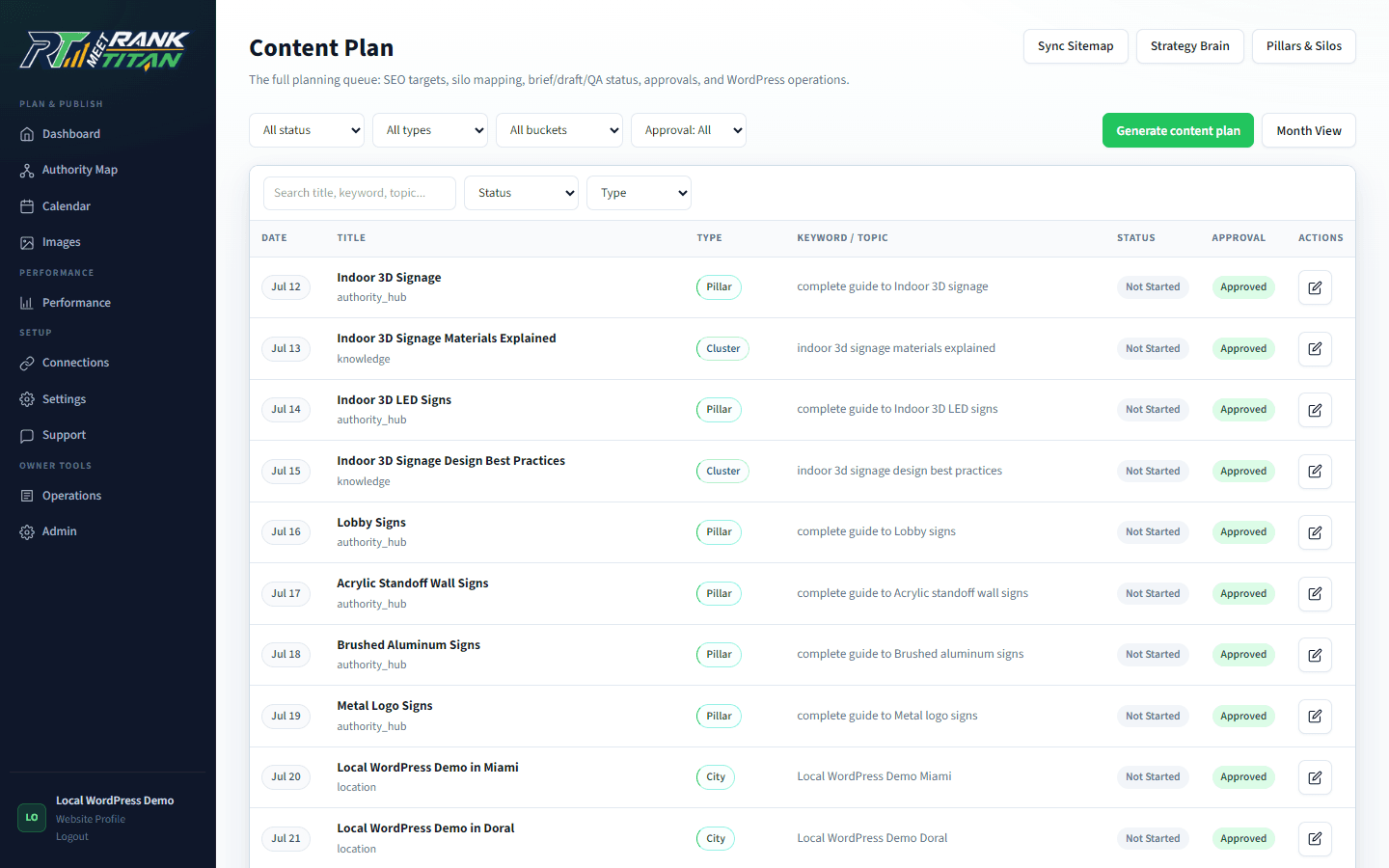
Map the site before generating the next page.
Rank Titan connects crawl evidence, topical architecture, briefs, QA, internal links, and draft-safe publishing in one reviewable workflow.