
AI SEO automation: the strategy-first guide
AI SEO automation works when it connects research, site architecture, briefs, production, quality control, publishing, and measurement. It fails when automation is treated as a shortcut for producing pages without evidence or editorial judgment.
What is AI SEO automation?
AI SEO automation is a controlled workflow that uses software and language models to accelerate repeatable SEO tasks—from crawling and opportunity classification through briefs, drafts, metadata, internal links, QA, and publishing—while people retain responsibility for strategy, proof, approval, and results.
The useful unit is not a generated article. It is a verified page package with a clear role in the site: one intent, one URL owner, the entities a reader expects, real sources, a link path, accurate metadata, appropriate structured data, and an approval state.
That distinction matters because search engines do not reward automation by itself. Google says generative AI can help with research and structure, but generating many pages without adding value can violate its scaled content abuse policy. The workflow must be designed to improve usefulness, accuracy, and editorial consistency—not merely output volume.
What does an end-to-end AI SEO workflow include?
A complete workflow moves through seven gates: source truth, crawl and inventory, opportunity mapping, page briefing, controlled drafting, quality review, and measured publishing. Skipping the early gates usually creates duplicate topics, weak claims, and orphan pages later.
- Source truth: approved offers, audiences, locations, proof, prohibited claims, tone, and conversion goals.
- Crawl and inventory: indexable URLs, status, page type, topic, depth, links, metadata, schema, and content condition.
- Opportunity mapping: missing commercial pages, informational clusters, comparison intent, refreshes, consolidation candidates, and internal-link gaps.
- Page brief: search intent, unique URL ownership, required entities, outline, sources, proof, schema, image direction, internal links, and CTA.
- Controlled drafting: the model receives the approved brief and site context instead of an isolated keyword prompt.
- Quality review: factual support, intent fit, originality, readability, claim risk, metadata, schema, accessibility, links, and conversion path.
- Publishing and measurement: draft-safe release, exact-route verification, index monitoring, query performance, conversions, and refresh decisions.
Which SEO tasks should be automated?
Automate high-volume tasks whose inputs, outputs, and failure rules can be made explicit. Keep consequential judgment with a person, especially decisions about positioning, factual claims, publication, consolidation, and whether a page deserves to exist.
Good automation candidates include sitemap collection, URL normalization, page classification, metadata checks, link-graph analysis, duplicate detection, outline assembly, formatting, schema preparation, QA checklists, and scheduling. These tasks become more reliable when the system stores evidence and reports uncertainty instead of hiding it.
Research summarization and first drafts can also be automated, but only when the sources are preserved and the final output is reviewed. Automation should make the editor's decision easier to audit, not make the editor invisible.
Where are human approval gates essential?
Human approval is essential before the topical map becomes a production backlog, before unsupported business claims enter a draft, before existing URLs are redirected or consolidated, and before any page is published to a live site.
- Strategy approval: confirm that the proposed cluster supports the business and does not cannibalize an existing page.
- Evidence approval: distinguish verified product facts, primary sources, customer proof, and unverified assumptions.
- Editorial approval: add experience, examples, nuance, and a useful point of view that a generic model cannot infer.
- Release approval: review final HTML, metadata, schema, images, links, and destination status before publishing.
- Performance approval: use Search Console and conversion evidence to decide whether to refresh, merge, expand, or retire content.
How do you prevent AI SEO automation from becoming scaled content abuse?
Put a value gate before generation and a proof gate before publication. A page should not be produced just because a keyword exists; it should answer a distinct user need better than the current site and contain information, structure, evidence, or utility worth indexing.
Google's current guidance focuses on accuracy, quality, relevance, originality, and people-first purpose regardless of whether content was made by a person or with AI. Its spam policy defines scaled content abuse by the lack of user value, not by a particular writing tool.
In practice, prevent abuse by limiting one URL to one query family, checking existing content before generation, requiring approved sources, rejecting thin location swaps, exposing authorship and update context where readers expect it, and refusing to publish drafts that only rephrase what already ranks.
Why must internal linking be part of the automation design?
Internal links turn isolated drafts into a crawlable authority system. Every important page should be discoverable from another page, and descriptive anchor text should help readers and search engines understand the destination before they follow it.
Google's link guidance says links help it discover pages and understand relevance. That means link planning belongs in the brief, not as a bulk plugin task after publication. Each support page should link to its parent pillar, a relevant next answer, and a conversion page when that next step is genuinely useful.
The automation should also detect orphan pages, broken destinations, excessive depth, redirect chains, and anchors that are empty or generic. Link counts alone are not the goal; contextual paths are.
How should AI SEO automation be measured?
Measure the workflow and the search outcome separately. Production speed and QA completion show whether operations improved; crawl discovery, indexing, impressions, qualified clicks, conversions, and citations show whether the published work earned visibility.
- Operational: time from approved opportunity to reviewed draft, QA failure rate, revision count, and publication accuracy.
- Architecture: orphan count, crawl depth, internal-link coverage, duplicate intent, and cluster completion.
- Search: indexed URLs, impressions, click-through rate, average position, non-brand query coverage, and assisted conversions.
- AI visibility: tested question set, brand mention rate, cited URLs, competitor citation share, and description accuracy.
- Governance: unsupported claims caught, failed publishes prevented, rollbacks required, and pages retired for low value.
AI SEO automation versus an AI writer
| Decision | AI writer | SEO automation system |
|---|---|---|
| Site context | Usually limited to the prompt | Stores crawl, content, brand, and link context |
| Strategy | Generates ideas on request | Maps gaps, ownership, priority, and dependencies |
| Output | Usually prose | Brief, draft, metadata, schema, links, images, and QA |
| Approval | Managed outside the chat | Explicit states before generation and publication |
| Publishing | Copy, paste, or a generic integration | Destination-aware, draft-safe release path |
| Measurement | Separate tools and spreadsheets | Connects pages and query sets back to the plan |
Implementation checklist
- Choose one canonical domain and verify Search Console and analytics for it.
- Create a source-of-truth profile for offers, audiences, proof, claims, tone, and conversions.
- Crawl the real site and classify every indexable URL before proposing new pages.
- Assign one owner URL to every primary query family and check cannibalization.
- Require briefs with entities, sources, internal links, schema, CTA, and acceptance criteria.
- Keep destructive, publication, and high-risk claim decisions behind human approval.
- Validate rendered HTML, metadata, schema, links, and exact routes before release.
- Track deployed, indexed, ranking, converting, and cited as separate states.
Frequently asked questions
Is AI-generated SEO content against Google guidelines?
No, not simply because AI was used. Google's guidance focuses on whether content is accurate, useful, original, and created for people. Using automation to produce many low-value pages primarily to manipulate rankings can violate its scaled content abuse policy.
Can AI automate SEO completely?
It can automate much of the repeatable workflow, but strategy, proprietary facts, expert experience, consequential edits, publication approval, and performance decisions still require accountable human judgment.
What is the safest first SEO task to automate?
Start with a read-only site inventory and QA checks. Crawling URLs, classifying page types, finding missing metadata, and mapping internal links create useful evidence without changing the live site.
What makes Rank Titan different from a general AI writer?
Rank Titan connects generation to a real site's crawl, authority map, content plan, page brief, internal links, QA state, and publishing workflow. The system is designed around reviewable SEO operations rather than isolated prompts.
Primary sources and further reading
See the Rank Titan tools used in this workflow
These are current captures from the working Rank Titan application—not conceptual dashboard mockups.
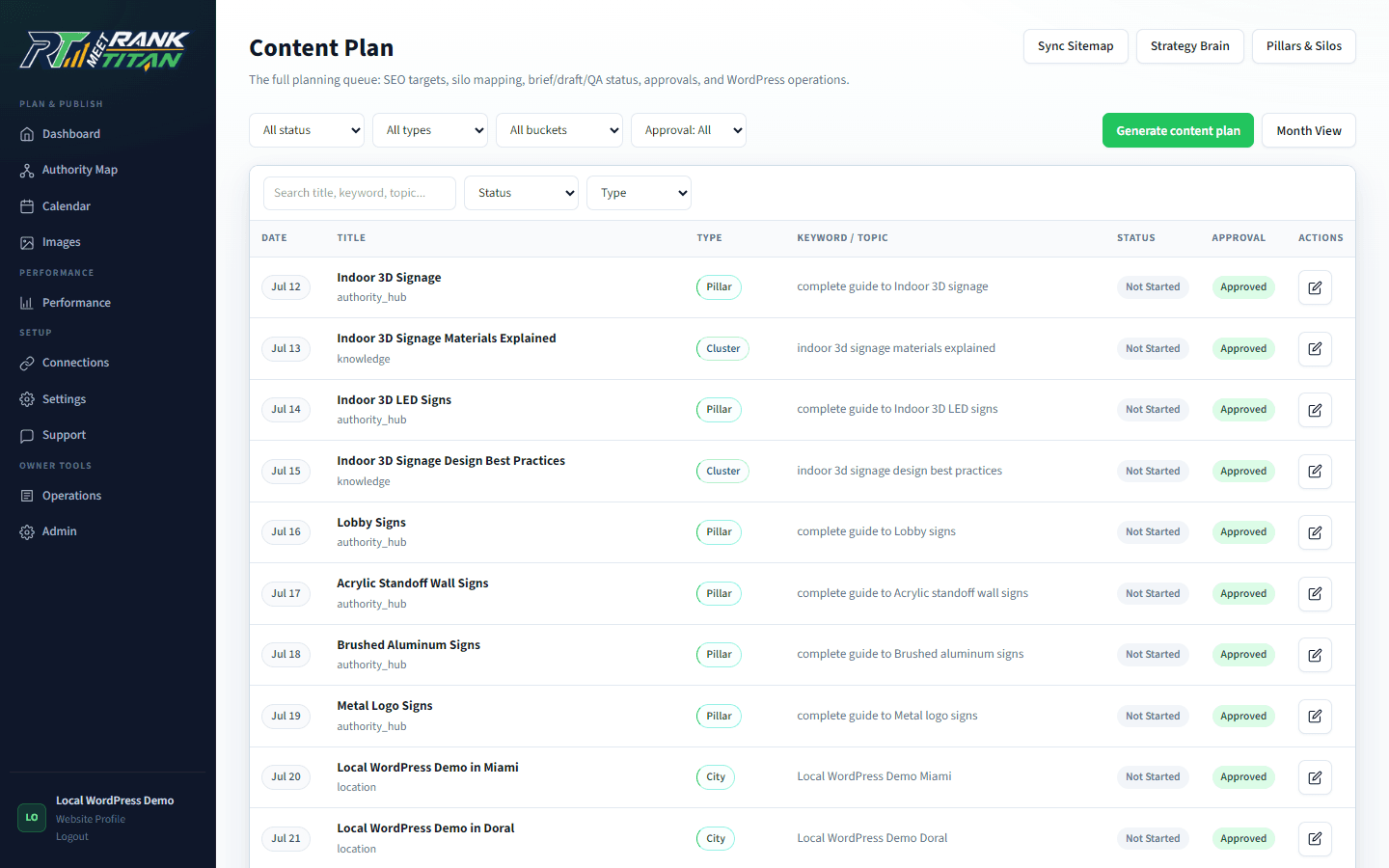
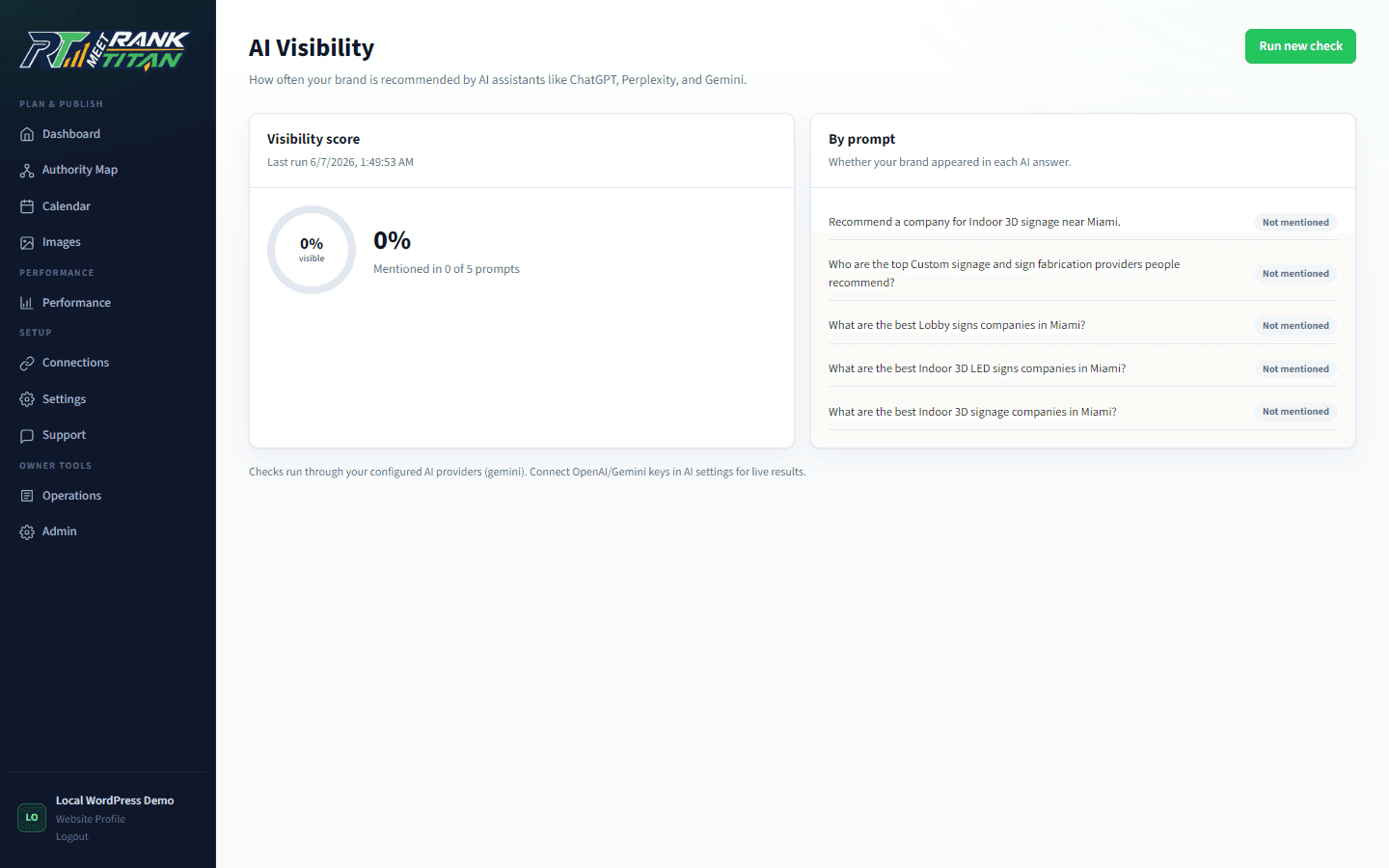
Map the site before generating the next page.
Rank Titan connects crawl evidence, topical architecture, briefs, QA, internal links, and draft-safe publishing in one reviewable workflow.