
Pillar page and topic cluster examples you can actually adapt
A useful cluster example shows more than a hub with many links. It explains the audience task owned by each URL, why the pages deserve to remain separate, how readers move between them, where commercial intent belongs, and which tempting variants were deliberately not published.
What makes a pillar page and topic cluster example valid?
A valid example has one broad but bounded pillar, several support pages with distinct audience tasks, contextual two-way links, and a useful next action. It should show page ownership and exclusions, not merely label the longest article as a pillar.
Topic clusters are an industry planning framework, not a named Google ranking feature. Google's public guidance is more direct: organize a site logically, publish unique and useful content, and make important pages discoverable through crawlable contextual links.
That is why an example should be judged by its decisions. Can a reader predict what each page answers? Does every support URL add a different format, decision, risk, or implementation task? Can the pillar route people to depth without trying to absorb every subtopic?
What does Rank Titan's topical-map cluster look like?
Rank Titan uses `/guides/topical-authority-map` as the broad planning owner. Separate guides own the build procedure, cannibalization remediation, field-level template, and worked examples, while `/features` owns product evaluation and conversion intent.
- Pillar: defines the map, inputs, page ownership, link model, prioritization, and measurement.
- Procedure: `/guides/how-to-build-topic-clusters` moves from inventory through release proof.
- Risk owner: `/guides/content-cannibalization-prevention` diagnoses and repairs confirmed conflicts.
- Template: `/guides/topical-map-template` specifies the fields and lifecycle states.
- Examples: this page demonstrates patterns and anti-patterns without repeating the full method.
- Commercial owner: `/features` explains how the working Authority Map and Content Plan support the task.
Example 1: a B2B SaaS problem cluster
Use a problem or operating-category pillar, then give definition, workflow, comparison, integration, risk, and measurement questions their own owners only when the expected answer differs. Product and pricing pages remain commercial destinations rather than support articles in disguise.
A pillar for SEO content operations can link to an automated-brief specification, a calendar-control guide, a release QA checklist, and a WordPress delivery workflow. The agency use-case page explains who the product fits. Each support page links back to the pillar and laterally only when the next task is natural.
Reject a second 'SEO content workflow' URL if it would repeat the operating-system stages. A wording variant is not a new page role.
Example 2: a local service cluster
A local cluster can be service-led, location-led, or question-led. Start with a core service owner, add legitimate location owners where coverage and proof support them, and use narrower guides to answer process, cost, material, maintenance, or permitting questions.
A sign company might have one core indoor-signage service page, a real Miami location or service-area page, a qualified service-in-location page, and support pages for materials, installation, maintenance, and buying decisions. It should not generate every service-city permutation automatically.
The conversion path usually returns from informational support to the appropriate service owner. Location pages should represent real coverage and never imply an office that does not exist.
Example 3: an ecommerce education cluster
Use a category or buying-guide owner for the broad decision, then give material guides, size or compatibility help, care instructions, comparisons, and original test evidence separate roles. Product detail pages keep transactional intent.
The cluster should reduce uncertainty that blocks a purchase. A comparison page can own the choice between two product types, while a care guide supports customers after purchase. Repeating category copy across dozens of product pages does not create a useful cluster.
Inventory availability, specifications, original photography, test methods, and support policies are stronger evidence than generic category prose.
Which cluster patterns should be rejected?
Reject architectures that use labels or link volume in place of distinct user value. The most common failures are duplicate owners, thin keyword variants, mechanical all-to-all links, and pillars with no useful depth or next action.
- Calling the longest article a pillar without defining its scope or support relationships.
- Creating one URL for every singular, plural, modifier, or city variation.
- Adding every cluster URL to every paragraph or footer regardless of context.
- Publishing support pages that all answer the same definition with different headings.
- Building informational volume without a relevant product, service, or conversion path.
- Copying another site's cluster without the business evidence needed to support it.
How should a worked cluster be measured?
Measure architecture, discovery, query ownership, engagement, and business outcomes separately. A visually complete cluster can still contain orphans, unstable owners, unindexed pages, irrelevant visits, or no useful conversion path.
- Architecture: inbound links, crawl depth, broken destinations, redirects, and orphan count.
- Ownership: whether one query family consistently resolves to its intended owner rather than rotating among pages.
- Discovery: sitemap presence, crawl activity, index state, impressions, and query breadth.
- Usefulness: support-page engagement, next-step clicks, assisted conversions, and sales or support reuse.
- Maintenance: stale claims, pages needing consolidation, and clusters that cannot sustain evidence quality.
Useful topic cluster versus loose article collection
| Signal | Loose collection | Useful cluster |
|---|---|---|
| Page ownership | Topics overlap without exclusions | Each URL owns one audience task |
| Pillar | Longest article or link dump | Bounded orientation and routing page |
| Support | Wording variants | Distinct procedures, risks, examples, or evidence |
| Links | Mechanical all-to-all grid | Contextual upward, lateral, and conversion paths |
| Proof | Generic summaries | Business facts, original examples, and current sources |
| Measurement | Article count | Crawl, ownership, discovery, outcomes, and maintenance |
Implementation checklist
- Name the pillar's broad but bounded audience task.
- List every support URL with its unique role and explicit exclusions.
- Map a relevant upward, lateral, and conversion link for each support page.
- Confirm that the example uses evidence the business can actually support.
- Reject wording variants that one owner can answer naturally.
- Use descriptive alt text and explanatory captions for every visual.
- Re-crawl the implemented graph and verify zero orphan owners.
- Measure query-to-page stability and business use after release.
Frequently asked questions
How many cluster pages should a pillar have?
There is no required number. Create only the support pages needed for distinct, relevant tasks that the site can answer with useful depth and evidence.
Is every long guide a pillar page?
No. A pillar has a defined broad role and routes readers to distinct deeper owners. Length alone does not create that architecture.
Should cluster pages all link to each other?
No. Every support page should have a clear relationship to its pillar, while lateral links should appear only where they advance the reader's next task.
Can I copy a competitor's topic cluster?
Use external examples to learn patterns, but build from your own audience, offers, current URLs, evidence, and conversion paths. Copying the URLs can import someone else's assumptions and overlap.
Primary sources and further reading
See the Rank Titan tools used in this workflow
These are current captures from the working Rank Titan application—not conceptual dashboard mockups.
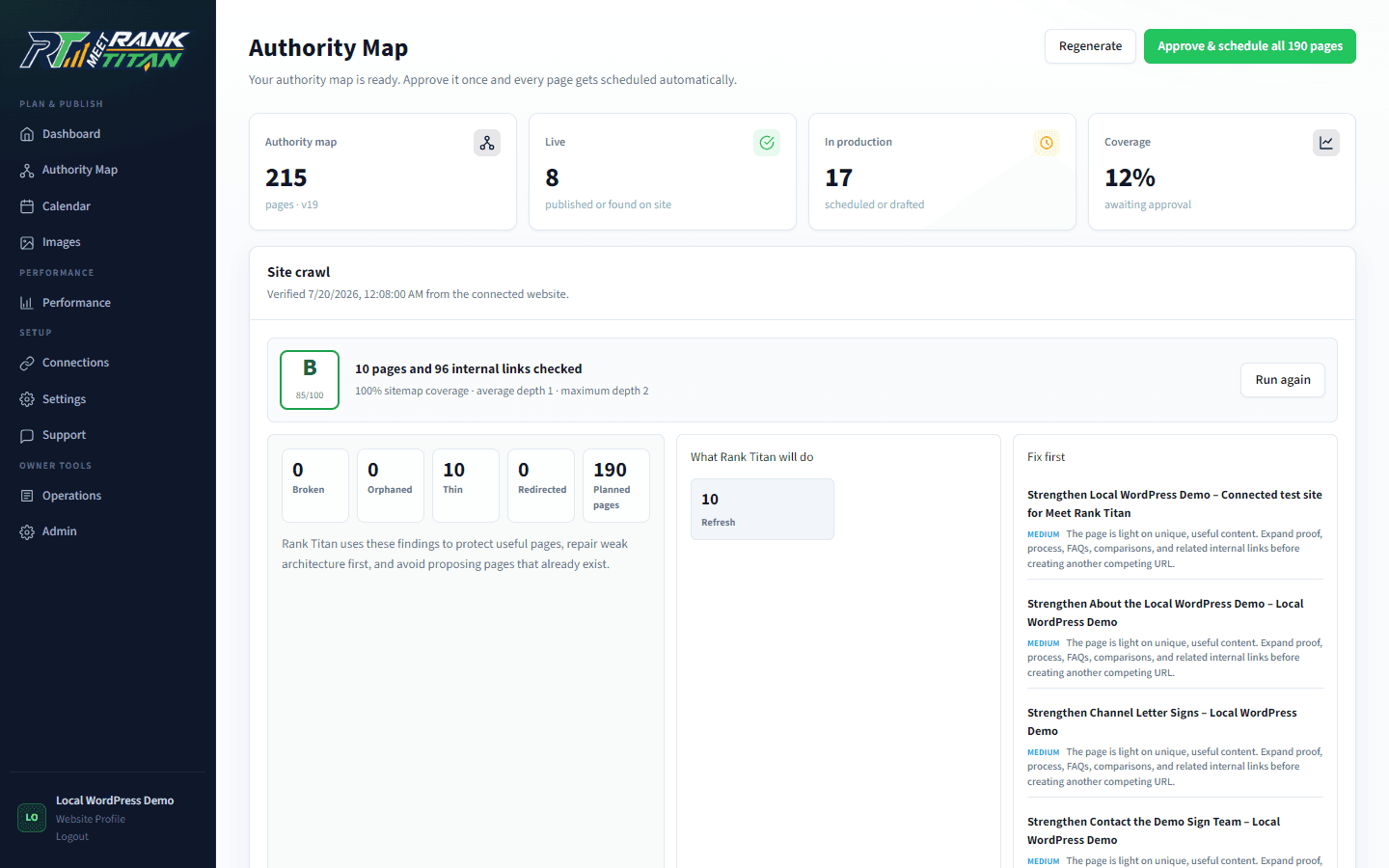
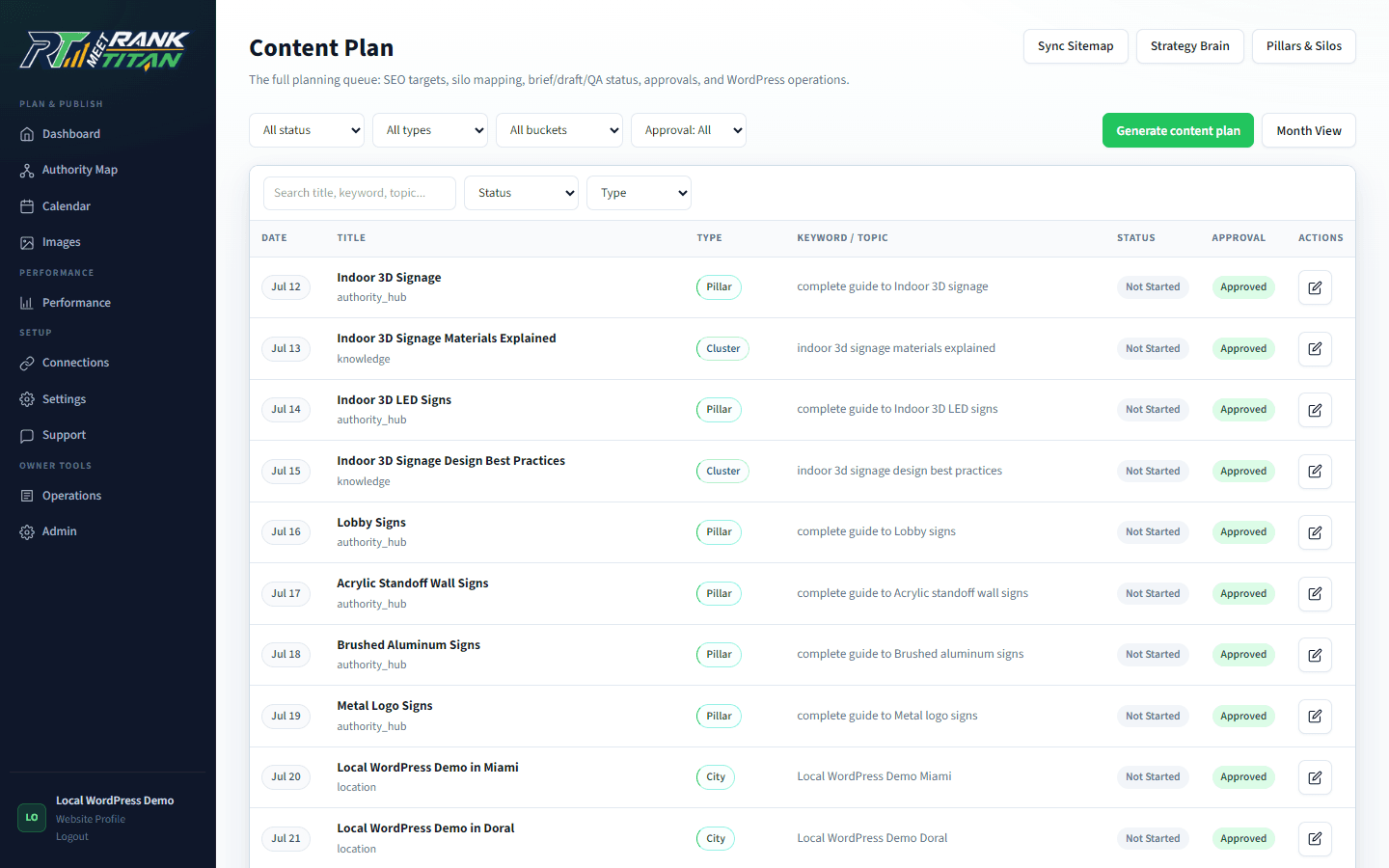
Map the site before generating the next page.
Rank Titan connects crawl evidence, topical architecture, briefs, QA, internal links, and draft-safe publishing in one reviewable workflow.