
Content cannibalization prevention with intent and URL ownership
Content overlap is normal; harmful cannibalization is a performance and ownership problem. The practical goal is not to force one page per repeated word. It is to give each important audience task a deliberate owner, identify cases where similar pages damage clarity or results, and choose a fix without discarding useful long-tail coverage.
What is content cannibalization?
Content cannibalization is a harmful ownership conflict in which multiple pages serve the same or very similar search intent and reduce the site's ability to present, strengthen, measure, or maintain the best owner. Keyword overlap alone is not enough; pages can share vocabulary while serving different decisions and query sets.
A pillar and a focused support page both mention the parent topic by design. A product page and an educational guide may target related language while satisfying evaluation and learning intent separately. The problem appears when pages are interchangeable, search visibility repeatedly switches between unintended URLs, links and updates are split, or consolidation would improve the total result.
Ahrefs' current guidance similarly cautions that multiple pages ranking for related keywords is not automatically a defect. Review intent and whole-page performance before merging or deleting anything.
How do you find real cannibalization instead of keyword overlap?
Combine a full URL inventory with page purpose, target intent, search-query and landing-page data, ranking history, internal links, canonicals, backlinks, conversions, and a side-by-side content review. Flag candidates first; make a decision only after confirming that the pages compete for the same task or impair the preferred owner.
- Two or more URLs receive impressions for the same high-value query family and alternate without a clear intent distinction.
- The page that ranks or converts is not the documented owner, and the preferred page receives weak or inconsistent internal support.
- Titles, H1s, introductions, sections, examples, CTAs, and link targets are substantially interchangeable.
- New pages repeat an existing answer because research started from keywords rather than the current sitemap.
- A legacy, tag, parameter, print, regional, or staging URL competes with the primary version because canonical signals are inconsistent.
- Teams cannot explain which URL should be updated when a fact, product, or search intent changes.
What belongs in a URL ownership matrix?
Record one canonical owner for each primary intent family with the URL, audience task, page type, parent topic, commercial role, supporting queries, competing URLs, exclusions, evidence, internal links, CTA, status, and measurement. The exclusions protect the owner as much as the outline does.
For example, a broad topical-authority guide can own the planning framework while a topic-cluster page owns the implementation procedure and a product page owns software evaluation. Their vocabulary overlaps, but their expected answer, page format, proof, and conversion role differ.
The matrix should include proposed pages before writing. If a new brief cannot state how its audience task differs from an existing owner, the default decision should be refresh, expand, consolidate, or do nothing—not create another URL.
How should a confirmed cannibalization issue be fixed?
Choose the smallest change that gives the audience and search systems a clearer owner: differentiate truly distinct pages, strengthen the intended owner, consolidate overlapping value, redirect an obsolete URL to an equivalent successor, repair canonical and internal-link signals, or remove a page with no durable role.
- Differentiate: rewrite purpose, sections, title, links, CTA, and supporting evidence when distinct intent genuinely exists.
- Strengthen: improve the preferred owner and route relevant internal links to it when another page ranks only because the intended page is weak.
- Consolidate: merge unique useful material into the strongest owner, update its structure, then redirect retired equivalents.
- Redirect: use a permanent server-side redirect only when the destination is genuinely equivalent; update all internal links and sitemap entries.
- Canonicalize: use canonical annotations for duplicate or very similar variants that must remain accessible, not as a substitute for resolving different indexable pages with the same intent.
- Remove or noindex: reserve for pages without a search role after reviewing links, navigation, conversions, and other audience needs.
How do canonical tags, redirects, sitemaps, and internal links work together?
Google treats redirects and canonical annotations as strong canonicalization signals and sitemap inclusion as a weaker signal. Internal links should consistently point to the chosen canonical URL. These technical signals help consolidate duplicate variants, but they do not repair two materially different pages that compete for the same intent.
Use self-referencing canonicals on intended owners, remove retired URLs from the sitemap, avoid redirect chains, and update navigation, breadcrumbs, contextual links, hreflang, structured data, and social URLs where applicable. Do not canonicalize every weak page to a broad hub while leaving misleading navigation and content in place.
After a live change, verify the status and canonical from rendered HTML, crawl the graph, and inspect the destination. Search engines may select a different canonical than the preferred hint, so Search Console evidence remains valuable after deployment.
How do you prevent cannibalization in an AI content workflow?
Make the current URL inventory and ownership matrix required inputs to opportunity selection and briefing. Block generation when the proposed intent matches an existing owner, require explicit exclusions and link targets, review new pages beside siblings, and re-crawl after every release batch.
Rank Titan's strategy-first workflow keeps the crawl, Authority Map, page roles, plan approval, brief, and internal links ahead of draft generation. This catches collisions while they are still cheap decisions. The same rules apply to service, city, comparison, glossary, and trend content—not only blog posts.
Track implementation and outcome separately. Record the chosen owner, change date, redirects, links updated, index state, query distribution, qualified traffic, conversions, and any long-tail losses. A consolidation is not successful merely because the old URL disappeared.
Normal topical overlap versus harmful cannibalization
| Test | Normal overlap | Harmful cannibalization |
|---|---|---|
| Audience task | Related but distinct | Same or interchangeable |
| Page role | Pillar, support, commercial, local, or comparison roles are explicit | Teams cannot name the intended owner |
| Content | Different decisions, evidence, structure, and depth | Repeated titles, sections, answers, and CTAs |
| Search data | Each URL earns useful query coverage | URLs switch, split signals, or suppress the preferred owner |
| Links | Contextual links reinforce distinct relationships | Internal support is divided or points to the wrong URL |
| Action | Maintain and monitor | Differentiate, strengthen, consolidate, redirect, or retire |
Implementation checklist
- Inventory every indexable URL, page type, canonical, title, H1, topic, and internal-link relationship.
- Map query and landing-page evidence to primary intent families and intended owners.
- Compare suspected pages by purpose, expected answer, structure, proof, CTA, links, and whole-page performance.
- Record owner, supporting queries, competing URLs, exclusions, parent, commercial role, and next action.
- Choose differentiate, strengthen, consolidate, redirect, canonicalize, noindex, remove, or no action with evidence.
- Update content, redirects, canonicals, sitemap, navigation, breadcrumbs, and contextual links together.
- Verify the exact live routes and retain the prior URL map for rollback and monitoring.
- Block future briefs that cannot prove a distinct task from an existing owner.
Frequently asked questions
Is ranking two pages for one keyword always cannibalization?
No. The pages may serve different intents or each earn valuable long-tail coverage. Investigate whether their coexistence harms the preferred owner or total performance before changing them.
Can a canonical tag fix keyword cannibalization?
Canonical tags are for duplicate or very similar URL variants. If two distinct pages target the same intent, resolve ownership through differentiation, consolidation, links, or another content decision.
Should overlapping pages always be merged?
No. Merge when one owner can serve the shared task without losing useful distinct coverage. Otherwise clarify the roles and strengthen each page's unique value.
How does Rank Titan help prevent cannibalization?
It uses the current site inventory, Authority Map, page roles, plan approval, brief exclusions, and internal-link planning before generation, so proposed pages can be checked against existing owners.
Primary sources and further reading
See the Rank Titan tools used in this workflow
These are current captures from the working Rank Titan application—not conceptual dashboard mockups.
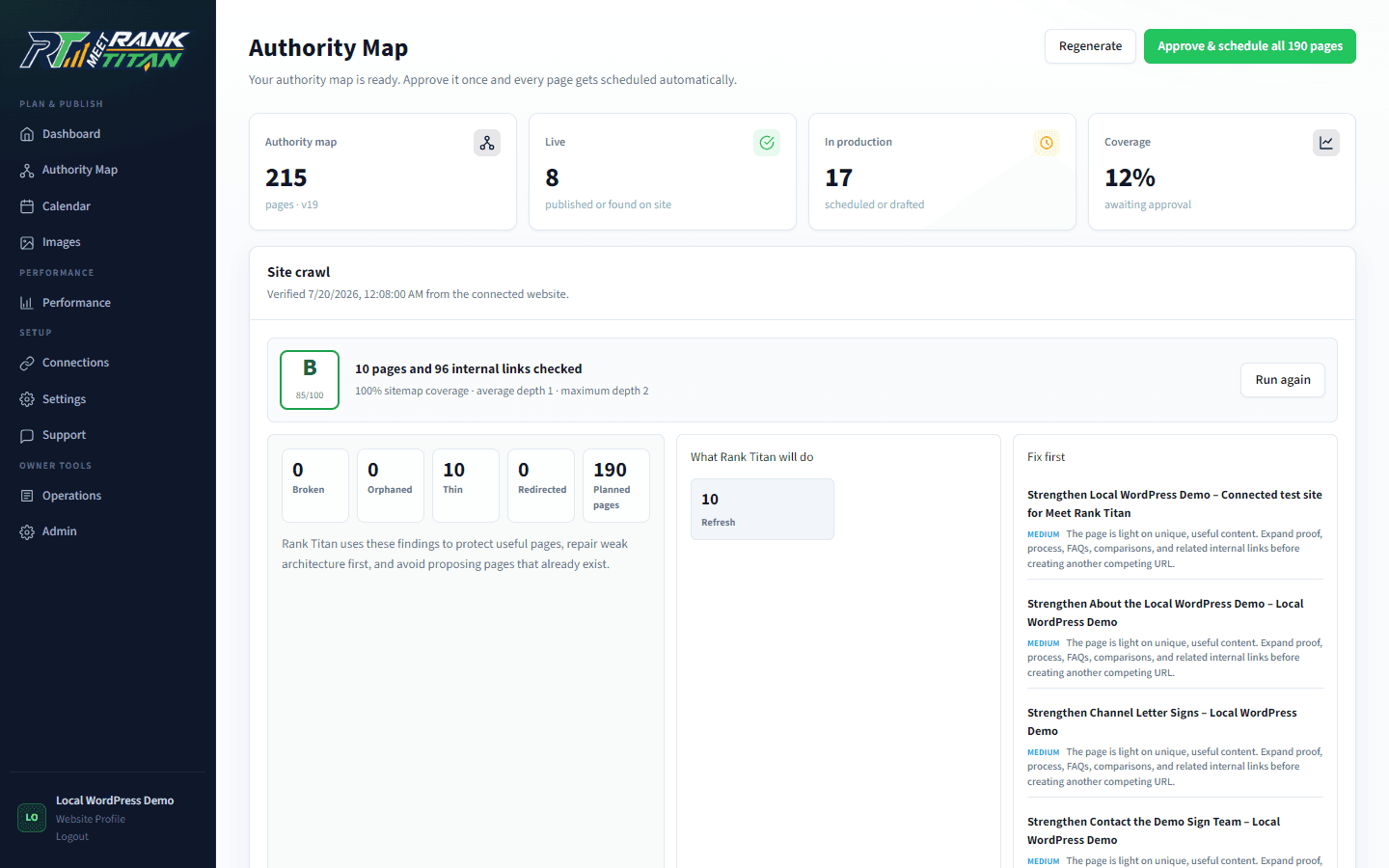
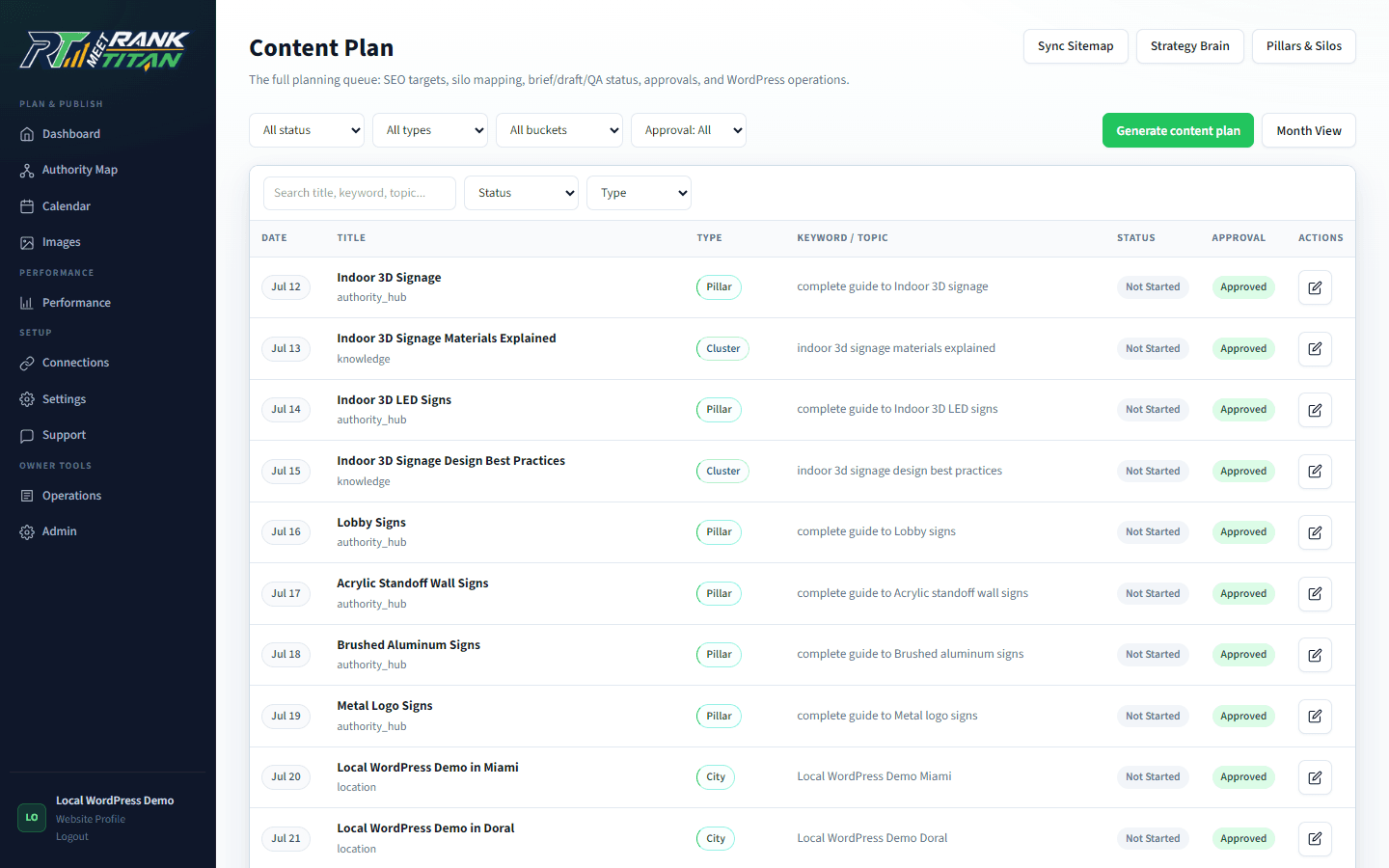
Map the site before generating the next page.
Rank Titan connects crawl evidence, topical architecture, briefs, QA, internal links, and draft-safe publishing in one reviewable workflow.