
Service page SEO template for a useful commercial owner
A service-page template is a decision and evidence structure, not fill-in-the-blank copy. It should help a buyer understand the offer, eligibility, process, proof, tradeoffs, and next action while giving the site one stable owner for that commercial task.
When does a service deserve its own SEO page?
Create a core service page when the business genuinely offers the service and the audience needs a dedicated explanation, decision path, or conversion route. Refresh an existing owner instead when it already serves that task, and reject a new URL when it only restates another service or city page.
Confirm the offer, audience, delivery area, exclusions, pricing factors, process, proof, and responsible internal expert before briefing. A keyword opportunity cannot establish that the business performs the work.
The page should remain useful without repeated geographic modifiers. Local pages can later explain materially different market conditions, but the core service owner carries the complete general offer.
Which fields belong in the service-page package?
Record the canonical owner, audience task, service definition, entities, proof ledger, outline, claims and vetoes, internal links, metadata, schema, media, CTA, destination settings, QA rules, and measurement query set before publication.
- Ownership: primary query family, intent, existing competing URLs, explicit exclusions, and parent service category.
- Business truth: availability, eligibility, service area, process, options, pricing factors, timelines, warranties, and limitations.
- Evidence: approved examples, credentials, policies, expert input, original images, and source records for material claims.
- Page assets: title, description, slug, canonical, headings, copy, FAQs, internal links, schema, images, alt text, and CTA.
- Release proof: approval, requested CMS status, connector result, final URL, rendered head, schema parse, links, images, and mobile conversion path.
What sections should a service page include?
Lead with a direct explanation of the service and buyer fit, then cover outcomes, scope, process, options, pricing factors, proof, common objections, FAQs, and a clear next action. Order sections around the real buying decision rather than a universal word count.
- Direct answer: what the service is, who it is for, and the problem it solves.
- Scope: what is included, excluded, optional, unavailable, or dependent on an inspection or consultation.
- Process: what happens before, during, and after delivery, including customer responsibilities.
- Decision support: materials, methods, alternatives, pricing factors, timelines, risks, and maintenance.
- Proof: inspectable examples, expertise, policies, accreditations, original images, and accurate testimonials when approved.
- Conversion: the information required to request a quote, book, buy, or confirm eligibility.
How should proof and claims be handled?
Tie every consequential claim to an approved business source, primary external source, or clearly attributed estimate. Omit unsupported awards, rankings, results, customer counts, guarantees, and invented experience rather than filling a template slot.
First-party proof can include documented projects, original photographs, methods, named expertise, policies, test results, and customer-approved outcomes. Preserve who supplied the fact and when it was reviewed.
A page can explain pricing factors without inventing a price, and it can describe a process without claiming every customer follows the same timeline. Explicit limitations are useful buying information.
How does the service page relate to city and location pages?
The core service page owns the general offer. A city or service-location page should exist only when real coverage, local constraints, evidence, buyer questions, or conversion details require a distinct answer. Never clone the service template across every target city.
Link qualified local pages to the core service owner, and link the service page to legitimate locations or service areas when that helps a buyer choose. Do not imply that a service-area page is a staffed branch.
If one regional owner can answer the task, keep one page. Service multiplied by city is a planning hypothesis, not an automatic publishing formula.
Which technical and structured-data checks belong in the template?
Require a successful crawlable URL, self-referencing canonical, one H1, useful metadata, descriptive internal links, accessible media, valid structured data that matches visible facts, and no conflicting robots or redirect behavior.
Use the most specific truthful schema type supported by the page. LocalBusiness properties must match a real business and location model; markup cannot create a branch, review, price, or service fact that the page and business do not support.
Verify the rendered HTML after CMS delivery. A populated metadata field or successful connector response does not prove that the public head, links, images, or structured data are correct.
What must pass before a service page is released?
The reviewer should confirm ownership, intent, factual accuracy, completeness, proof, claims, readability, metadata, canonical, headings, links, media, accessibility, schema, destination state, and conversion path, then retain the evidence used to approve the release.
- Compare the page against existing commercial owners and likely query overlap.
- Confirm that every service, location, credential, example, and promise is approved and current.
- Test every internal and conversion link, image, form, and interactive element at desktop and mobile sizes.
- Parse the structured data and compare it with the visible page.
- Record local, deployed, rendered, indexed, ranking, and converting as separate states.
Generic service template versus evidence-led service owner
| Decision | Generic template | Evidence-led owner |
|---|---|---|
| Qualification | Keyword exists | Real offer and distinct audience task |
| Copy | Universal marketing sections | Buyer decisions, scope, tradeoffs, and constraints |
| Proof | Placeholder claims | Approved examples, expertise, policies, and sources |
| Locations | Service copied across cities | Core owner plus selectively qualified local pages |
| Schema | Markup added for keywords | Properties match visible and real business facts |
| Release | Page saved in CMS | Rendered route, assets, links, schema, and conversion verified |
Implementation checklist
- Confirm the service, audience, eligibility, coverage, process, and exclusions with an accountable owner.
- Audit existing pages and assign one canonical commercial owner.
- Build a proof ledger and prohibit unsupported claims before drafting.
- Answer scope, process, options, pricing factors, timelines, objections, and next action.
- Link to the parent category, qualified local owners, useful support content, and conversion path.
- Make metadata, schema, images, and alt text match the visible page.
- Test the exact rendered route, links, form, images, and mobile layout.
- Measure discovery, query ownership, qualified visits, conversions, and upkeep separately.
Frequently asked questions
How long should an SEO service page be?
Use the length needed to answer the actual buying task with accurate scope, proof, decisions, and next steps. A universal word count cannot determine usefulness.
Should every service and city combination have a page?
No. Create a combined page only when the business serves the market and the local task, evidence, or conversion path is materially distinct.
Which schema should a service page use?
Use valid structured data that accurately describes visible content and the real business model. Do not invent a location or unsupported property merely because it is available in a schema vocabulary.
Can Rank Titan turn this template into a draft?
Rank Titan can carry approved ownership, evidence, brief fields, links, metadata, schema, images, QA, and destination settings into a draft package. Human factual and release approval still matter.
Primary sources and further reading
See the Rank Titan tools used in this workflow
These are current captures from the working Rank Titan application—not conceptual dashboard mockups.
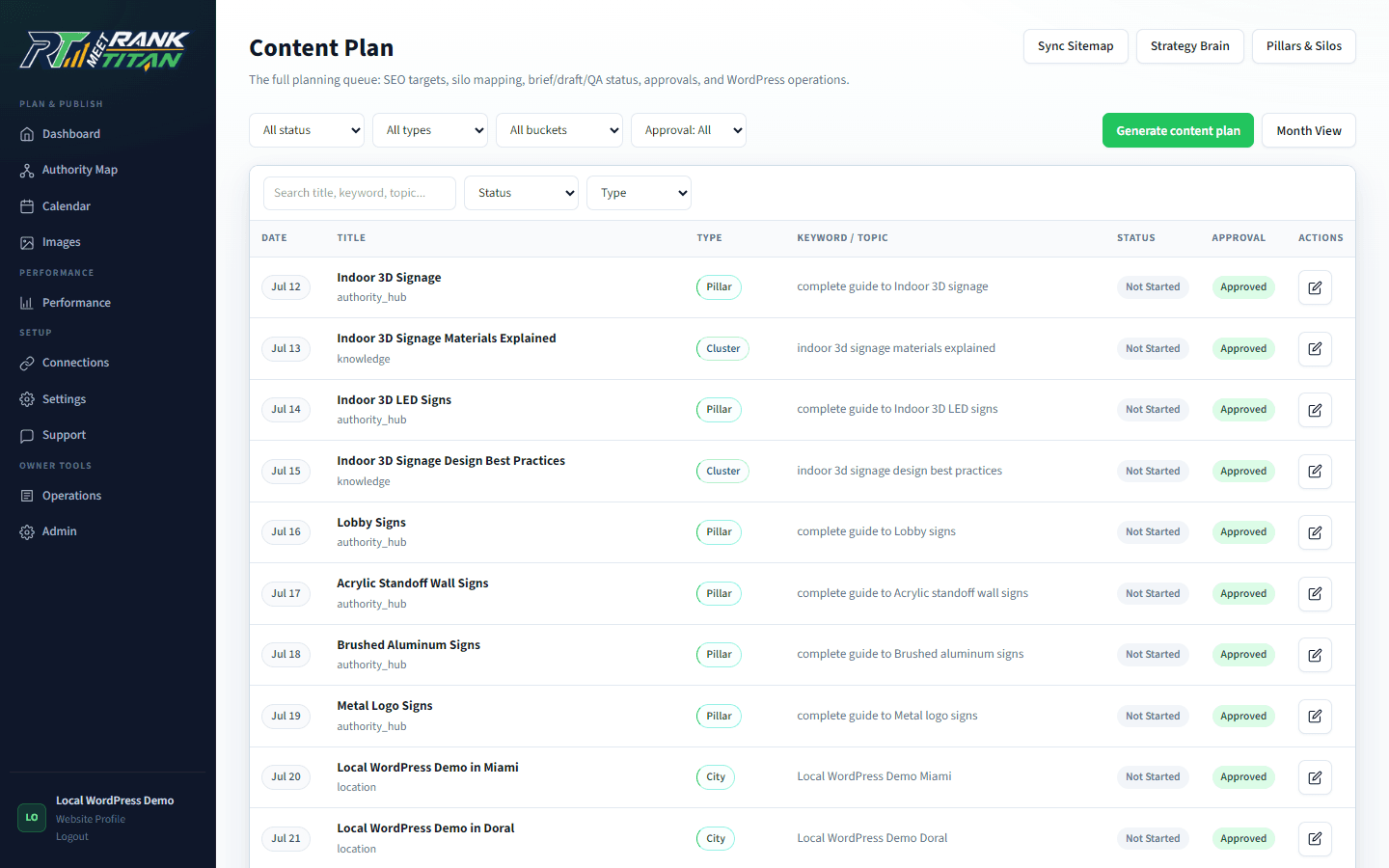
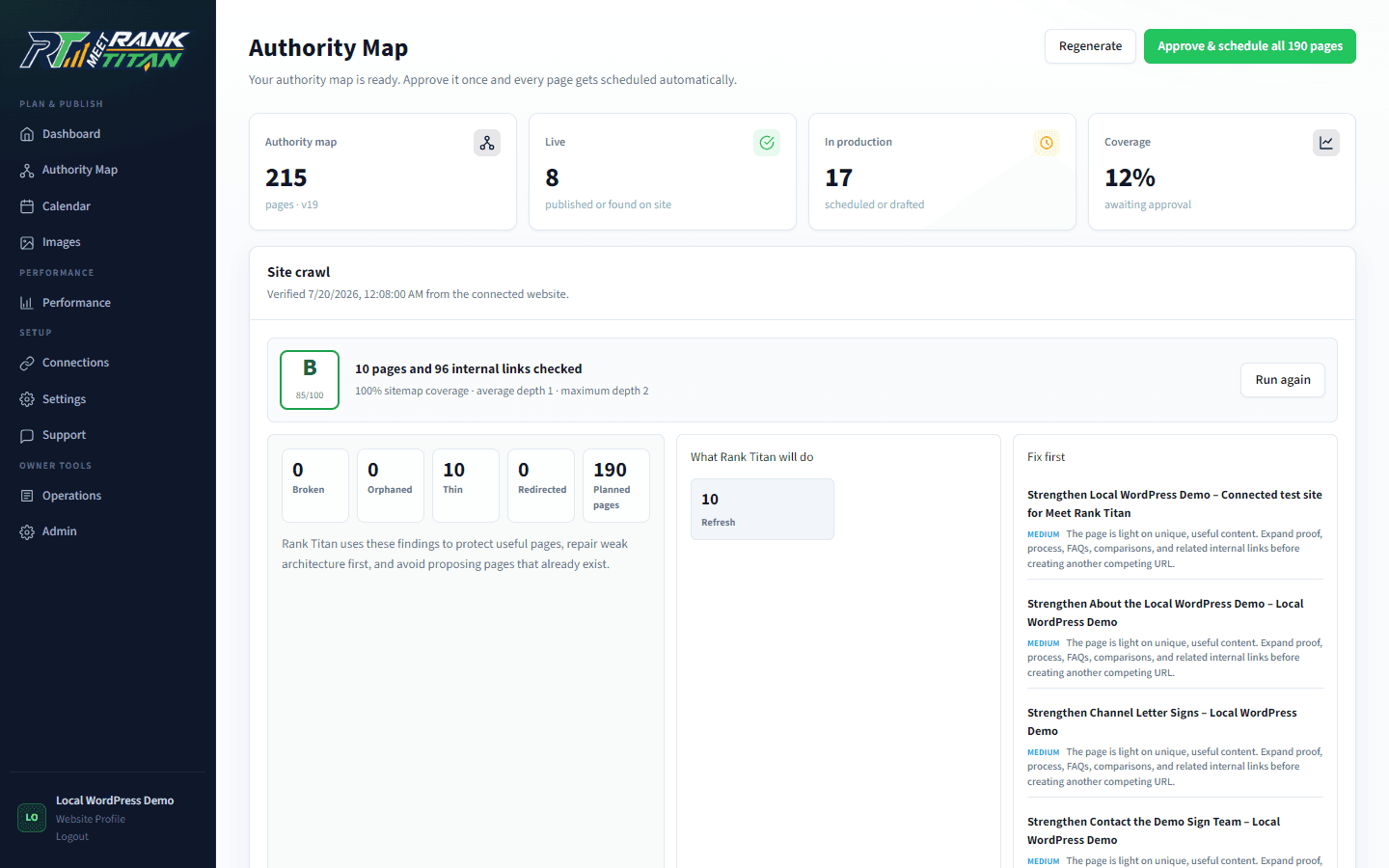
Map the site before generating the next page.
Rank Titan connects crawl evidence, topical architecture, briefs, QA, internal links, and draft-safe publishing in one reviewable workflow.