
Local SEO content strategy built around real services and places
A local SEO content strategy should explain what the business does, where it can genuinely serve customers, how the service works in those markets, and why a buyer can trust the answer. It is a site architecture and evidence system—not a command to publish every service and city combination.
What is a local SEO content strategy?
A local SEO content strategy maps real services, physical locations, service areas, local buyer questions, proof, and conversion paths to a controlled set of canonical pages. It decides which core service, location, service-in-location, FAQ, comparison, and supporting guide pages deserve to exist and how they should link.
The central decision is page ownership. A core service page explains the offer across the business. A location page explains a real office, branch, or served market. A service-location page exists only when the combined intent and local evidence justify a distinct answer. Helpful guides support those commercial owners instead of competing with them.
Local SEO also extends beyond the website. Business profiles, maps, reviews, directories, community sources, and consistent public facts can affect discovery and trust. The website remains the place where the business can present the complete, controlled explanation and conversion path.
What local source truth must be established first?
Confirm the legal and public business name, actual address or service-area model, phone and contact paths, opening hours, services, served markets, eligibility constraints, licenses where relevant, approved proof, and the claims the business cannot support. Never infer an office, project, review, or service area from a keyword opportunity.
- Locations: distinguish staffed customer-facing premises from service areas, remote coverage, mailing addresses, and places not served.
- Services: define the actual offer, exclusions, availability, process, pricing factors, and who can purchase it in each market.
- Proof: approved photos, completed work, staff expertise, policies, credentials, testimonials, response details, and first-party data with source records.
- Entity consistency: use the same accurate brand, address, phone, URL, categories, and hours across controlled profiles where applicable.
- Vetoes: prohibit invented locations, fake local projects, purchased or fabricated reviews, unsupported superlatives, and guarantees the business cannot honor.
How should a local service website be structured?
Start with one owner for each core service and each legitimate physical location or market-level task. Add service-location pages selectively when the user needs a materially different local answer and the business can provide local proof. Connect guides and FAQs to those owners through descriptive internal links.
A practical hierarchy can include a service hub, individual service pages, a locations or service-areas hub, qualified location pages, and supporting decision content. The URL pattern matters less than consistency, crawlable links, stable canonicals, and an information scent that tells people what the page will answer.
Avoid automatically multiplying every service by every city. First compare likely intent and existing owners. A location landing page may adequately cover several services; a core service page may already answer a broad regional query. Create a combination page only when its local constraints, proof, buyer questions, process, or conversion path are meaningfully distinct.
What makes a local page genuinely useful?
A useful local page combines accurate service information with evidence and decisions that matter in that place. The page should still help if the city name is removed from the heading. Local proof is not a list of landmarks added to otherwise duplicated copy.
- How service delivery, scheduling, travel, permitting, climate, property types, regulations, or availability differs in the market.
- Approved examples, images, case details, staff coverage, or customer questions that truly belong to that location.
- Clear service boundaries: where the team travels, what is unavailable, and how a buyer confirms eligibility.
- Relevant options, pricing factors, timelines, risks, and preparation steps for the local audience.
- A direct path to the core service explanation, nearby legitimate locations where helpful, contact action, and accurate business-profile destination.
Which technical SEO elements support local content?
Every indexable local page needs a stable URL, successful status, self-referencing canonical, useful title and description, one descriptive H1, crawlable internal links, accessible media, and structured data that accurately matches the visible page and real business model.
Google's LocalBusiness structured-data documentation supports business details such as address, hours, departments, and other properties when applicable. Markup does not create a physical location and should not be copied across service-area pages as if each city were a branch. Use the most specific truthful type and keep visible details consistent with the JSON-LD.
Include intended pages in the XML sitemap, but do not mistake submission for indexation. Check rendered canonicals, robots directives, broken links, redirect chains, schema validity, image loading, and mobile conversion paths. Search Console can later confirm discovery, index status, and query-page relationships once access is configured.
How should local SEO pages move through production?
Require a real target service and location, page-owner check, local evidence list, brief, factual review, uniqueness review, SEO and accessibility QA, destination approval, and rendered verification. Scale the workflow only after those gates work on a small representative set.
Rank Titan's current playbook requires a target location before city-page drafting, prohibits invented offices, projects, reviews, and physical presence, links city pages back to the core service, and carries local uniqueness into the review state. The content plan keeps page type, target topic, schedule, and approval visible before generation.
Measure each release separately. Record live date, crawl and index state, query impressions, qualified visits, calls or forms where attribution is available, conversion quality, page overlap, and upkeep burden. Consolidate or retire pages that do not provide a distinct user task rather than preserving a large count for appearance.
Local authority system versus city-keyword publishing
| Decision | City-keyword publishing | Local authority system |
|---|---|---|
| Starting point | Service and city combinations | Real offers, locations, audience tasks, current pages, and proof |
| Page threshold | A keyword variant exists | Distinct intent, local usefulness, evidence, and conversion path |
| Content | Shared template with place-name swaps | Accurate service answer plus market-specific decisions and proof |
| Links | Large city list | Service, location, guide, and nearby-page relationships that help navigation |
| Schema | LocalBusiness repeated for every city | Markup matches actual business type, location, and visible facts |
| Outcome | Number of pages published | Verified discovery, useful traffic, qualified conversions, and maintainability |
Implementation checklist
- Verify real services, premises, service areas, contacts, hours, proof, and prohibited claims.
- Inventory existing local URLs and assign one canonical owner to every primary task.
- Separate core service, physical location, service-area, and service-location page roles.
- Require distinct local usefulness and approved evidence before creating a new URL.
- Connect every city or service-area page to the appropriate core service and conversion path.
- Make canonicals, robots, titles, headings, links, images, and schema match rendered content.
- Publish through factual, uniqueness, SEO, accessibility, and destination approval gates.
- Track live, indexed, ranking, converting, maintained, and consolidated as separate states.
Frequently asked questions
Does every city a business serves need a page?
No. A city page should answer a distinct local task with accurate service coverage and evidence. One strong regional or location owner may be better than many thin combinations.
Can a service-area business create location pages without an office?
It can create useful pages for markets it genuinely serves, but it must not imply a staffed physical location. The page and structured data should accurately describe the service-area model.
Should local pages include LocalBusiness schema?
Use structured data only when its properties accurately match the visible content and real business. Do not mark every target city as a separate physical branch.
Can Rank Titan generate city pages?
Rank Titan can plan and draft city and service-location pages when a real target location is present. Its current rules prohibit invented local proof and keep the pages behind approval and uniqueness review.
Primary sources and further reading
See the Rank Titan tools used in this workflow
These are current captures from the working Rank Titan application—not conceptual dashboard mockups.
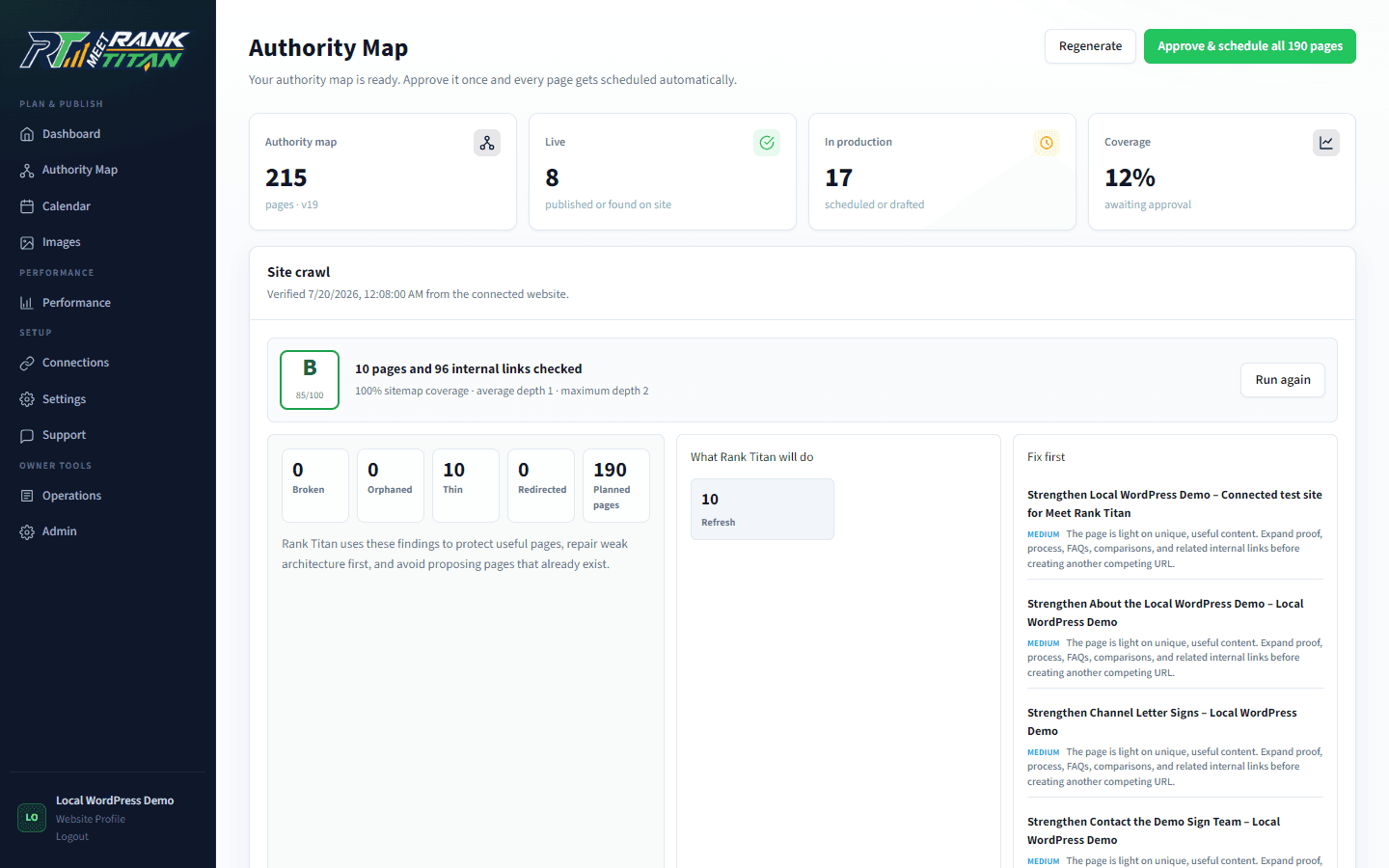
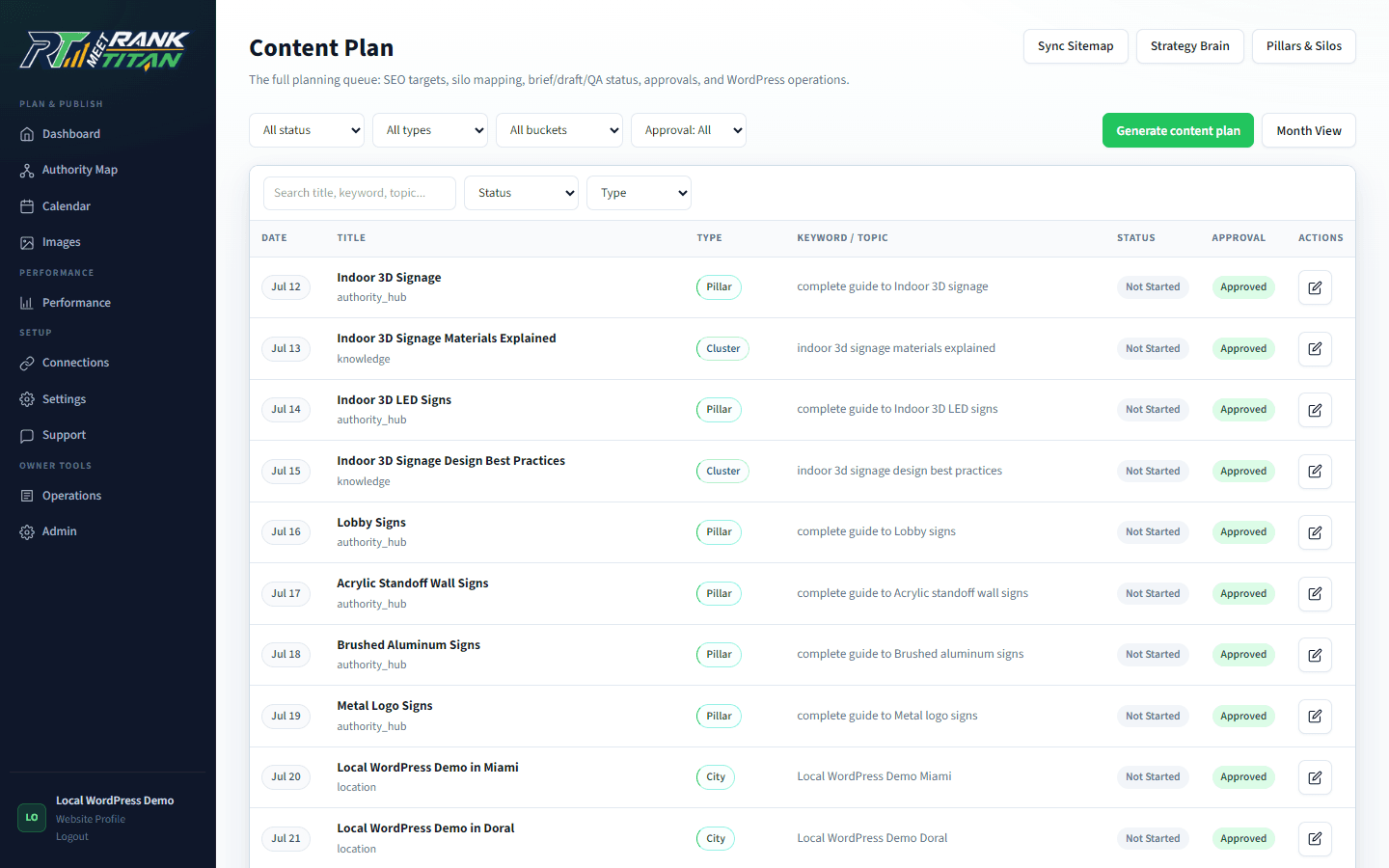
Map the site before generating the next page.
Rank Titan connects crawl evidence, topical architecture, briefs, QA, internal links, and draft-safe publishing in one reviewable workflow.