
A topical map template for page ownership, entities, and internal links
A useful topical map template is a decision system, not a colorful list of keywords. It joins the current site's pages with proposed coverage and records why each page exists, what it owns, which entities and evidence it needs, how it links, what it must not overlap, and whether it is only planned or actually live.
What is a topical map template?
A topical map template is a structured set of fields for inventorying existing URLs and planning distinct canonical page owners around entities, audience tasks, search intent, page roles, evidence, internal links, priority, conversion paths, and lifecycle state. It can live in a database, spreadsheet, graph, or product as long as the decisions are explicit.
The template must begin with the real site. A blank keyword sheet cannot reveal an owner that already exists, a redirect chain, a weak orphan page, or a commercial URL that should receive support. Import crawled evidence before adding proposed pages.
The map should also tell the team what not to publish. Each row needs an exclusion or overlap note so a focused support page does not expand into its pillar, a guide does not steal product intent, and a city page does not repeat a core service owner.
Which existing-page fields belong in the template?
For every current URL, capture status, indexability, canonical, title, description, H1, page type, primary entity and intent, parent or hub, crawl depth, incoming and outgoing internal links, structured data, approximate depth, freshness, evidence assets, search and conversion data where available, and a keep, improve, consolidate, redirect, or remove recommendation.
- Identity: normalized URL, canonical URL, route owner, locale, template, content ID, and CMS record.
- Technical: status, robots, sitemap membership, redirect target, title, description, H1, JSON-LD types, and last modified.
- Meaning: audience task, query family, intent, page type, primary and supporting entities, funnel role, and conversion action.
- Graph: parent, children, inbound links, outbound links, anchor themes, orphan status, and crawl depth.
- Evidence: author or owner, sources, screenshots, first-party proof, update risk, performance data, and recommended action.
Which proposed-page fields belong in the template?
A proposed row should include the working URL, title, primary query family, audience task, intent, page type, parent cluster, commercial owner, required entities and questions, supporting evidence, proof gaps, exclusions, internal-link plan, CTA, schema and image direction, priority, dependencies, acceptance criteria, approver, and current status.
Add a decision column for create, refresh, consolidate, link, measure, or no action. A gap does not always require new content. A weak current owner may need improvement; an isolated page may need links; a promising topic may need first-party proof before it can be responsibly briefed.
Use status language that prevents false completion: proposed, approved, briefed, drafted, QA, destination-ready, deployed, rendered-verified, indexed, ranking, converting, mentioned, cited, refresh due, and retired. Teams can simplify the vocabulary, but should not treat a local draft as a live search outcome.
How should clusters and entities be represented?
Give each cluster a parent topic and audience promise, then define one pillar or hub, its commercial owner, focused support pages, entity coverage, question and intent ladder, proof assets, conversion routes, and link rules. Entities describe what the subject is; page ownership decides where each audience task is answered.
A cluster can contain definition, procedure, comparison, risk, template, local, use-case, and product pages without forcing them into identical formats. Record the relationship type so links explain why the pages connect rather than forming a mechanical ring.
Separate page-level requirements from site-level entities. The Organization, product, services, audiences, locations, authors, policies, and brand facts may recur across the site, while a support page needs only the subset that serves its task.
How do you build the internal-link blueprint in the map?
Record planned source, target, relationship, anchor intent, placement, reason, dependency, and verification state. Every support page should have a discoverable path to its parent and relevant commercial owner; pillars should link to important support pages; cross-links should exist only when they answer the reader's natural next question.
- Upward: support page to parent pillar or hub for broader context.
- Downward: pillar to the support pages necessary to complete the topic.
- Commercial: educational page to the most relevant product, use case, service, or conversion owner.
- Lateral: sibling pages connected by a real next question, comparison, dependency, or risk—not quota.
- Backfill: existing pages that should link to a newly deployed owner after the route is verified.
- Proof: link is present in rendered HTML, crawlable, direct, descriptive, and points to the canonical URL.
How should the template control priority and production?
Prioritize by business relevance, audience demand evidence, owner-page dependency, current gap, proof readiness, conversion path, implementation effort, risk, and measurement access. Require architecture approval before briefs and release approval before publication, then update the map from the actual result.
A sensible order often starts with technical blocks and commercial owners, then pillars, dependency support pages, and later breadth. Do not schedule a support fleet before the parent, evidence, and link targets exist. Mark blockers such as missing proof, unclear owner, unavailable credentials, unsupported destination, or unresolved product claims.
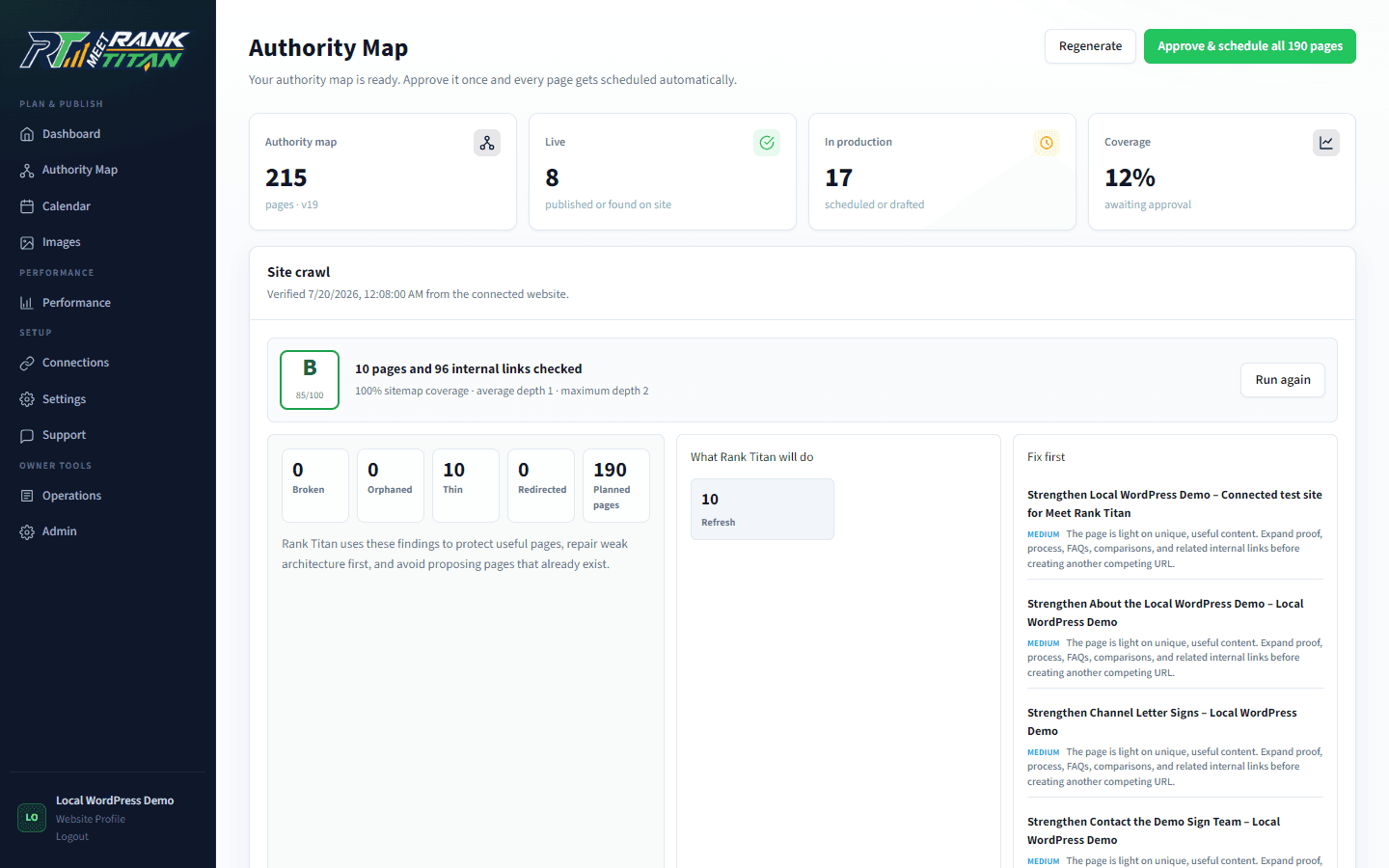
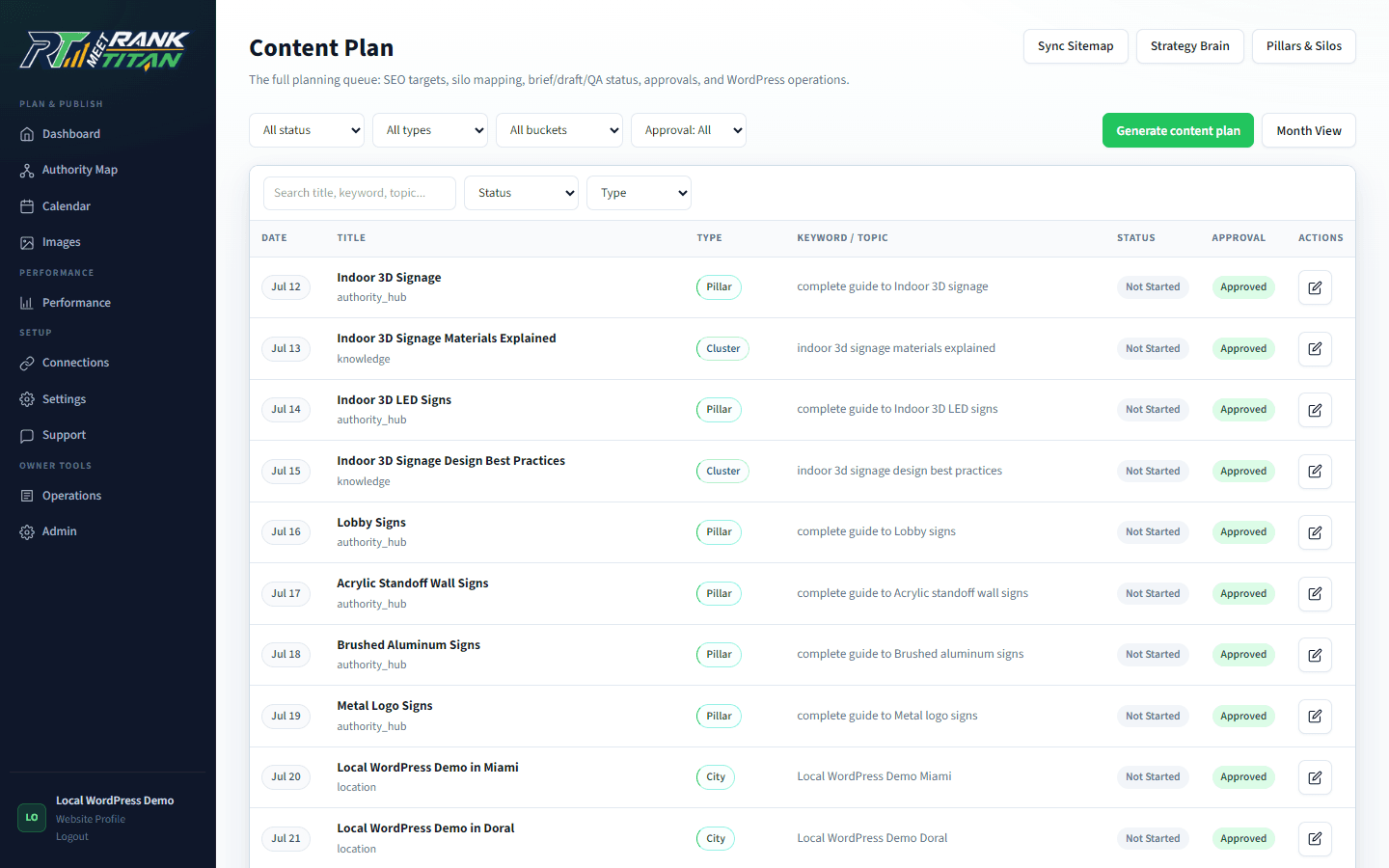
Rank Titan's Authority Map and Content Plan make these relationships operational: existing coverage and priorities feed distinct page types and approval states. The durable template still matters because it records the acceptance criteria, evidence, and blockers behind the visual plan.
Keyword list versus processed topical map template
| Template area | Keyword list | Processed topical map |
|---|---|---|
| Current site | May include ranking URLs | Crawl, indexability, canonicals, page roles, links, proof, and actions |
| Grouping | Keyword similarity | Entities, audience tasks, intent, format, owner URL, and cluster role |
| New page | Keyword and volume | Create-versus-refresh decision, evidence, exclusions, dependencies, and CTA |
| Links | Suggested related pages | Source, target, relationship, anchor intent, placement, and verification |
| Priority | Volume and difficulty | Business value, demand evidence, dependency, proof readiness, effort, risk, and measurement |
| Status | Planned or published | Approved, briefed, drafted, QA, deployed, indexed, performing, and maintained |
Implementation checklist
- Import the current crawl, canonical, indexability, metadata, H1, schema, page type, and link graph.
- Assign audience task, intent, entities, role, parent, commercial owner, CTA, and lifecycle action to every URL.
- Add proposed pages only after checking for an existing owner and defining clear exclusions.
- Record evidence, proof gaps, sources, images, schema direction, acceptance criteria, and approval owner.
- Map upward, downward, commercial, lateral, and backfill links with canonical targets and reasons.
- Prioritize by business value, demand evidence, dependencies, proof readiness, effort, risk, and measurement access.
- Keep proposed, implemented, deployed, indexed, ranking, converting, mentioned, and cited states separate.
- Reconcile the template with the live crawl and performance data after every release batch.
Frequently asked questions
Is a topical map just a keyword cluster spreadsheet?
No. A useful map includes current URLs, owner decisions, entities, intent, page roles, evidence, exclusions, internal links, conversion paths, priorities, approvals, and lifecycle state.
Should every entity in a topical map become a page?
No. Some entities belong as sections or supporting context. Create a page only when it serves a distinct audience task with enough evidence and a place in the site architecture.
Can I use this topical map template in a spreadsheet?
Yes. Use separate inventory, ownership, cluster, link, evidence, release, and measurement views if one sheet becomes unwieldy. The field discipline matters more than the software.
How often should a topical map be updated?
Update it after crawl changes, approved releases, consolidations, new products or markets, important search evidence, and scheduled performance reviews. It should reflect the live site, not remain a launch artifact.
Primary sources and further reading
See the Rank Titan tools used in this workflow
These are current captures from the working Rank Titan application—not conceptual dashboard mockups.
Map the site before generating the next page.
Rank Titan connects crawl evidence, topical architecture, briefs, QA, internal links, and draft-safe publishing in one reviewable workflow.