
AI search visibility: measure mentions, citations, and actions separately
AI search visibility describes how a brand, product, expert, location, or source appears inside generated answers. A useful program records what was asked, which system answered, what it said, whether the brand was mentioned, what sources it cited, which competitors appeared, and what content action the observation justifies.
What is AI search visibility?
AI search visibility is the observed presence and treatment of a brand or source in generated answers for a defined set of buyer questions. It includes brand mentions, recommendation position, cited URLs, competitor presence, answer accuracy and context, platform coverage, and changes across repeated runs.
The phrase overlaps with generative engine optimization (GEO) and answer engine optimization (AEO), but measurement comes before optimization. A brand can be named without receiving a citation, cited without being recommended, or described inaccurately despite a high mention rate. Those are different outcomes and require different actions.
AI answers are also variable. Model versions, retrieval sources, location, account state, prompt wording, and repeated sampling can change a response. A single screenshot is evidence of one observation, not a universal ranking.
Which AI visibility metrics should remain separate?
Keep mention rate, recommendation position, citation rate, cited-page share, competitor share of voice, answer accuracy, sentiment or framing, platform coverage, and referral traffic as separate measures. A composite score can summarize a dashboard, but it should never replace the underlying observations.
- Mention: the brand or entity appears anywhere in the answer.
- Recommendation: the answer presents the brand as an option for the buyer's task, with position where a list exists.
- Citation: a link or named source supports the answer; record the exact URL and whether it belongs to the brand or a third party.
- Competitor presence: another brand appears for the same prompt, including its position and cited sources.
- Accuracy and framing: the answer describes the offer, availability, location, limitations, and differentiators correctly.
- Outcome: AI referral sessions and conversions where analytics exposes them, without assuming every influenced decision produces a click.
How do you build a useful AI visibility prompt set?
Start with real buyer tasks and separate branded, category, problem, comparison, local, and trust questions. Store the exact prompt, locale, date, provider, model, and run conditions so the observation can be compared or repeated instead of remembered approximately.
High-value prompts include category recommendations, best-for-use-case questions, alternatives, comparisons, how-to problems, pricing or selection factors, and local provider questions. Branded prompts are useful for accuracy, but they should not inflate discovery visibility because the brand is already named in the question.
Map each non-brand prompt to an owner page or a documented content gap. Near-duplicate prompts can be grouped into an intent family, but retain exact wording when sampling because small changes can materially affect the answer.
What does Rank Titan's current AI visibility check measure?
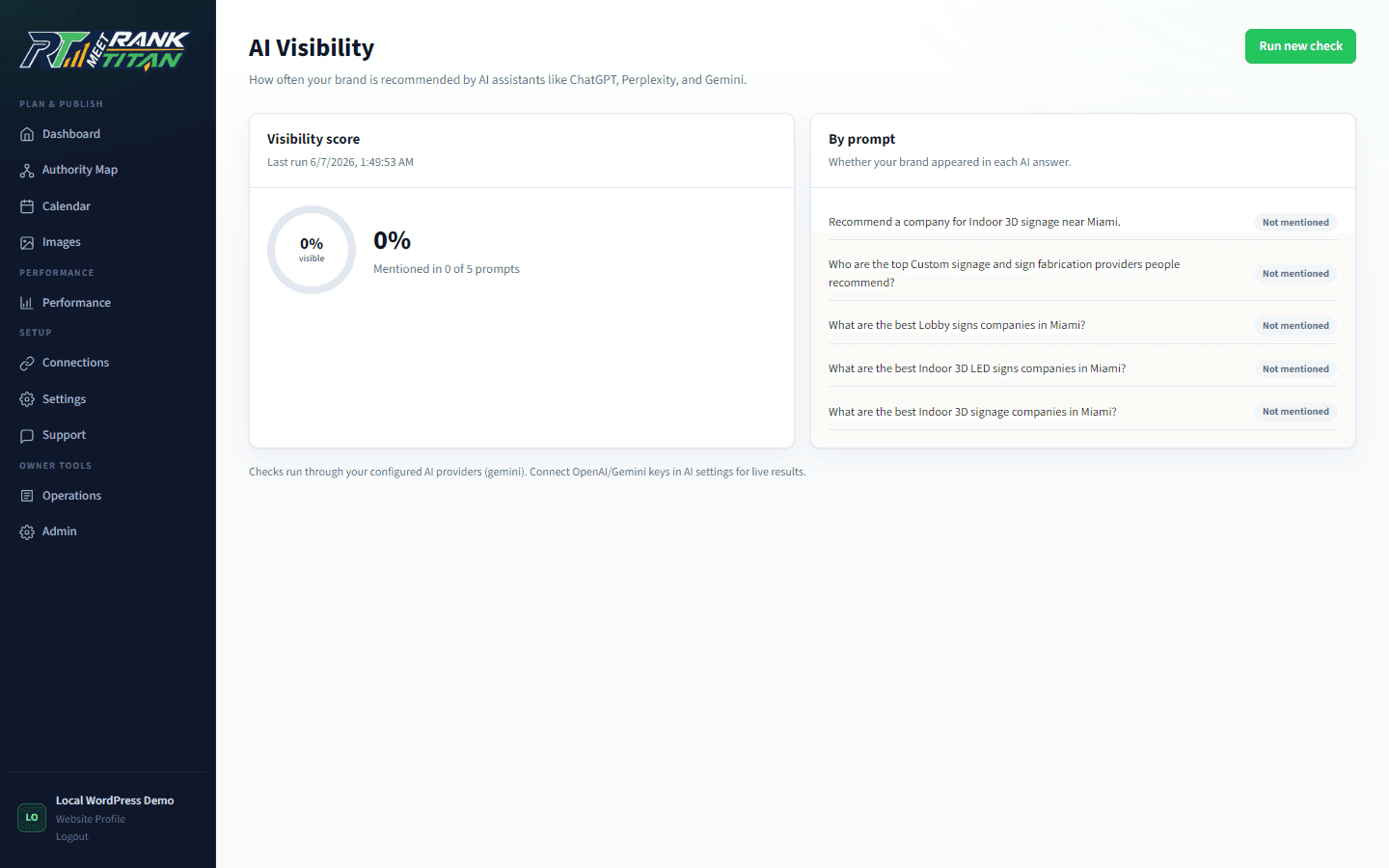
The current Rank Titan check generates up to five service, industry, and location questions from the site profile, runs them through the configured AI provider, and stores the prompt, provider, model, answer, brand mention, recommendation position when available, score, and timestamp.
The summary groups the latest run and reports mention rate across its prompts. This creates a reproducible starting observation connected to the same site profile and content workflow used for planning. Live results require configured provider credentials; mock-mode output is not market evidence.
The current check does not independently query ChatGPT, Perplexity, Gemini, and every other answer engine, and it does not extract cited URLs. Multi-platform citation monitoring, competitor share of voice, repeated sampling, and historical trend reporting therefore remain separate work. Rank Titan should describe those as gaps or follow-on measurement, not imply that one provider response proves market-wide visibility.
How do AI visibility observations become content actions?
Link every meaningful observation to an owned page, evidence gap, entity correction, comparison need, third-party source opportunity, internal-link change, or no-action decision. Monitoring creates value only when the team can explain the evidence, the proposed change, and what will be re-tested.
- Missing category mention: strengthen the canonical category or service owner with clear positioning, proof, and relevant comparisons.
- Competitor cited from a page you lack: decide whether a distinct comparison, methodology, data set, or expert resource deserves an owner URL.
- Incorrect brand description: correct first-party pages and important profiles with consistent entity and offer facts.
- Third-party source repeatedly cited: pursue legitimate inclusion, expertise, research, reviews, or public documentation rather than copying the source.
- Owned page cited but not converting: improve the next step, trust evidence, product explanation, and measurement without removing the answer that earned citation.
- One anomalous answer: repeat the observation before commissioning work.
How do SEO, GEO, and AEO work together?
They share the same foundation: accessible pages, clear entities, direct answers, useful evidence, trustworthy sourcing, coherent internal links, and technically valid delivery. Traditional search measures ranked and clicked documents; AI visibility adds how generated answers select, summarize, mention, and cite those documents and entities.
Do not create a duplicate AI-only version of every SEO page. Give the primary intent one strong canonical owner that helps a person complete the task and is easy for search and answer systems to interpret. Add concise definitions, comparisons, steps, tables, FAQs, original evidence, dates, and source attribution when those elements genuinely help.
Technical accessibility still matters. Crawlers need reachable links and allowed content, important pages need stable canonicals, structured data must match visible text, and fresh releases need sitemap and index verification. AI visibility is an additional observation layer, not permission to ignore search fundamentals.
Traditional rank tracking versus AI visibility observation
| Question | Rank tracking | AI visibility |
|---|---|---|
| Unit measured | Query, URL, position, and feature | Prompt, answer, entity, citation, provider, and model |
| Presence | A URL ranks or does not | Brand may be mentioned, recommended, cited, or absent |
| Competitors | Other ranked domains | Named competitors and the sources supporting their inclusion |
| Variability | Location, device, and SERP changes | Those factors plus wording, retrieval, model, and repeated sampling |
| Traffic | Clicks are a primary outcome | Influence can occur without a click; referral traffic remains separate |
| Action | Improve or consolidate an owner page | Correct entities, strengthen pages, earn sources, and re-test prompts |
Implementation checklist
- Define buyer-relevant branded, category, problem, comparison, trust, and local prompt families.
- Store the exact prompt, date, locale, provider, model, and run conditions.
- Record mentions, recommendation position, citations, competitors, accuracy, and framing separately.
- Repeat representative prompts and label stochastic observations honestly.
- Map each prompt family to a canonical owner page or an explicit gap.
- Turn findings into evidence, content, entity, link, third-party source, or no-action decisions.
- Verify crawler access, canonicals, links, structured data, and sitemap discovery.
- Re-test after meaningful releases and compare against the dated baseline.
Frequently asked questions
Is AI search visibility the same as an organic ranking?
No. A ranking describes a URL's position in a search result. AI visibility describes how an entity or source appears inside a generated answer. They influence each other but require different observations.
What is the difference between a mention and a citation?
A mention names or describes the brand. A citation attributes information to a source or links to a URL. A brand can receive either, both, or neither in the same answer.
Can an AI visibility score guarantee leads?
No. A score summarizes selected observations. Prompt coverage, answer context, audience fit, referral behavior, conversion path, and real business outcomes must still be reviewed separately.
Does Rank Titan monitor every AI platform?
No. Its current check runs a small prompt set through the configured AI provider and records mention observations. Broader multi-platform citation and competitor monitoring requires additional data collection.
Primary sources and further reading
See the Rank Titan tools used in this workflow
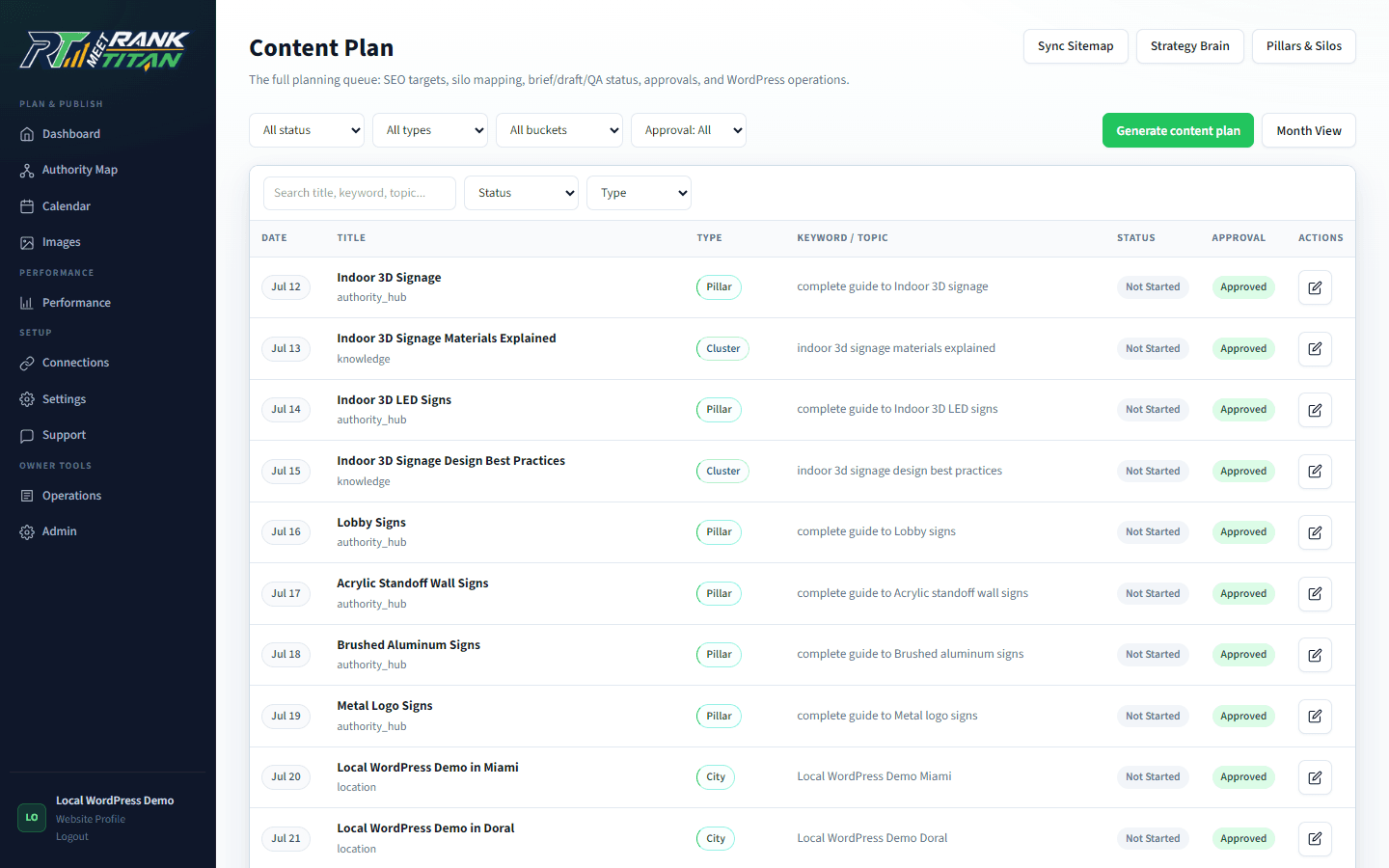
These are current captures from the working Rank Titan application—not conceptual dashboard mockups.
Map the site before generating the next page.
Rank Titan connects crawl evidence, topical architecture, briefs, QA, internal links, and draft-safe publishing in one reviewable workflow.