
GEO vs SEO vs AEO: different labels, one connected visibility system
SEO, GEO, and AEO describe related attempts to make useful information discoverable and usable across ranked results and generated answers. The boundaries are not standardized. Use the labels to clarify the surface, observation, and action—not to create three disconnected content strategies.
What do SEO, GEO, and AEO mean?
SEO is the broad practice of helping search systems understand and surface useful pages. AEO usually emphasizes direct-answer surfaces such as featured answers, voice responses, and generated summaries. GEO usually emphasizes how generative systems retrieve, synthesize, mention, recommend, and cite brands or sources. AEO and GEO are often used interchangeably.
No universal standards body owns the marketing definitions. Some practitioners treat AEO as the broader answer discipline and GEO as its generative subset; others reverse the scope or use both for the same work. State what surface and metric you mean instead of assuming the acronym resolves the ambiguity.
Traditional organic search now includes generated experiences, and AI assistants can use web search and cited sources. The same crawlable, accurate, well-structured page may support ranked links, direct answers, and generative citations.
What is the unit of visibility in each discipline?
SEO commonly observes a query, result surface, URL, position, impression, click, and conversion. AEO observes whether content supplies or supports a direct answer. GEO observes the prompt, generated answer, brand or entity treatment, recommendation, cited source, competitor presence, provider, model, and repeated run.
- Ranked visibility: which canonical URL appears for which query, in which market, device, and result feature.
- Answer visibility: whether a concise and accurate passage, entity, or structured result satisfies the question directly.
- Generative visibility: whether the brand or source is retrieved, mentioned, recommended, cited, represented accurately, and influential in the synthesized answer.
- Traffic: organic and AI-referral sessions where analytics exposes them, kept separate from no-click influence.
- Business outcome: qualified inquiry, signup, purchase, assisted conversion, trust correction, or another declared goal.
Which foundations do SEO, GEO, and AEO share?
They share technical accessibility, stable canonical owners, clear entities, accurate facts, useful answers, original evidence, logical structure, descriptive links, trustworthy sources, maintainable pages, and measurement. A generated-answer strategy cannot compensate for blocked crawling, invented claims, duplicate owners, or content that does not help a person.
Google's documentation for AI features says ordinary Search technical requirements and guidance remain relevant; it does not require special AI text files or schema for inclusion. OpenAI separately documents crawler controls for search and training behavior. Crawler policy should match the business's intended access rather than a generic allow-or-block slogan.
Structured data can clarify supported entities and page types when it matches visible content, but it is not a citation switch. Likewise, a direct answer can improve comprehension without guaranteeing that any particular system will extract it.
What work becomes more important for generative and answer visibility?
Prompt-family research, mention-versus-citation measurement, competitor and cited-source analysis, answer accuracy review, explicit entity relationships, extractable passages, comparison and decision content, original evidence, first-party documentation, corroborating third-party sources, and repeated sampling become more visible parts of the workflow.
- Define real category, problem, comparison, local, trust, and branded accuracy prompt families.
- Capture full answers and cited URLs under recorded provider, model, locale, and date conditions.
- Separate a brand mention from a recommendation, cited owned page, cited third party, positive framing, and referral visit.
- Correct entity and product facts consistently across first-party pages and important public sources.
- Publish evidence, methods, limitations, comparisons, documentation, examples, data, and direct answers when they genuinely serve the audience.
- Re-test stable prompts after releases without claiming causality from one changed answer.
Should teams run separate SEO, GEO, and AEO content calendars?
Usually no. Use one canonical page-ownership and content operation, then add the observations and requirements needed for each surface. A query family and prompt family can map to the same owner when the audience task is the same; create another URL only when a distinct task or format justifies it.
A service guide can rank, provide a direct answer, and become a cited source without three versions. Give it a clear answer, complete decision support, evidence, sources, structured sections, useful links, accurate metadata and schema, and a maintained canonical route.
The measurement views can remain separate because their evidence differs. Search Console query-page data, analytics referrals, manual or tool-based prompt observations, cited-source records, and business conversions should connect to the same owner without collapsing into one visibility score.
How does Rank Titan connect SEO, GEO, and AEO work?
Rank Titan uses one site profile, crawl, Authority Map, page-ownership plan, brief and draft package, QA workflow, internal-link graph, and controlled publishing path. AI visibility observations can then become page, evidence, entity, link, or source actions instead of a detached reporting dashboard.
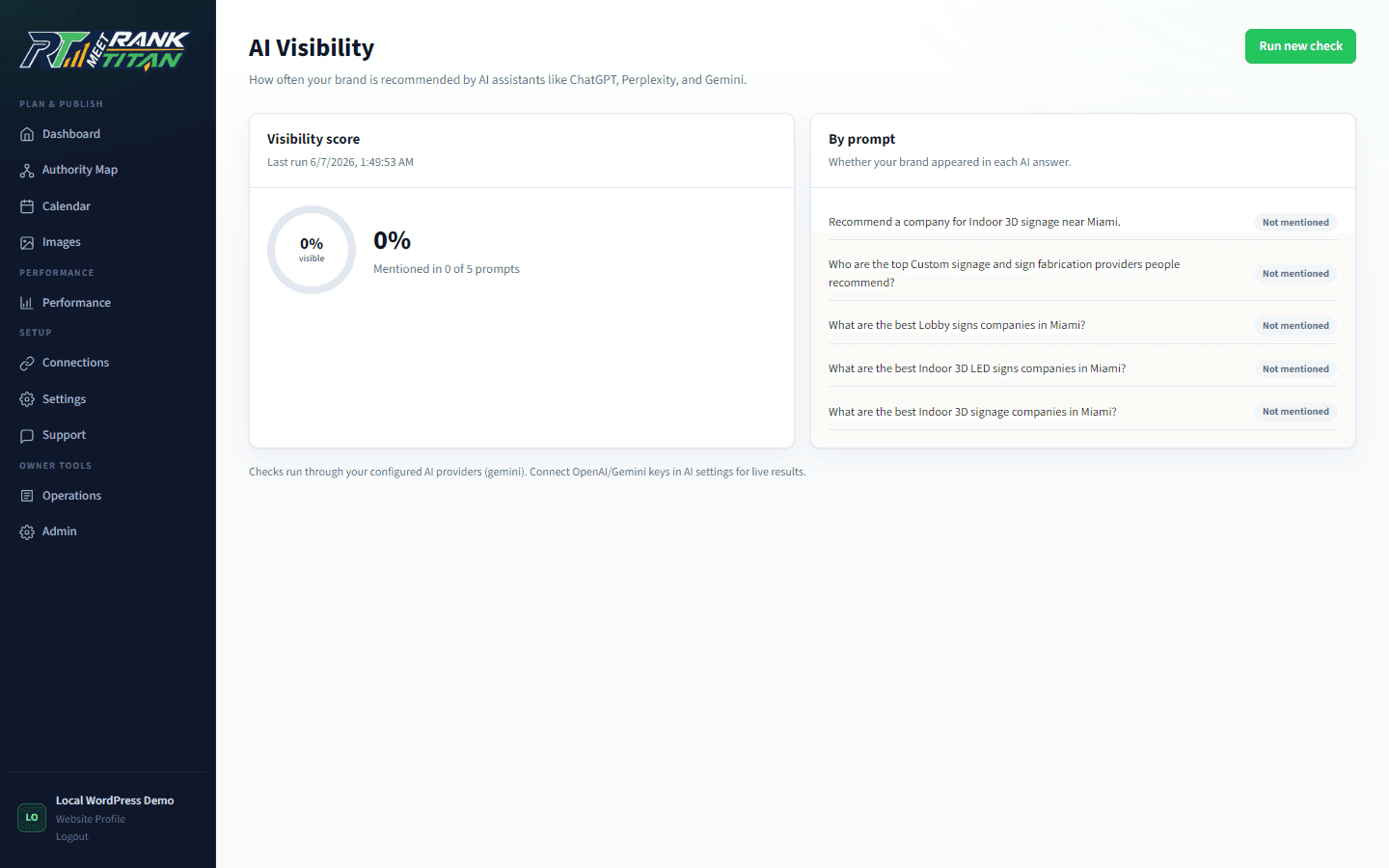
The current AI visibility check is intentionally narrower than the overall framework: it creates a small service, industry, and location prompt set and runs it through the configured provider, storing prompt, provider, model, answer, mention, position, score, and time. It does not independently monitor every platform or extract citations.
Search Console and GA4 are separate first-party measurement dependencies. Rank Titan's local code can load analytics and expose verification metadata, but canonical property access, a real GA4 measurement ID, deployment, sitemap submission, and live data remain external configuration and approval states.
SEO, AEO, and GEO comparison
| Dimension | SEO | AEO / GEO emphasis |
|---|---|---|
| Primary surface | Ranked and rich search results | Direct and generated answers across search and assistants |
| Observed unit | Query, URL, position, impression, click | Prompt, answer, entity, mention, recommendation, citation, provider, model |
| Content goal | A useful canonical page that deserves discovery | A useful source and entity that can be accurately extracted, summarized, or cited |
| Distinct work | Indexation, query ownership, links, snippets, and search performance | Prompt sets, answer accuracy, cited sources, competitor presence, repeats, and framing |
| Shared foundation | Crawlability, canonicals, quality, evidence, structure, links, entities, maintenance | The same foundation; no guaranteed citation shortcut |
| Outcome | Qualified search visibility and conversions | Accurate presence, citations or recommendations, referrals, influence, and conversions |
Implementation checklist
- Define the surface and metric each acronym means in your reporting.
- Use one canonical owner for the same audience task across ranked and generated experiences.
- Verify crawler access, indexability, canonicals, links, structured data, and rendered content.
- Add direct answers, evidence, documentation, comparisons, examples, methods, and limitations where useful.
- Track query-page performance separately from prompts, mentions, recommendations, citations, and answer accuracy.
- Map every visibility finding to a page, entity, evidence, internal-link, third-party source, or no-action decision.
- Retain provider, model, date, locale, exact prompt, full answer, and cited URLs for repeatable observations.
- Connect search and AI visibility to qualified business outcomes without inventing causal certainty.
Frequently asked questions
Is GEO replacing SEO?
No. Generated answers add surfaces and measurement needs, while crawlable, accurate, authoritative web pages and search discovery remain foundational. Treat GEO as connected work, not a replacement site.
Are GEO and AEO the same thing?
They often overlap or are used interchangeably. Some teams use AEO for direct-answer systems broadly and GEO for generative synthesis specifically. Define your surface and metric instead of relying on the label alone.
Do I need separate pages for SEO and AI search?
Usually not when the audience task is the same. Build one strong canonical owner that is useful, structured, evidenced, and accessible, then measure how it performs across surfaces.
Can Rank Titan measure GEO?
Its current provider-backed check records a small prompt set and brand mention observations. A complete GEO program also needs multi-platform citations, competitor sources, accuracy, repeated sampling, referrals, and action tracking.
Primary sources and further reading
See the Rank Titan tools used in this workflow
These are current captures from the working Rank Titan application—not conceptual dashboard mockups.
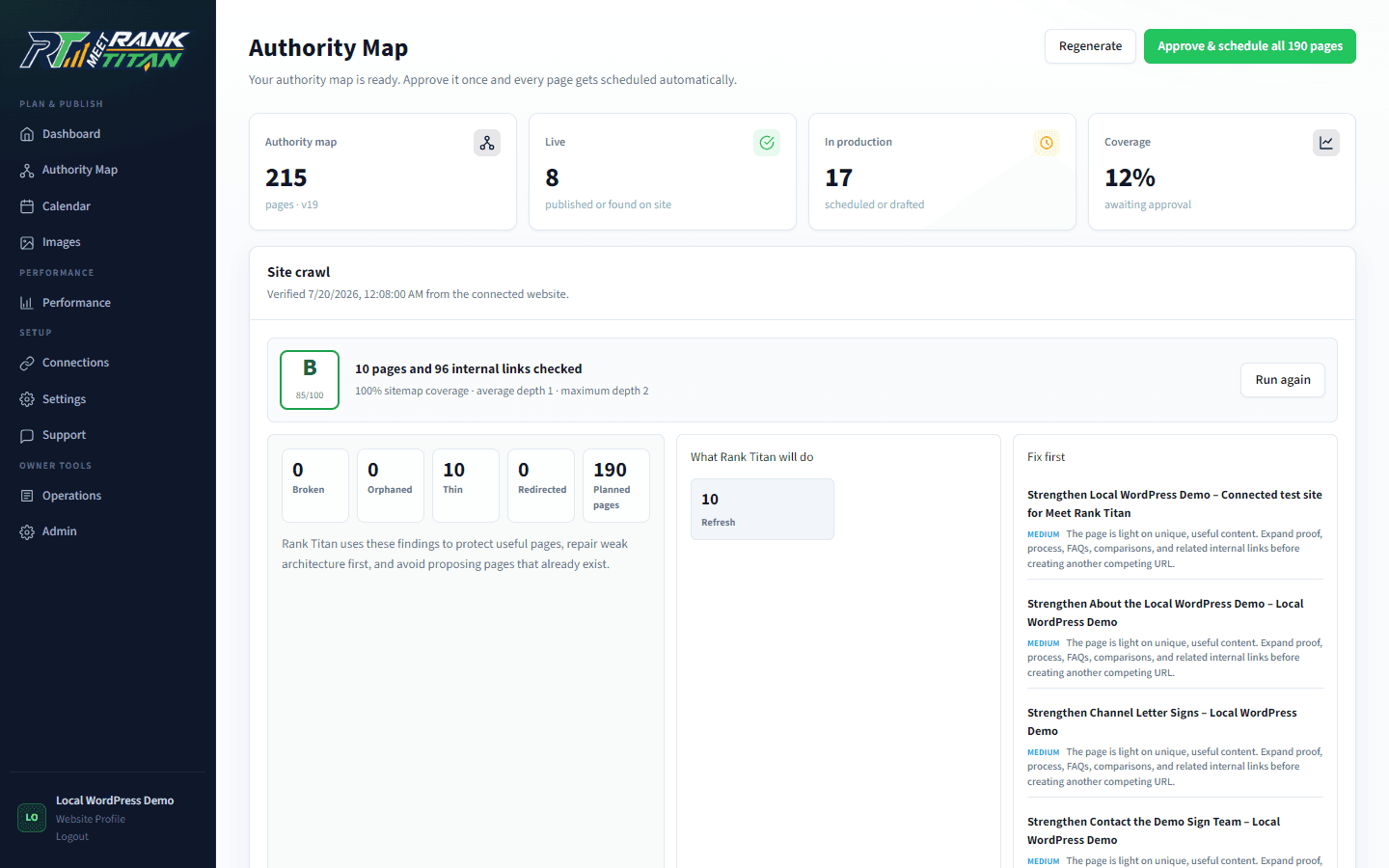
Map the site before generating the next page.
Rank Titan connects crawl evidence, topical architecture, briefs, QA, internal links, and draft-safe publishing in one reviewable workflow.