
How to earn AI search citations without pretending they are guaranteed
No page format, schema type, or optimization score can guarantee an AI citation. Citation is a provider-specific retrieval and synthesis outcome. Brands can improve their opportunity by publishing accessible, accurate, specific, well-supported sources, strengthening entity consistency, earning legitimate corroboration, and measuring the actual prompts and cited URLs.
How does an AI search citation happen?
In a web-grounded answer, the system interprets the prompt, may run one or more searches or retrieval steps, selects candidate sources, synthesizes an answer, and exposes citations according to its product and model behavior. A source can be retrieved without being cited, cited without naming the brand, or named without linking to the brand's site.
Providers differ in search indexes, retrieval queries, freshness, source selection, citation display, model versions, and how much cited material influences the final answer. Current research treats citation selection and citation absorption as separate questions, which is a useful reporting discipline even though the field is still evolving.
Record the exact observation rather than claiming a stable AI rank. Prompt wording, location, account state, retrieval, and repeated runs can change the source set.
Can AI search systems crawl and understand the source?
Start with a stable successful URL, allowed crawler policy, server-rendered or reliably rendered main content, self-consistent canonical, descriptive title and H1, crawlable internal links, accessible text and media, valid structured data where supported, and no authentication or script failure blocking the answer.
Crawler names and controls differ by provider. OpenAI documents separate user agents for search-related discovery and training controls; Google says existing Search technical requirements and guidance apply to its AI features. Decide access intentionally and verify the served robots and HTML rather than copying a generic robots file.
A sitemap can aid discovery but cannot force selection or citation. Likewise, an `llms.txt` file is not a general inclusion requirement stated by Google or OpenAI. Prioritize the accessible canonical web page and accurate public documentation.
What makes a page useful as an AI citation source?
Useful sources answer a specific question clearly, support claims with inspectable evidence, define entities consistently, provide enough context to avoid misquotation, expose authorship and freshness where relevant, and contribute original information or practical value beyond a rewritten summary.
- Direct answer followed by the explanation, method, assumptions, limitations, and related decisions.
- Original data, methodology, product documentation, technical reference, examples, screenshots, calculations, templates, or expert analysis.
- Specific and verifiable claims with dates, units, definitions, source links, and correction or update paths.
- Comparison tables and decision criteria that state the evaluated version, evidence, tradeoffs, and unknowns.
- Clear organization, descriptive headings, lists or tables when appropriate, and passages that remain accurate when quoted with their context.
- Visible alignment between copy, metadata, structured data, authorship, organization, and linked first-party facts.
How do entity consistency and third-party sources affect citation work?
Keep the brand name, category, products, services, locations, people, policies, and URLs accurate across controlled properties. Then earn legitimate independent coverage, reviews, directories, research references, community participation, and partnerships where those sources genuinely help the audience. Do not fabricate corroboration or mass-place promotional mentions.
An audit may show that answer systems repeatedly cite review sites, standards bodies, documentation, news, communities, or competitor resources for a prompt family. Treat that as a source map. Decide whether to improve first-party evidence, earn inclusion, contribute expertise, correct a profile, or create a better primary source.
Third-party visibility is not controlled like on-page SEO. Disclose conflicts, follow community and editorial rules, avoid fake accounts or reviews, and measure the accuracy and relevance of coverage rather than counting mentions alone.
Which pages should be created or improved for citation opportunities?
Map each valuable prompt family to an existing canonical owner first. Improve that page when it can satisfy the task. Create a distinct methodology, research, comparison, integration, product documentation, glossary, FAQ, local, or problem-solving page only when the audience needs a separate answer and the evidence supports it.
- Category recommendations: clear positioning, best-fit criteria, proof, limitations, comparisons, and current product facts.
- How-to problems: reproducible steps, prerequisites, troubleshooting, examples, safety constraints, and verification.
- Factual questions: concise answer, definitions, date, units, source, update cadence, and deeper context.
- Comparisons: versioned first-party evidence, neutral fit criteria, tradeoffs, unknowns, and a visible methodology.
- Original research: question, sample, method, raw or inspectable data where appropriate, findings, limitations, authorship, and update date.
- Documentation: stable URLs, precise names, supported behavior, examples, compatibility, errors, and change history.
How should AI citation work be measured?
Use a versioned buyer-prompt set across declared providers and conditions. Store full answers, brand mentions, recommendations, cited URLs, page ownership, competitors, answer accuracy, context, run number, and date. Track AI referrals and conversions separately, and re-test after meaningful releases without claiming causality from one observation.
A citation rate needs a denominator and scope. Separate owned-page citations from third-party sources that mention the brand, and separate citations from recommendations. Review which part of a cited page supports the answer; a citation marker does not prove every generated claim is correct.
Rank Titan's current check records prompt-level mentions through the configured provider but does not extract citations or cover every platform. Use it as a small mention baseline, then add a complete audit process for cited URLs, competitors, repeats, accuracy, and action tracking.
Citation shortcut claims versus evidence-led citation work
| Decision | Shortcut claim | Evidence-led approach |
|---|---|---|
| Access | Add one AI file or schema type | Verify provider controls, canonical HTML, crawlable links, rendering, and stable URLs |
| Content | Use an answer-block formula | Answer clearly with original evidence, context, method, limits, and maintainable ownership |
| Authority | Repeat entity keywords | Keep facts consistent and earn legitimate independent corroboration |
| Pages | Publish every prompt as a URL | Map prompts to owners; create only distinct useful sources |
| Metric | One visibility score | Mentions, recommendations, citations, pages, competitors, accuracy, referrals, and outcomes separated |
| Promise | Guaranteed citation | Observable opportunity, transparent method, repeated sampling, and no guarantee |
Implementation checklist
- Define valuable prompt families, providers, markets, competitors, and an exact dated baseline.
- Verify crawler policy, status, canonical, rendering, internal links, sitemap, and structured data.
- Map each prompt family to a canonical owner or a documented evidence or source gap.
- Add direct answers, original evidence, methods, examples, screenshots, documentation, and limitations where useful.
- Keep brand, product, service, people, location, policy, and URL entities accurate across controlled sources.
- Earn legitimate third-party corroboration where the audited cited-source map justifies it.
- Capture full answers, citations, mentions, competitors, accuracy, provider, model, date, locale, and repeat number.
- Re-test after verified releases and connect observations to qualified referrals and business outcomes.
Frequently asked questions
Can schema guarantee an AI search citation?
No. Valid structured data can clarify supported visible facts for systems that use it, but it does not guarantee retrieval, selection, citation, or recommendation.
Do I need an llms.txt file to get cited?
Google and OpenAI do not state it as a general inclusion requirement in the cited official guidance. Verify the canonical page, crawler access, rendering, links, and accurate content first.
What content is most likely to be useful for citations?
Specific, accurate, inspectable sources such as original research, documentation, methodologies, comparisons, examples, data, and clear answers can create strong citation opportunities, but provider behavior varies and no format guarantees selection.
Can Rank Titan guarantee AI citations?
No. Rank Titan can help map prompt and content gaps, build reviewable page packages, and record a provider-backed mention baseline. Citation outcomes require external observation and cannot be guaranteed.
Primary sources and further reading
See the Rank Titan tools used in this workflow
These are current captures from the working Rank Titan application—not conceptual dashboard mockups.
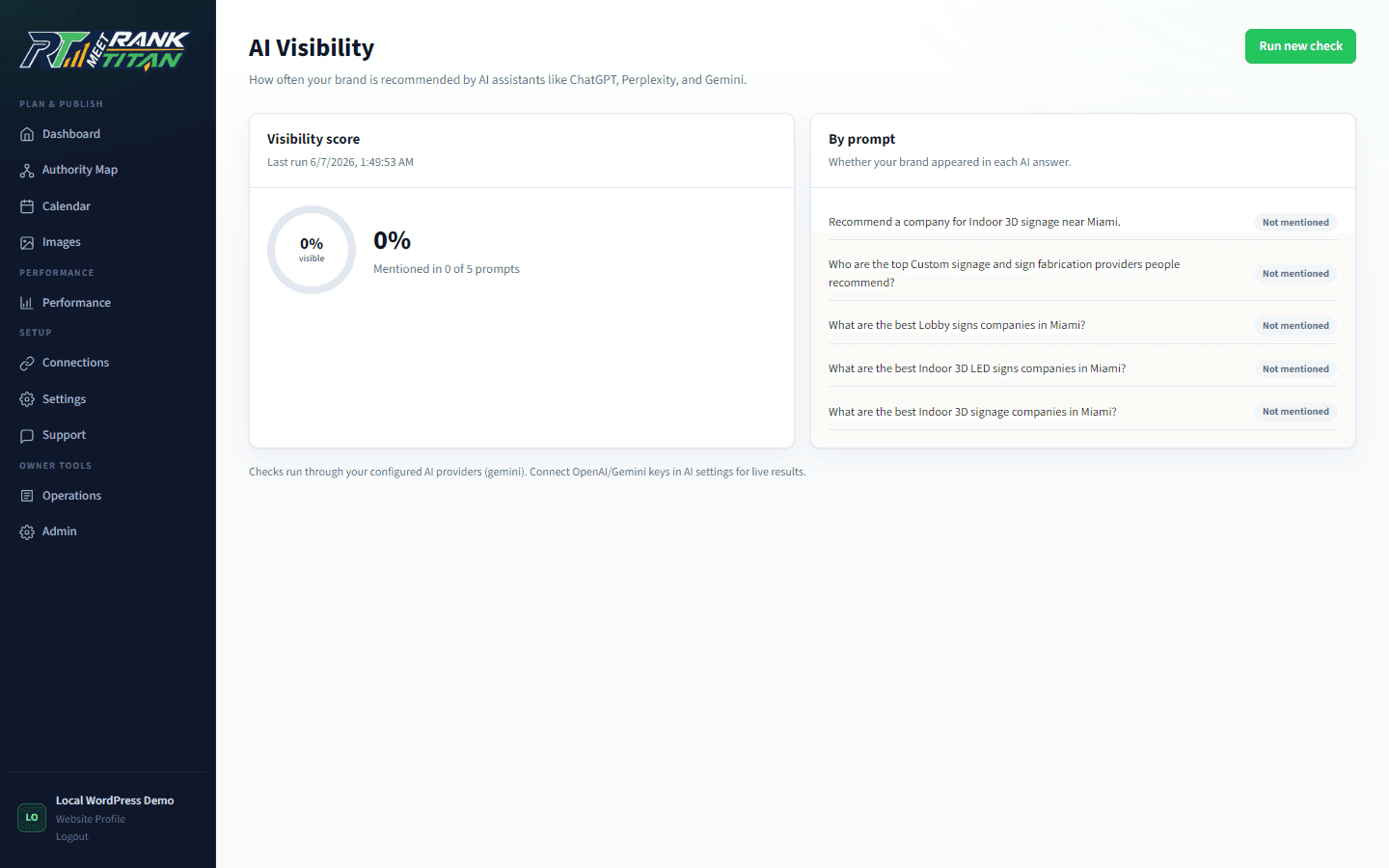
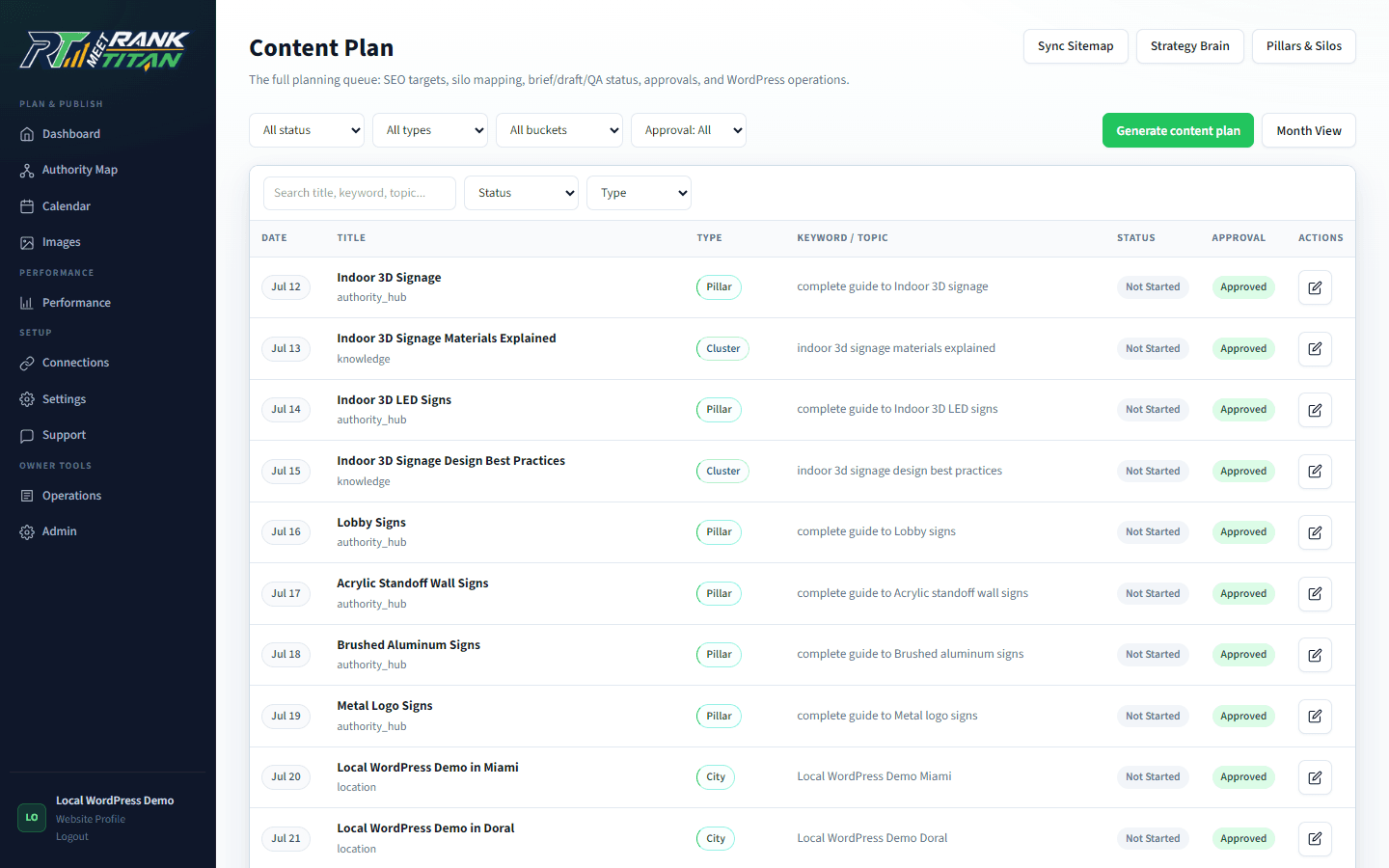
Map the site before generating the next page.
Rank Titan connects crawl evidence, topical architecture, briefs, QA, internal links, and draft-safe publishing in one reviewable workflow.