
How to run an AI search visibility audit you can repeat
An AI visibility audit should be a dated, reproducible evidence set. It defines the buyer questions in scope, captures answers and sources under known conditions, separates the different kinds of visibility, links gaps to owned pages, and states what the audit cannot prove.
What should an AI visibility audit answer?
The audit should show where the brand is mentioned, recommended, cited, described accurately, or displaced by competitors for a defined set of buyer prompts and platforms. It should also identify the cited sources and the page, entity, evidence, or distribution action most likely to address each material gap.
Write the scope before running prompts: brand and aliases, products or services, markets and locations, buyer stages, competitors, platforms, languages, devices or account conditions, sampling dates, and exclusions. Otherwise a headline percentage can change simply because the question set changed.
The result is a baseline, not a causal experiment. It tells you what selected systems returned under recorded conditions. It cannot prove how every user is answered or guarantee that a content change caused a later difference.
How should audit prompts be selected and owned?
Build prompt families from buyer research and commercial decisions, then map each family to an existing canonical page, a documented content gap, or a third-party evidence need. Separate branded accuracy prompts from non-brand discovery prompts so the brand name in the question does not inflate visibility.
- Category: best or recommended providers for a defined audience, location, budget, or constraint.
- Problem: how to solve a specific job before the buyer knows a product category.
- Comparison: brand versus competitor, method versus alternative, or product-class tradeoffs.
- Trust: safety, qualifications, proof, reviews, integrations, limitations, and who the offer is or is not for.
- Local: provider, service, neighborhood, city, availability, and location-specific selection factors.
- Branded: what the company does, pricing or plan facts, capabilities, policies, and common misconceptions.
What data should be captured for every answer?
Retain the exact prompt and full answer with timestamp, provider, model or surface, locale, run number, brand mention, recommendation position, cited URLs, cited page ownership, competitors, accuracy, framing, and reviewer notes. Store raw observations before calculating aggregate scores.
Mention, citation, and recommendation are separate boolean or categorical fields. A cited URL should be normalized so variants do not split the same page, and a citation should be labeled owned, earned third-party, directory, review, community, news, or another useful source class.
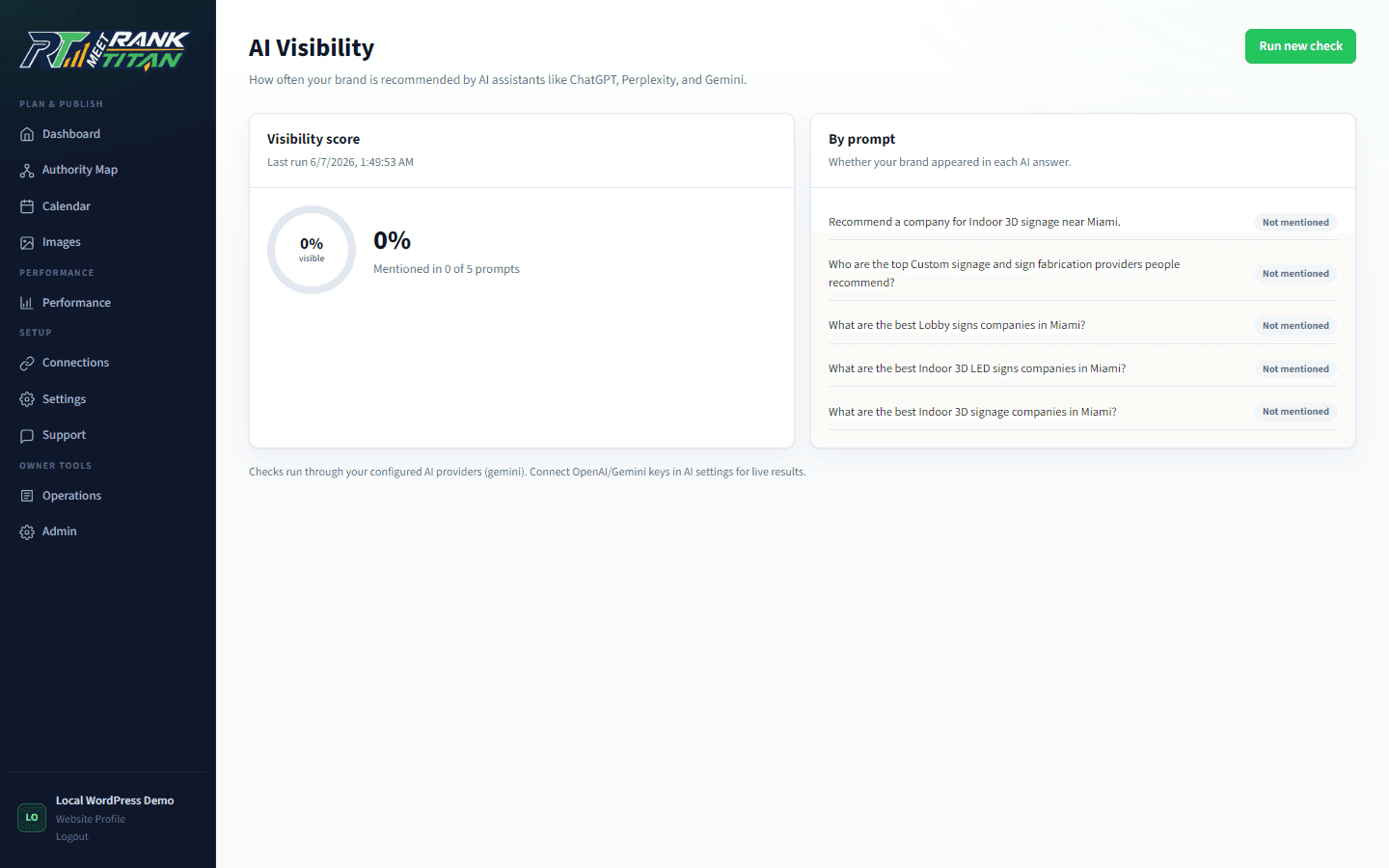
Rank Titan's current data model retains prompt, provider, model, answer, mention, position, score, raw provider data, and time. A complete cross-platform audit should extend that evidence with cited URLs, competitor records, accuracy review, run conditions, and repeat number.
How many prompts and repeat runs are enough?
There is no universal sample size. Use enough prompts to represent the decisions that matter, then repeat a stable subset to expose answer variability. Report the exact sample, coverage, and confidence limits instead of describing a small convenience set as total market visibility.
A focused first baseline might cover a few high-value prompts in each relevant family, while a multi-location or multi-product business needs stratified sets. Remove accidental near-duplicates from aggregate reporting, but preserve variants when wording itself is the test.
Repeat runs are especially important for prompts that trigger major content investment or executive claims. Compare changes only when the prompt family, provider or surface, location, and sampling method are reasonably consistent. Model updates and retrieval changes still make the result observational.
How do you prioritize audit findings?
Prioritize by buyer value, evidence strength, page ownership, gap severity, feasibility, and the cost of being wrong. The action should name the target page or source, the required proof, the responsible owner, the approval boundary, and the prompt set that will be re-tested.
- Correct material inaccuracies across owned pages and important public profiles first.
- Improve an existing canonical owner before creating a near-duplicate page for the same intent.
- Create distinct comparison, methodology, research, integration, location, or FAQ pages only when they serve an unmet audience task.
- Strengthen first-party proof with screenshots, documentation, authorship, dates, examples, data, and transparent limitations.
- Pursue legitimate third-party coverage where cited sources show that independent evidence shapes the answer.
- Record no action when a finding is low-value, anomalous, outside scope, or unsupported by repeat observations.
What should the final AI visibility audit report contain?
Deliver an executive summary, scope and method, prompt inventory, raw observation log, metric definitions, findings by prompt family and platform, cited-source analysis, competitor comparison, accuracy risks, owner-page map, prioritized action register, limitations, and re-test schedule.
Every chart should lead back to inspectable records. Show denominators with percentages, keep branded and non-brand visibility separate, and avoid mixing mentions with citations. If a provider credential was absent, a run used mock data, or a platform was not tested, label the gap prominently.
Close the loop after approved releases. Verify the exact public route, crawl and sitemap discovery, index state, analytics annotation, and then re-run the stable prompt subset. Keep implemented, deployed, indexed, ranking, converting, mentioned, and cited as independent statuses.
Weak snapshot versus reproducible AI visibility audit
| Audit choice | Weak snapshot | Reproducible audit |
|---|---|---|
| Prompt set | A few improvised questions | Versioned families tied to buyer tasks and owner pages |
| Evidence | Screenshots and a total score | Exact prompts, answers, citations, providers, models, dates, and run numbers |
| Metrics | Mentions and citations blended | Mention, recommendation, citation, competitor, accuracy, and traffic separated |
| Sampling | One answer per prompt | Repeated stable subset with method and variability disclosed |
| Action | Publish more content | Named page, proof, source, owner, approval, and re-test |
| Claim | How AI sees the brand | What selected systems returned under recorded conditions |
Implementation checklist
- Freeze the brand, market, competitor, platform, prompt-family, date, and locale scope.
- Separate branded accuracy prompts from non-brand discovery prompts.
- Map every prompt family to a canonical owner, explicit content gap, or source need.
- Capture full answers, mentions, positions, citations, competitors, accuracy, and run conditions.
- Repeat the highest-value prompts and retain the raw observation log.
- Report denominators, platform coverage, variability, credentials, and limitations.
- Prioritize bounded actions with evidence, owners, approval gates, and target routes.
- Verify approved releases and re-test the unchanged baseline set on schedule.
Frequently asked questions
Can I run an AI visibility audit manually?
Yes. A spreadsheet can support a small baseline if it retains exact prompts, answers, sources, conditions, and repeat runs. Automation becomes useful as the set, platforms, locations, or reporting cadence grows.
Should branded prompts count in the visibility score?
Track them for factual accuracy, but report them separately from non-brand discovery. Naming the brand in the question makes mention much easier and can distort a combined score.
How often should AI visibility be audited?
Run a baseline before meaningful changes, re-test after releases have had a reasonable discovery window, and use a stable recurring cadence for important prompts. Avoid reacting to every isolated answer.
Does a citation prove the cited page is correct?
No. It proves that the answer referenced a source in that observation. Review whether the source supports the claim, whether the page is accurate, and whether the citation is relevant to the buyer's task.
Primary sources and further reading
See the Rank Titan tools used in this workflow
These are current captures from the working Rank Titan application—not conceptual dashboard mockups.
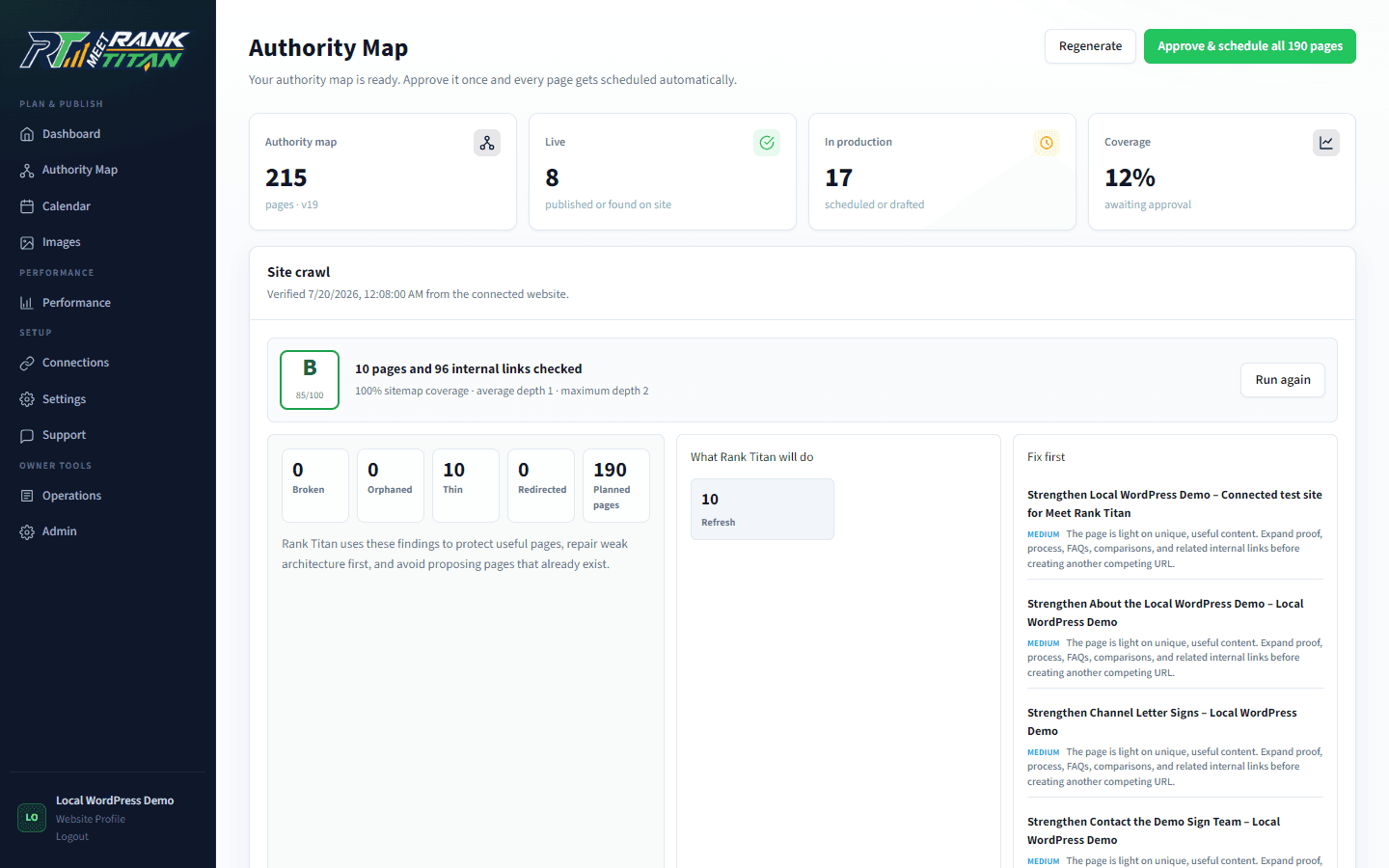
Map the site before generating the next page.
Rank Titan connects crawl evidence, topical architecture, briefs, QA, internal links, and draft-safe publishing in one reviewable workflow.