
The AI SEO workflow from site evidence to measured release
A useful AI SEO workflow does not begin with a writing prompt or end with a publish button. It turns real site and business evidence into an approved page decision, carries a complete package through controlled production, proves the destination result, and measures what happens afterward.
Stage 1: establish source truth and operating boundaries
Record the business, products or services, audiences, locations, processes, differentiators, conversion paths, approved proof, tone, authorship, regulated or time-sensitive facts, forbidden claims, destination permissions, analytics access, and the people responsible for strategy, facts, editorial quality, publishing, and outcomes.
AI can make plausible gaps look complete. The source-of-truth profile must therefore distinguish known facts, approved sources, assumptions that need review, and claims that must never be invented. An empty proof field is a blocker or research task—not permission to create a testimonial, local project, statistic, or integration claim.
Set automation mode and approval rules before content enters the queue. Read-only crawling and deterministic QA have lower risk than live updates. Service pages, regulated topics, builder-managed content, and direct publishing generally need stronger gates than a routine draft.
Stage 2: crawl and classify the current site
Inventory every discoverable and submitted URL with status, indexability, canonical, title, description, H1, page type, topic, structured data, depth, internal links, media, freshness, and available search or conversion evidence. Normalize duplicates and identify technical blocks before proposing new pages.
- Confirm the canonical host, redirect behavior, robots policy, sitemap, and accidental indexable environments.
- Classify commercial owners, pillars, support pages, locations, comparisons, utilities, legal pages, and irrelevant or private routes.
- Find broken links, redirect chains, missing metadata, thin pages, orphans, weak owners, duplicate variants, and unsupported schema.
- Retain raw crawl evidence and retrieval dates so later recommendations can be traced to the state that produced them.
- Separate a technical defect, content gap, link gap, evidence gap, measurement gap, and new-page opportunity.
Stage 3: map opportunities, owners, and dependencies
Group real query and audience tasks, compare current result formats, assign one canonical owner to each primary intent family, map pillars and focused support pages, specify commercial and conversion owners, record exclusions, and choose create, refresh, consolidate, link, measure, or no action. Approve the architecture before scheduling production.
A keyword cluster is not yet a page plan. The same vocabulary can support a definition, procedure, comparison, template, risk guide, local page, and product owner. Conversely, several wording variants may need one strong page. The decision belongs in a URL ownership matrix with clear intent boundaries.
Dependencies shape order. Fix canonical and crawl blocks before measuring content; strengthen a service owner before creating city and guide support; publish a pillar before orphaned spokes; obtain proof before briefing a high-risk claim.
Stage 4: assemble the brief and draft package
Create a versioned brief with purpose, intent, audience task, page role, required sections and entities, decisions, proof, sources, hard vetoes, internal links, schema and image directions, CTA, destination constraints, and acceptance criteria. Generate the draft only after the plan or brief receives the required approval.
The draft package should contain visible content, metadata, suggested slug, canonical and robots intent, structured data, media and alt text, internal links, source records, model and prompt-package provenance where retained, and revision history. Keep the brief separate so reviewers can see whether a change affects strategy or prose.
AI is most useful here for assembling context, exploring structures, drafting from known inputs, checking package completeness, and preparing alternate wording. It should not decide whether an unsupported claim is true or whether a consequential live page may be replaced.
Stage 5: review, QA, and deliver safely
Run factual, editorial, SEO, accessibility, originality, evidence, internal-link, metadata, schema, image, conversion, and risk checks. Record required fixes and approval. Deliver through a destination-aware, permission-limited path and verify both the CMS record and the exact rendered route.
- Facts: approved claims, sources, dates, calculations, local coverage, product behavior, and prohibited language.
- Page quality: direct answer, task completion, unique value, structure, examples, clarity, sources, and conversion fit.
- Search: owner alignment, title, description, H1, canonical, robots, schema, internal links, images, alt text, and crawl path.
- Destination: authentication, post type, author, status, schedule, editor or builder, SEO adapter, media permission, idempotency, and rollback reference.
- Rendered proof: status, visible content, responsive layout, links, images, structured data parsing, console behavior, sitemap entry, and no accidental private data.
Stage 6: measure discovery, outcomes, and maintenance
Annotate the live release, then track deployment, crawl discovery, indexation, owner-query impressions, clicks, qualified sessions, conversions, internal-link contribution, AI mentions or citations, and maintenance needs separately. Feed evidence back into the map as refresh, consolidate, link, expand, or no-action decisions.
A page can be implemented locally but not deployed, live but noindexed, indexed but not visible for the intended query, visible but attracting the wrong audience, or useful without owning the last-click conversion. Status precision prevents reports from assigning outcomes to work that has not reached the required state.
Set review windows based on business and content risk rather than publishing volume. Update time-sensitive facts, retire obsolete pages, repair broken evidence and links, and review clusters as systems so a new page does not recreate ownership conflicts.
Prompt-to-publish versus controlled AI SEO workflow
| Stage | Prompt-to-publish | Controlled workflow |
|---|---|---|
| Input | Keyword and prompt | Business truth, crawl, owners, evidence, links, and destination rules |
| Decision | Generate a page | Create, refresh, consolidate, link, measure, block, or no action |
| Output | Article body | Brief, content, metadata, schema, media, links, sources, QA, and destination package |
| Approval | Optional edit | Separate strategy, factual, editorial, risk, and publication gates |
| Publishing | Generic CMS action | Authenticated, permission-limited, destination-aware, idempotent delivery |
| Completion | Post created | Rendered route verified, then discovery, index, visibility, conversion, and upkeep measured |
Implementation checklist
- Establish site-specific facts, proof, prohibitions, owners, destination rules, and measurement access.
- Crawl and classify the real site before creating a keyword or content backlog.
- Assign canonical owners and choose create, refresh, consolidate, link, measure, block, or no action.
- Approve dependencies and architecture before scheduling briefs and drafts.
- Move the brief, content, metadata, schema, media, links, sources, and QA as one package.
- Keep consequential claims and live actions behind named human approvals.
- Verify the connector or CMS record and the exact rendered route after delivery.
- Track live, indexed, visible, converting, cited, maintained, and retired as separate states.
Frequently asked questions
What is the first step in an AI SEO workflow?
Establish business and site source truth, risk boundaries, owners, and measurement access. A keyword prompt is not enough context for a safe page decision.
Where should AI be used in the workflow?
Use it to accelerate evidence classification, opportunity analysis, brief assembly, drafting from approved inputs, package checks, and bounded QA. Keep strategy, truth, risky claims, and publication accountable to people.
When is an AI SEO page complete?
The production package may be complete before delivery. The page is live only after deployment and rendered verification; discovery, indexing, rankings, conversions, and citations are later evidence states.
Can Rank Titan run this workflow?
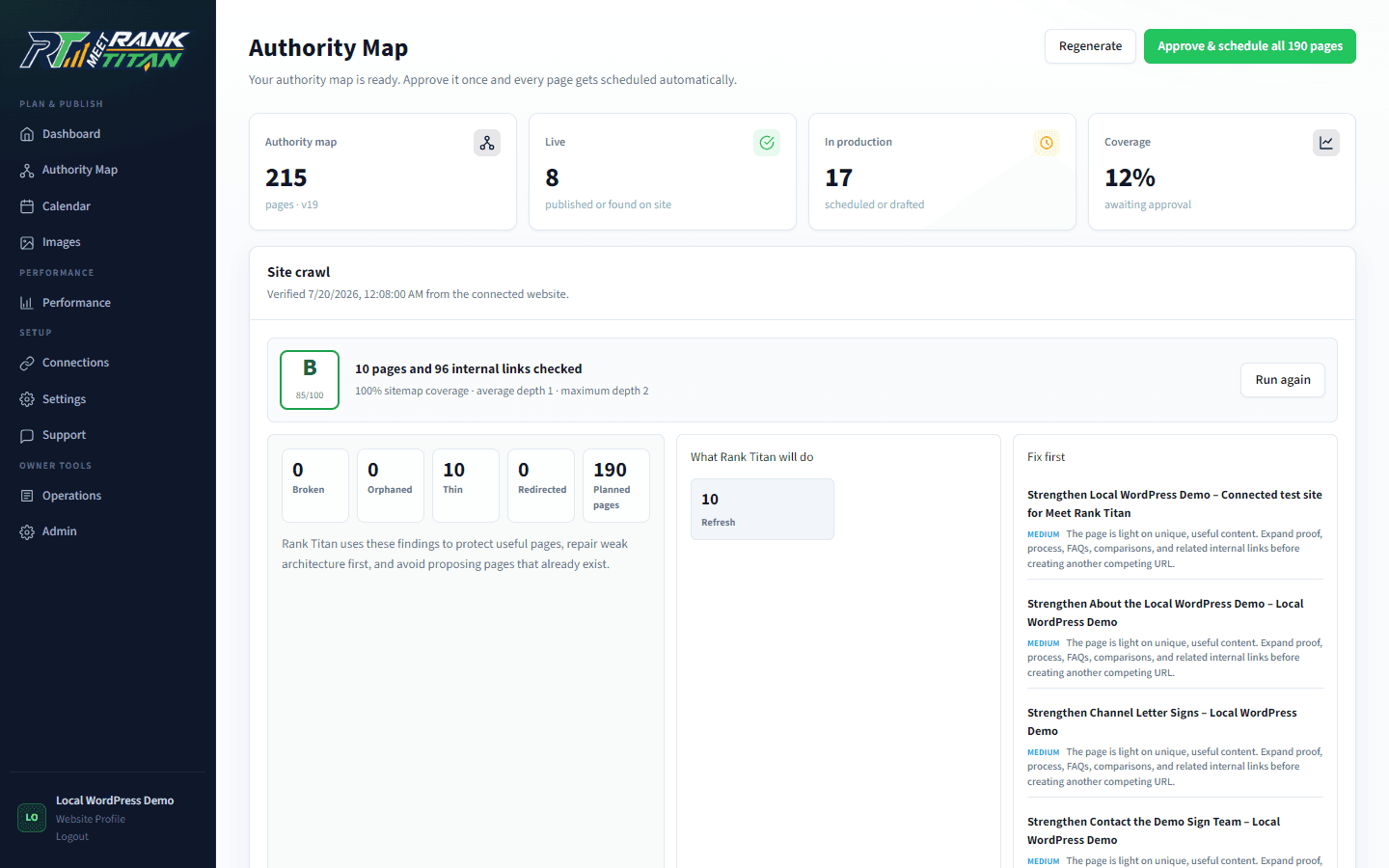
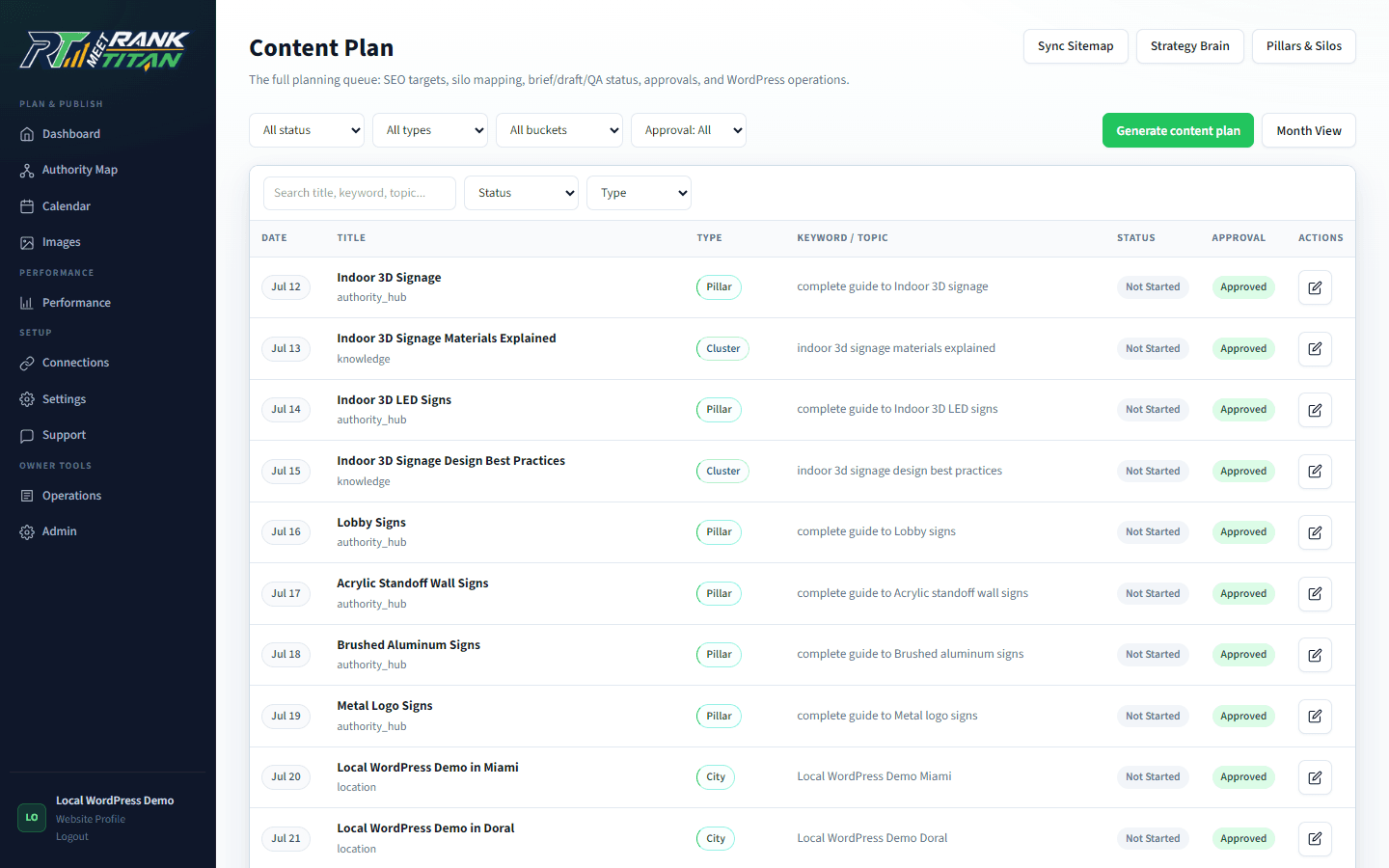
Rank Titan connects site crawl, Authority Map, plan approval, briefs, drafts, QA, links, images, destination settings, WordPress delivery, and measurement integrations while keeping distinct approval and result states.
Primary sources and further reading
See the Rank Titan tools used in this workflow
These are current captures from the working Rank Titan application—not conceptual dashboard mockups.
Map the site before generating the next page.
Rank Titan connects crawl evidence, topical architecture, briefs, QA, internal links, and draft-safe publishing in one reviewable workflow.