
How to automate SEO without scaling AI spam
The safe dividing line is not whether AI touched the page. It is whether automation helps create accurate, original, useful work for a real audience—or removes the decisions and effort that give a page value. Safe scale requires evidence, page ownership, accountable review, controlled release, and a willingness not to publish.
Does Google ban AI-generated SEO content?
Google's current guidance does not ban content because generative AI was used. It emphasizes accurate, high-quality, relevant, people-first work and warns that producing many pages without added value can violate scaled content abuse policies. The workflow and resulting value matter more than the tool label.
Automation has legitimate uses in research, classification, structure, metadata, accessibility support, and drafting. Risk rises when the system invents facts, paraphrases existing results, manufactures thousands of query variants, hides authorship or purpose, or publishes without audience value and accountable review.
Do not use AI detectors or a 'humanizer' as the safety model. A page can sound human and still be false, duplicative, irrelevant, or spammy. Test the page's purpose, evidence, unique contribution, ownership, usability, and release controls directly.
Which SEO tasks are safest to automate first?
Begin with read-only evidence collection and deterministic checks: crawl inventory, status and canonical validation, metadata completeness, schema parsing, broken-link detection, page-type classification, internal-link graphs, source retention, package completeness, and change reporting. Add generative and live-write actions only after reliable gates exist.
- Low risk: crawl, normalize, classify, compare, flag, extract, validate, and report without changing the live site.
- Moderate risk: suggest keyword groups, intent, owners, outlines, metadata, link targets, image descriptions, and draft alternatives for review.
- Higher risk: generate complete pages, factual summaries, regulated or local claims, structured data, media, or edits to established owners.
- Highest risk: automatic publication, destructive consolidation, redirects, canonical changes, builder overwrites, bulk local pages, and external distribution.
- Escalate controls with risk instead of applying one approval setting to every action.
Which gates prevent low-value automated pages?
Require a real audience task, current-site check, canonical owner, distinct intent, approved evidence, useful page brief, explicit exclusions, internal-link plan, conversion path, factual and editorial review, technical package QA, destination approval, and rendered verification. A failed gate should block or reroute the item, not lower a score and publish anyway.
The create-versus-improve gate is especially important. Many apparent keyword gaps belong as sections, updates, links, consolidations, or no action. A system that can only respond by generating another URL will scale overlap and maintenance debt.
Use hard vetoes for invented reviews, awards, statistics, physical locations, projects, customers, prices, licenses, guarantees, integrations, quotes, and product behavior. Missing proof should remain visibly missing until a responsible person supplies or approves it.
How do you add value beyond summarizing search results?
Ground pages in first-party expertise, actual product or service details, original examples, process, screenshots, data, tools, decision frameworks, limitations, comparisons, local evidence, or analysis that helps the audience complete a task. Sources support facts; they do not replace a reason for the page to exist.
- Use real product captures and explain the exact workflow or limitation visible in them.
- Add approved cases, examples, calculations, templates, checklists, methods, or data the reader can apply.
- State boundaries, uncertainty, prerequisites, tradeoffs, and who should not use the approach.
- Connect the answer to the site's broader architecture so the reader can reach deeper context and an appropriate next step.
- Refresh or retire pages whose unique value disappears instead of preserving them for publication count.
Which scaled patterns should trigger a stop rule?
Stop or require escalation when proposed pages differ mainly by keyword, city, product, competitor, or question substitutions; when evidence and owner URLs are missing; when several briefs share the same expected answer; when review capacity is exceeded; or when live defects and low-value outcomes accumulate faster than the team can correct them.
Local and comparison programs need special care. A city page must reflect a real served location and distinct local usefulness; a competitor page needs current first-party verification and neutral fit criteria. Neither should be produced from a variable list alone.
Set quantitative operational stop rules even when outcome thresholds are not yet known: maximum unreviewed queue, maximum consecutive QA failures, zero tolerance for prohibited claims or credential leakage, publication disabled after repeated connector defects, and expansion paused when the ownership matrix is incomplete.
How do you prove the automation is useful rather than merely active?
Track package completeness, factual and QA failures, revision rate, blocked unsafe actions, publish errors, rendered defects, rollback events, cycle time, and maintenance load alongside discovery, indexation, query visibility, qualified traffic, conversions, and AI mentions or citations. Volume alone is not an outcome.
Label the actual state of every item. A generated draft is not implemented, a merged branch is not deployed, a live page is not necessarily indexed, and an indexed page can still be unhelpful. These distinctions prevent automated dashboards from rewarding work that never reached or benefited the audience.
Review results by owner page and cluster, not only by article count. Consolidate conflicting pages, strengthen weak commercial owners, improve link paths, correct facts, and pause content types whose evidence or conversion value does not justify continued scale.
High-risk AI content scale versus governed SEO automation
| Control | High-risk scale | Governed automation |
|---|---|---|
| Trigger | Keyword or schedule | Audience task, site gap, owner decision, evidence, and dependency |
| Page threshold | A variation can be generated | Distinct useful answer and supportable proof justify a URL |
| Inputs | Prompt and ranking summaries | Approved business truth, sources, current pages, links, proof, and vetoes |
| Review | Readability or detector score | Factual, editorial, SEO, evidence, risk, destination, and rendered gates |
| Publishing | Automatic by default | Permission-limited, draft-safe, reversible, and blocked on failed gates |
| Success | Pages or words published | Useful discovery, qualified outcomes, low defects, and maintainable ownership |
Implementation checklist
- Begin with read-only crawl, classification, extraction, validation, and reporting tasks.
- Define source truth, approved evidence, forbidden claims, owners, risk tiers, and publication permissions.
- Require a distinct audience task and canonical owner before a proposed page enters briefing.
- Choose refresh, consolidate, link, measure, block, or no action when a new URL is not justified.
- Add first-party expertise, examples, screenshots, data, methods, limitations, or tools beyond summaries.
- Block failed factual, evidence, duplication, QA, security, destination, or rendered checks.
- Set stop rules for queue growth, repeated failures, unsupported patterns, and review-capacity limits.
- Measure defects, maintenance, discovery, qualified traffic, conversions, and citations—not output volume alone.
Frequently asked questions
Is all AI SEO content spam?
No. Google focuses on usefulness, quality, accuracy, and policy compliance. AI can assist a responsible workflow; low-value scaled production is risky regardless of the specific tool.
Can AI SEO automation be fully hands-off?
Low-risk evidence and validation tasks can be highly automated. Strategy, proof, consequential claims, destructive changes, and live publication need accountable controls and often human approval.
How many AI-generated pages are safe to publish?
There is no universal safe count. Publish only pages with distinct audience value, evidence, ownership, quality, and maintenance capacity. A small set can be spammy; a large useful library can be legitimate.
What is the most important anti-spam control?
The ability to decide not to create a URL. Requiring a distinct owner and audience task prevents automation from converting every keyword variation into a page.
Primary sources and further reading
See the Rank Titan tools used in this workflow
These are current captures from the working Rank Titan application—not conceptual dashboard mockups.
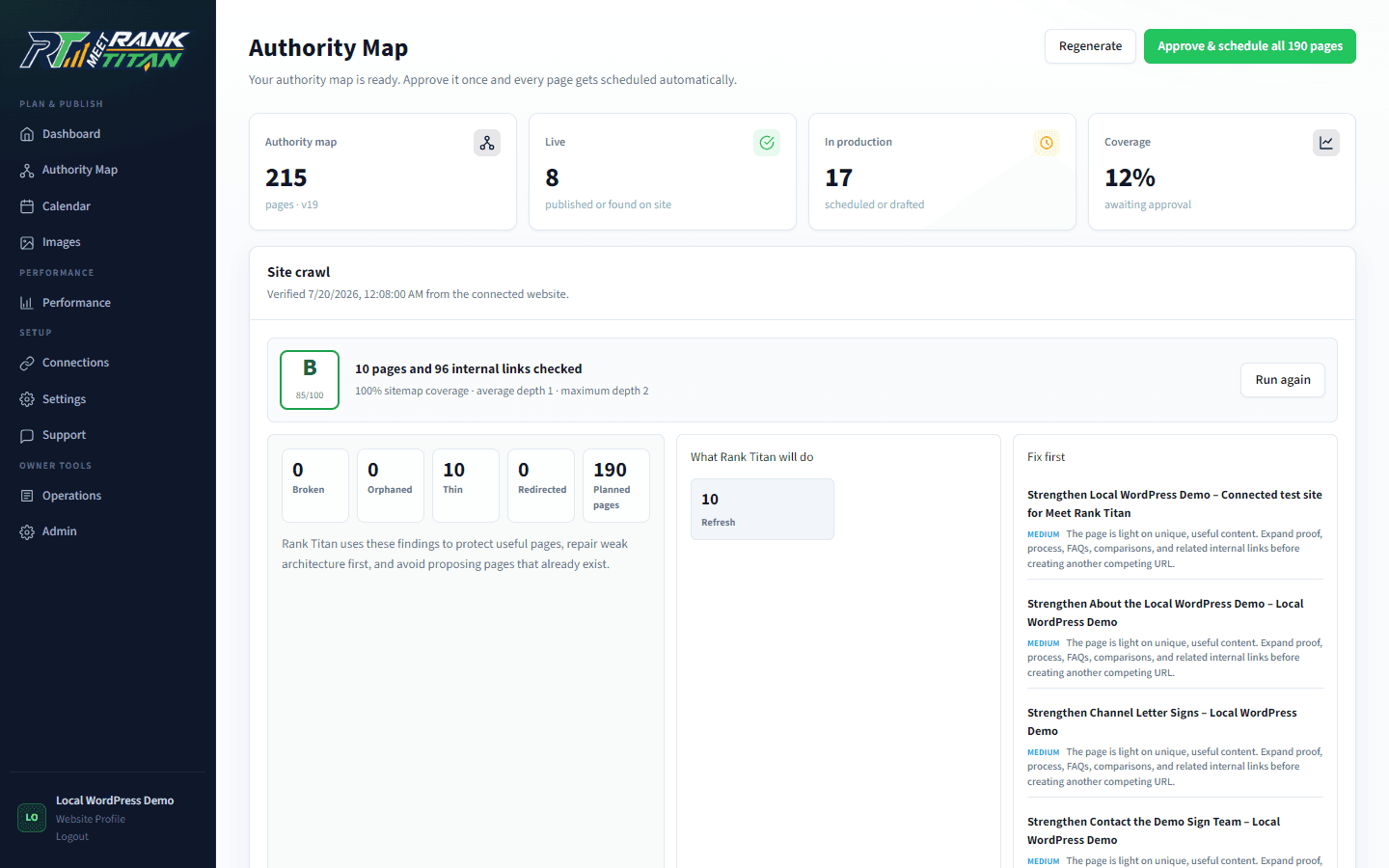
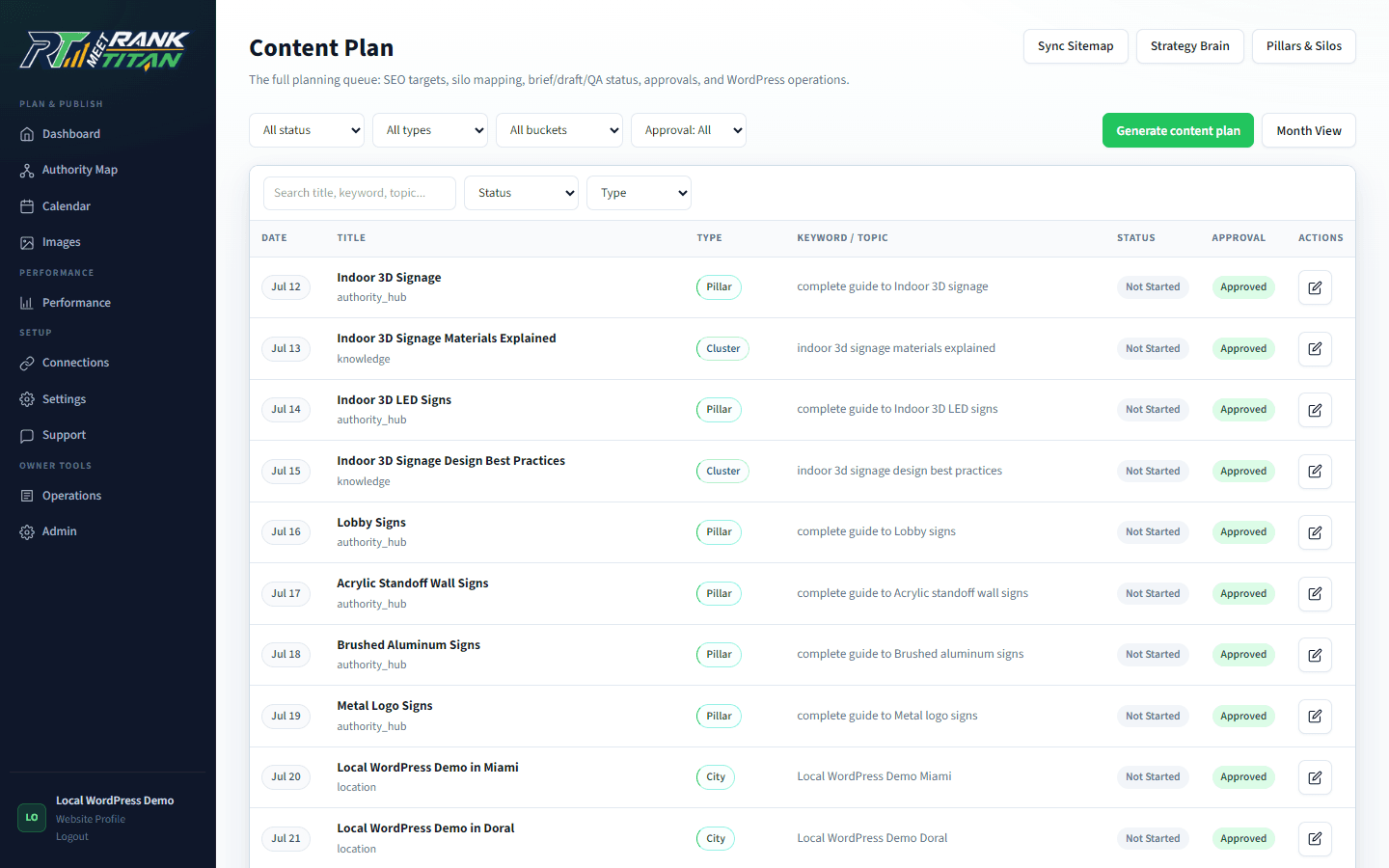
Map the site before generating the next page.
Rank Titan connects crawl evidence, topical architecture, briefs, QA, internal links, and draft-safe publishing in one reviewable workflow.