
How to avoid doorway pages in a scalable local SEO program
Doorway risk is not solved by making every generated page longer. A scalable local program needs a reason for each URL, accurate market coverage, material local usefulness, a distinct audience task, and a clear destination—not a collection of near-identical search entrances.
What is doorway abuse?
Google describes doorway abuse as sites or pages created to rank for specific, similar queries that lead users to intermediate pages that are less useful than the final destination. Local risk often appears as many city, region, or service-location pages that are substantially interchangeable or funnel users to the same generic answer.
A local landing page is not automatically a doorway page. The question is whether it serves a distinct user need with accurate, useful information and a real conversion path. Several pages can share a design system while still providing different value; several long pages can still be doorways if their purpose and substance are the same.
The review must consider the whole set. A page may look acceptable alone but become clearly repetitive when compared with twenty siblings that replace the place name, metadata, and a few sentences.
Which signals indicate doorway-page risk?
Risk rises when many URLs target slight query variants, repeat the same sections and claims, imply locations the business does not have, lack local proof or decisions, compete for the same intent, receive little meaningful navigation, and send everyone to the same generic destination.
- City names, headings, titles, metadata, or hero images are the main differences across pages.
- The business cannot state how coverage, availability, process, proof, or buyer decisions differ by market.
- Every page implies a local office, team, project, review, or address that cannot be verified.
- Several service, city, and regional URLs answer the same task without a documented canonical owner.
- Pages are reachable only through sitemap submission, a dense city footer, or search results—not useful site navigation.
- The CTA immediately routes to a generic service or lead form because the local page adds no decision value.
How do you audit an existing set of local pages?
Inventory every indexable local URL, classify its role, normalize its target service and location, compare content and headings across siblings, verify business coverage and proof, map internal links, inspect performance and conversion evidence, and assign a keep, improve, consolidate, redirect, noindex, or remove decision with an owner.
Do not use a word-count threshold as the verdict. Compare the purpose, facts, examples, entities, internal links, CTA, and user decisions. Identify pages whose only unique tokens are place names and pages that compete with a stronger service or regional owner.
Preserve evidence before changing live URLs: crawl data, analytics and Search Console data where available, inbound links, conversion records, current canonicals, redirects, and screenshots. A low-traffic page can still support navigation or a local audience, while a ranking page can still be misleading or low quality.
Should a risky local page be improved, consolidated, redirected, or removed?
Improve it when a real distinct local task and evidence exist. Consolidate near-duplicates into the strongest owner when one page can answer the audience well. Redirect retired URLs to a genuinely equivalent destination. Remove or noindex only with a documented purpose and an understanding of links, navigation, and search history.
- Keep: distinct task, accurate coverage, meaningful local value, useful links, conversion path, and maintenance owner.
- Improve: legitimate market and intent exist, but evidence, structure, links, accuracy, or conversion detail is incomplete.
- Consolidate: several pages answer the same job and one comprehensive owner will serve users better.
- Redirect: the old URL has a clear equivalent successor; avoid sending every retired city page to the homepage.
- Remove or noindex: the page has no durable user-facing search role, but first repair internal links, sitemaps, and navigation.
- Block publication: proposed page lacks a real target location, distinct intent, approved proof, or safe ownership.
How can local content be scaled without scaling doorway risk?
Scale the evidence and decision workflow before scaling page output. Require real service and location inputs, owner checks, brief fields, hard vetoes, local uniqueness review, staged batches, factual approval, rendered QA, and post-release measurement. Stop expansion when the evidence cannot support another distinct page.
Rank Titan's current rules require a real target location for city pages, prohibit fake offices, local projects, reviews, ratings, and physical presence, link the page to its core service, and expose the approval state before generation and publishing. These controls reduce risk only when responsible users review the actual outputs.
Begin with a small set representing different page roles and markets. Review them side by side, not one at a time. A reusable structure is acceptable; interchangeable substance is not. Keep an explicit stop rule for combinations that lack evidence or cannibalize a current owner.
What should be verified after local-page cleanup?
Re-crawl the site and confirm status codes, redirects, canonicals, robots rules, sitemap entries, titles, H1s, schema, links, images, mobile layout, and conversion paths. Then use first-party search and analytics data to watch owner-page queries, index state, qualified visits, conversions, and unexpected losses.
Keep implementation, deployment, discovery, indexation, ranking, conversion, and maintenance separate. A redirect committed in code is not a live redirect; a submitted sitemap is not proof of indexing; and a traffic increase does not validate a misleading location claim.
Annotate the release and retain the prior URL map. If consolidation produces unexpected behavior, the team needs a clear record of the old owners, new destinations, links changed, and verification dates.
Legitimate local owner versus doorway page
| Test | Legitimate local owner | Doorway risk |
|---|---|---|
| Audience task | Distinct and stated | A slight query variation |
| Coverage | Real physical location or service area described accurately | Presence is vague, exaggerated, or fabricated |
| Substance | Local decisions, boundaries, proof, process, and service depth | Place-name swaps and repeated claims |
| Site role | Connected to service, location, guides, and conversion | An intermediate search entrance to the same destination |
| Ownership | No conflicting canonical page | Multiple regional, city, and service pages answer the same job |
| Maintenance | Facts and performance have an accountable owner | Pages remain because they were generated |
Implementation checklist
- Inventory all local URLs and normalize their service, location, intent, status, and owner.
- Compare sibling pages for repeated headings, claims, examples, links, media, and CTA paths.
- Verify every physical location, service area, project, review, image, credential, and availability claim.
- Test whether each page helps after the city name and metadata are removed.
- Choose keep, improve, consolidate, redirect, noindex, remove, or block with written reasoning.
- Preserve crawl, link, query, conversion, and URL-map evidence before live changes.
- Update navigation, internal links, canonicals, redirects, structured data, and sitemap together.
- Re-crawl after deployment and monitor discovery, indexing, owner queries, conversions, and maintenance.
Frequently asked questions
Are all city pages doorway pages?
No. A city page can be a legitimate owner when it serves a distinct local task with accurate coverage, meaningful information, proof, navigation, and a clear conversion path.
Does adding more words prevent doorway risk?
No. Longer repeated or fabricated content can still be low value. The page needs distinct purpose, substance, evidence, and ownership—not a length threshold.
Should duplicate city pages be redirected to the homepage?
Usually only redirect when there is a genuinely equivalent successor. A relevant service, regional, or consolidated location page may be appropriate; the homepage should not be a catch-all without a real match.
Can AI safely scale local landing pages?
AI can help assemble briefs and drafts from approved inputs, but real location coverage, proof, uniqueness, ownership, consequential claims, and publication require accountable review.
Primary sources and further reading
See the Rank Titan tools used in this workflow
These are current captures from the working Rank Titan application—not conceptual dashboard mockups.
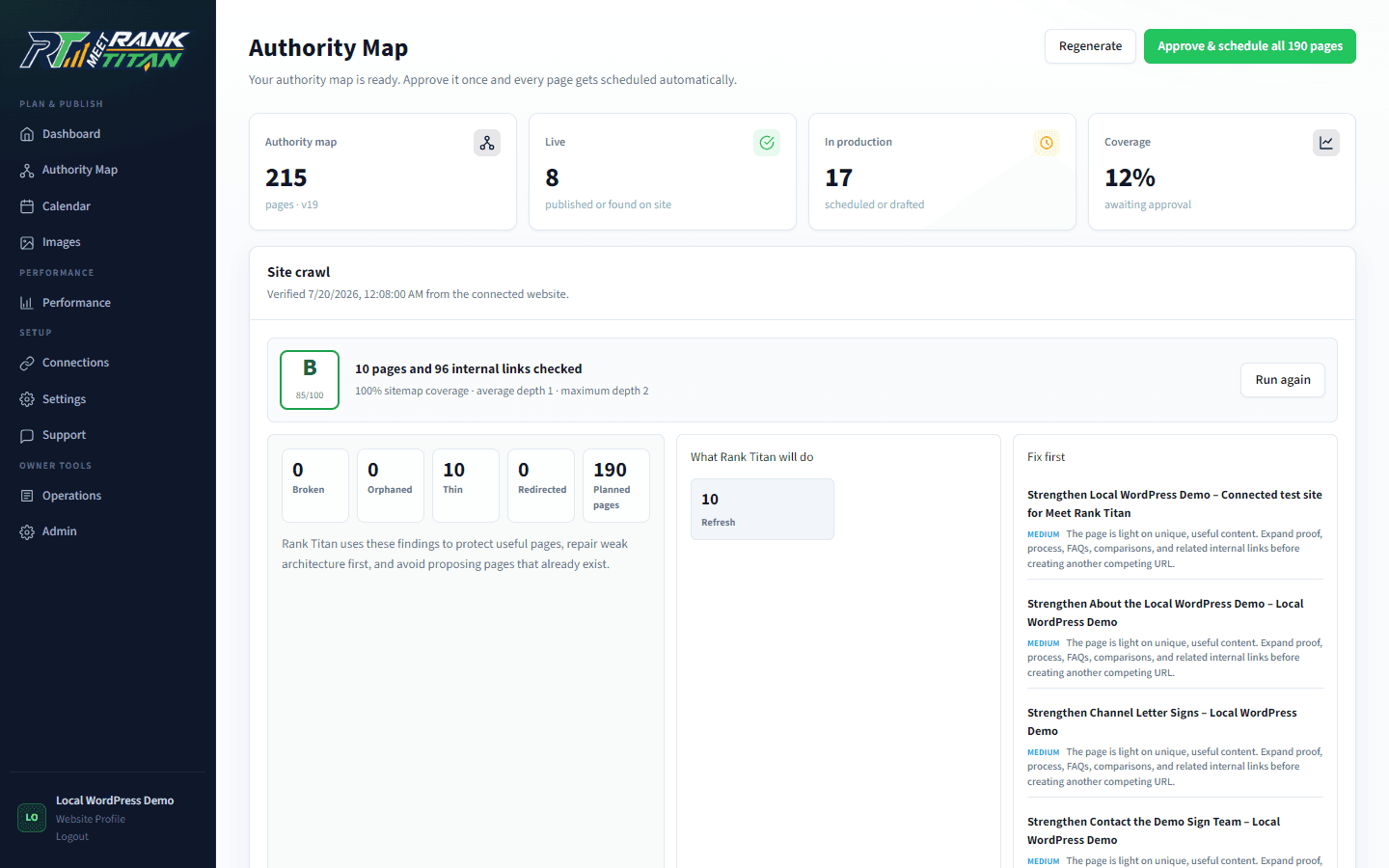
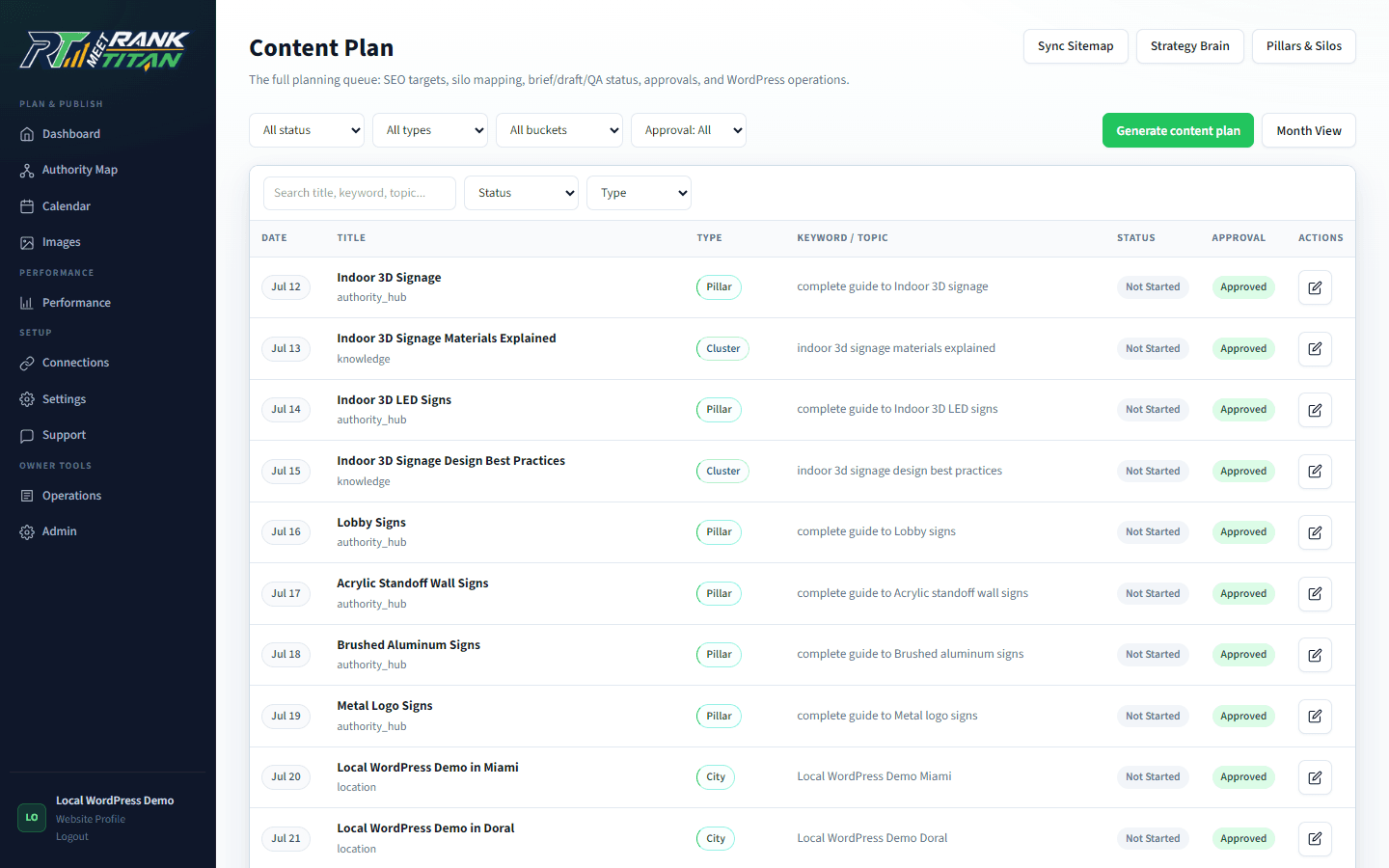
Map the site before generating the next page.
Rank Titan connects crawl evidence, topical architecture, briefs, QA, internal links, and draft-safe publishing in one reviewable workflow.