
Internal linking for local SEO: build and audit the real graph
Local internal linking should help a customer move among the service, place, evidence, decision, and conversion pages that belong together. It should also give crawlers a clear path to every important canonical owner without relying on footer grids or mechanical exact-match anchors.
What should be inventoried before changing local links?
Crawl the canonical site and classify core services, locations, service areas, service-location pages, supporting guides, conversion destinations, redirects, canonicals, status codes, inbound links, outbound links, and crawl depth before adding or removing links.
The inventory prevents a common mistake: building links to proposed URLs while ignoring a stronger existing owner. Normalize alternate hosts, parameters, trailing-slash variants, redirects, and canonicals so one page is not counted as several destinations.
Add business context to the graph. A technically valid link can still be misleading if it sends a reader from a city page to a service the business does not provide there.
Which link directions belong in a local cluster?
Use upward links from support and local pages to their service or location owner, downward links to useful deeper answers, lateral links between genuinely related tasks, and conversion links to the appropriate contact, booking, quote, or visit path.
- Service to location: show where the service is genuinely available when place is part of the decision.
- Location to service: route visitors to the complete service explanation and eligibility details.
- Guide to owner: connect informational questions to the commercial service or location they support.
- Owner to guide: surface material, process, cost, maintenance, comparison, or local-rule details when useful.
- Nearby locations: link only when the alternative is legitimate and helpful, not to create a city-keyword grid.
- Conversion: use the destination that matches the page's real market and service context.
How should local internal-link anchors be written?
Use concise language that describes the destination and fits the sentence. Vary anchors naturally around the page's actual role; do not force the same city-service phrase into every link.
Google recommends crawlable anchor elements and descriptive anchor text. That means a linked service name, location name, or next question is usually clearer than 'click here,' an empty icon, or a JavaScript-only control.
The surrounding paragraph should explain why the destination is useful. An anchor is not a substitute for a real relationship between pages.
How do you audit a local internal-link graph?
For every indexable owner, verify at least one relevant inbound path, reasonable crawl depth, successful final destination, correct canonical, descriptive anchor, and a useful route onward. Then inspect the graph by page role rather than link count alone.
- Orphans: indexable sitemap URLs with no crawlable inbound link from another canonical page.
- Depth: important service or location owners buried behind too many clicks or pagination states.
- Broken paths: 4xx/5xx targets, redirected internal links, redirect chains, and links to noncanonical variants.
- Role gaps: support pages with no parent, commercial pages with no evidence path, or city pages with no core service link.
- Anchor gaps: generic, misleading, empty, image-only without useful alt text, or repetitive keyword patterns.
- Conversion gaps: local pages that explain the offer but route to the wrong market or no next action.
Which local link tactics should be avoided?
Avoid large keyword-rich city grids, automatic all-to-all linking, links hidden from users, anchors that misrepresent the destination, and links to thin service-city pages created only to receive internal authority.
A footer can provide useful navigation, but it should not carry the entire local architecture or expose hundreds of near-identical destinations. Contextual links within service, location, and support content provide clearer information scent.
Do not preserve a weak page solely because other pages link to it. If evidence supports consolidation or removal, update the source links and use a mapped redirect where appropriate.
How are local link changes verified?
Re-crawl the rendered site after implementation, compare the before-and-after graph, and verify exact destinations at desktop and mobile sizes. Record link changes separately from later crawl discovery, indexation, rankings, and conversions.
- Confirm zero unintended orphans and no new broken or redirected internal links.
- Check that priority service and location owners remain within the intended crawl depth.
- Verify visible focus, keyboard access, image alt text, and mobile navigation where links appear in interactive controls.
- Inspect Search Console query-to-page patterns only after the live changes are crawled; do not infer them from local HTML.
- Use qualified clicks, forms, calls, bookings, and assisted journeys to judge whether the paths help people.
Mechanical local linking versus task-based linking
| Decision | Mechanical approach | Task-based graph |
|---|---|---|
| Starting point | City and service keyword list | Canonical owners, page roles, coverage, and buyer journeys |
| Placement | Footer grid or automatic block | Contextual page copy and useful navigation |
| Anchors | Repeated exact-match phrase | Descriptive natural destination language |
| Relationships | Every page links to every page | Upward, downward, lateral, and conversion paths by task |
| Maintenance | Link count monitored | Orphans, depth, final status, canonicals, redirects, and outcomes |
| Local truth | All markets treated alike | Links reflect actual service and location eligibility |
Implementation checklist
- Crawl canonical URLs and normalize hosts, parameters, redirects, and canonical variants.
- Classify service, location, service-location, support, and conversion owners.
- Give every indexable priority page at least one relevant crawlable inbound link.
- Use descriptive natural anchors and explain the destination in context.
- Repair broken targets, redirect hops, excessive depth, and wrong-market conversions.
- Reject footer grids and automatic all-to-all link patterns.
- Re-crawl rendered desktop and mobile pages after implementation.
- Measure architecture, discovery, query ownership, and qualified journeys separately.
Frequently asked questions
Should every location page link to every service page?
Only link to services genuinely available and useful for that location's audience. A complete all-to-all grid can mislead customers and dilute navigation.
Are exact-match anchors required for local SEO?
No. Use descriptive anchors that accurately identify the destination and read naturally. Repeating the same city-service phrase everywhere is unnecessary.
How do I find orphan local pages?
Compare the canonical XML sitemap with links found in a rendered crawl. Any intended indexable URL with no inbound crawlable link from another canonical page needs review.
Can internal links guarantee local rankings?
No. They improve discovery, context, and navigation, while rankings also depend on relevance, quality, business signals, competition, and many external observations.
Primary sources and further reading
See the Rank Titan tools used in this workflow
These are current captures from the working Rank Titan application—not conceptual dashboard mockups.
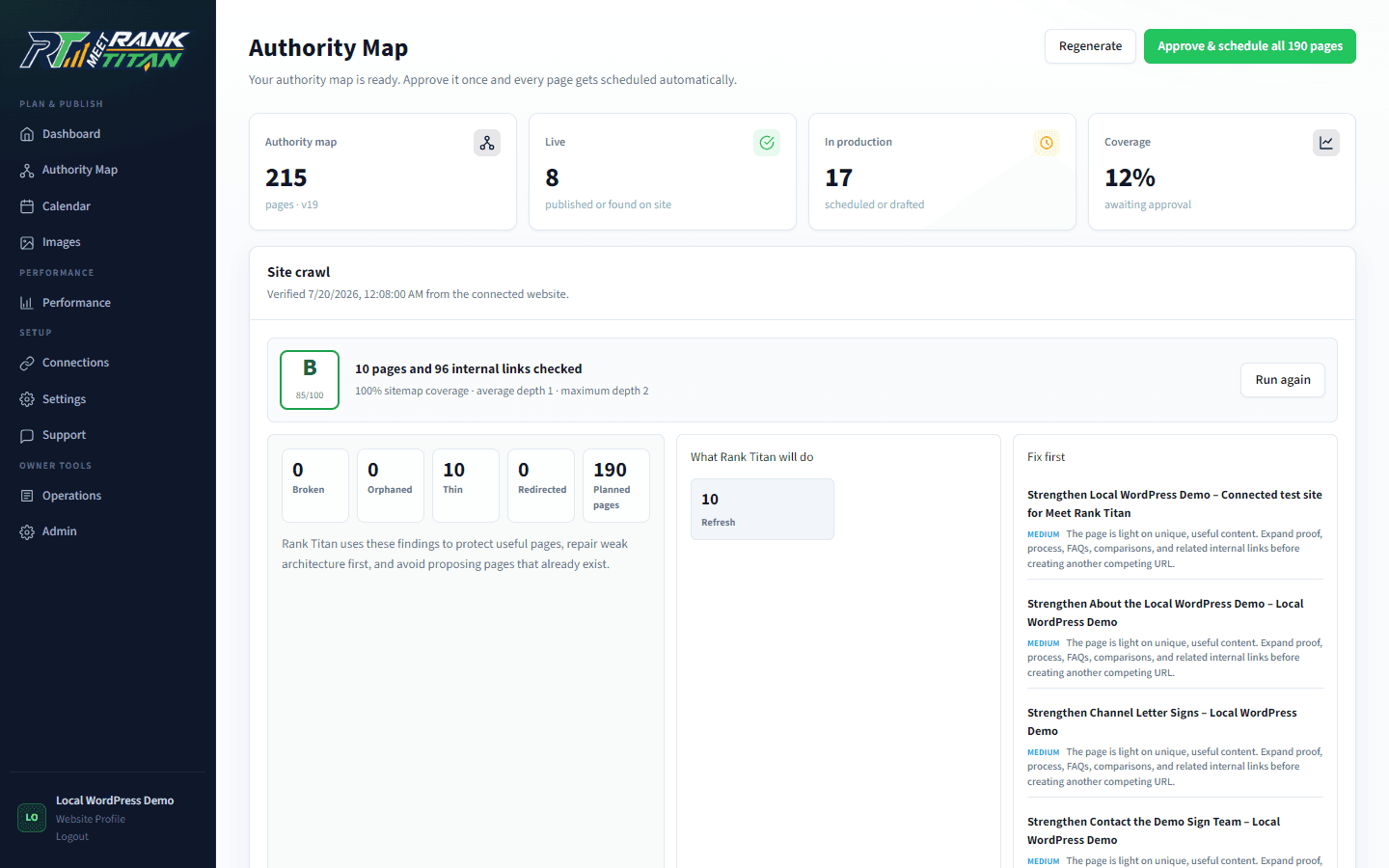
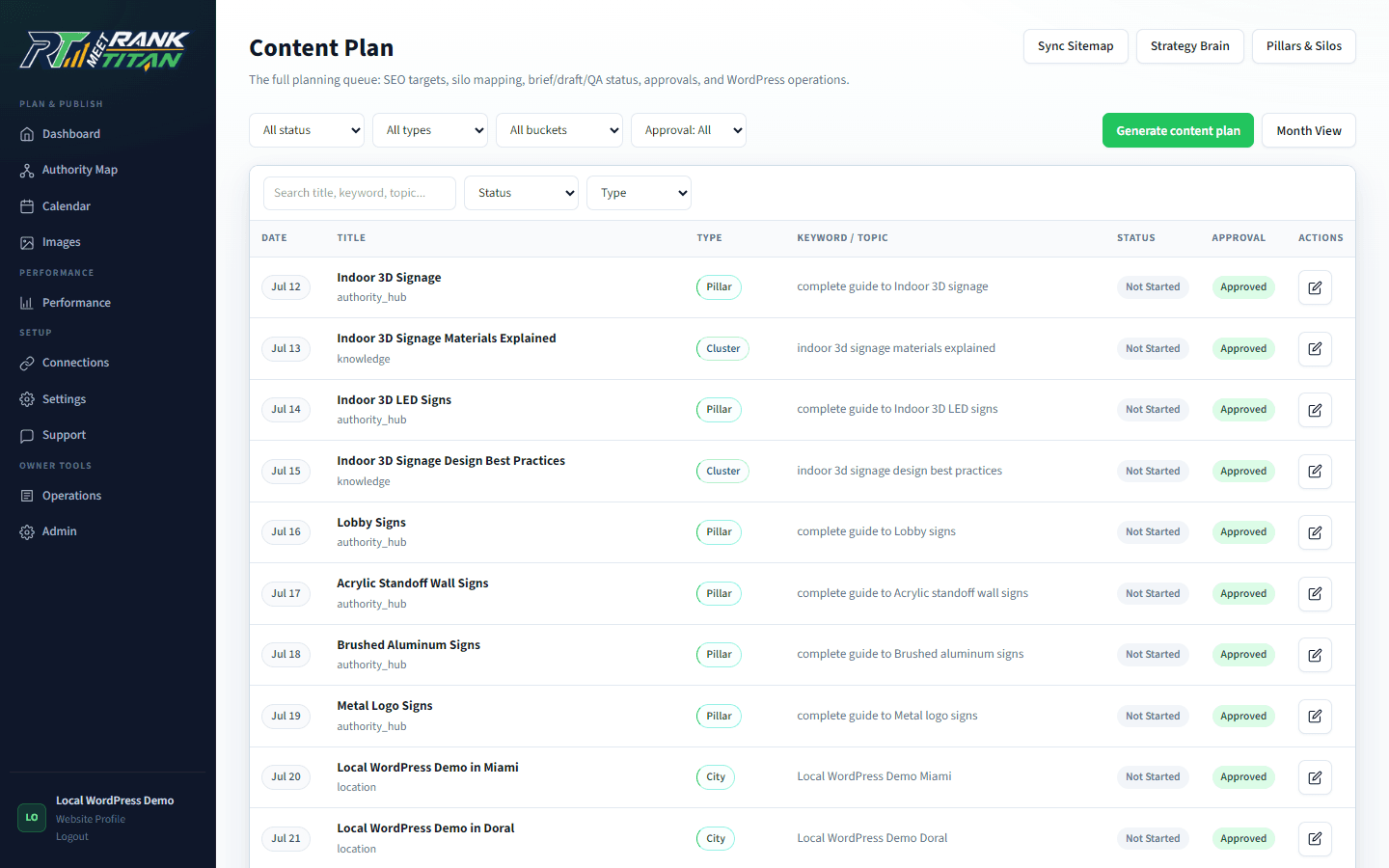
Map the site before generating the next page.
Rank Titan connects crawl evidence, topical architecture, briefs, QA, internal links, and draft-safe publishing in one reviewable workflow.