
Local SEO topic clusters built around real coverage
A local topic cluster connects the pages a real customer needs to understand a service in a market. It is not a matrix that turns every service and city into an indexable URL. The model must begin with genuine coverage, distinct tasks, and evidence.
What is a local SEO topic cluster?
A local SEO topic cluster is a group of distinct service, location, service-location, and supporting information pages connected around a real market and conversion path. Every URL has one owner task and links to the broader service or location context.
The cluster model is useful because local journeys mix commercial and informational questions. A buyer may need to confirm service availability, compare options, understand permitting, see local proof, and request a quote. Those questions do not automatically belong on separate pages.
Start from the current site, business profile, services, actual locations or service areas, approved evidence, and buyer questions. Then choose the smallest architecture that answers them clearly.
What must be true before building a local cluster?
The business must genuinely offer the service in the market, accurately represent its physical or service-area model, provide a useful conversion path, and have enough distinct evidence or buyer decisions to support the proposed owners.
- Verify legal and public business identity, staffed locations, service areas, contact paths, hours, and eligibility.
- Confirm service scope, exclusions, availability, local constraints, pricing factors, timelines, and accountable experts.
- Inventory existing service and location URLs before proposing combinations.
- Preserve approved local proof such as real projects, original images, policies, staff coverage, and customer questions.
- Reject any cluster that depends on invented offices, reviews, projects, landmarks, or interchangeable city copy.
Model 1: service-led local cluster
Use a core service page as the commercial owner, then connect qualified location or service-area pages and narrower decision guides. This model fits businesses whose offer is stable across several markets but whose availability or proof needs local clarification.
The service page explains the full offer, process, options, and general proof. A location page can describe the business's real presence or service coverage. A service-location owner exists only when combined intent and market-specific usefulness justify it.
Support pages can answer materials, cost factors, timelines, preparation, maintenance, comparisons, or permitting. They link to the service owner rather than becoming disguised lead pages for every city.
Model 2: location-led cluster
Use a legitimate branch or market owner as the hub when customers primarily choose by location. Link to the services actually available there, local logistics and policies, real staff or project proof, and the location's conversion path.
A staffed branch page can accurately expose address, hours, departments, contact details, and applicable LocalBusiness properties. A service-area page should not borrow those physical-location signals.
Do not publish a separate page for every nearby municipality when one market owner answers the same task. Use clear coverage text and navigation instead of doorway fleets.
Model 3: local question and evidence cluster
Use support pages for recurring local decisions that require enough depth to distract from a commercial owner: regulations, materials, climate, timelines, maintenance, comparisons, project examples, or original local research.
A question page should remain useful beyond a lead-capture form and include accurate sources, dates, limitations, and a natural route to the relevant service or location. It should not repeat the complete service pitch.
Original evidence pages can become strong sources for both search and AI-answer citations, but they must expose a methodology and avoid presenting a small sample as universal market truth.
How do you prevent local cluster cannibalization?
Write one ownership statement and one exclusion for every URL. Compare likely query overlap, existing visibility, page format, local evidence, and conversion path before splitting, then monitor which page search systems actually show.
- Core service owns the general offer; it does not pretend to be every local market page.
- Location owner covers real premises or a bounded market; it does not repeat every service in full.
- Service-location page owns a distinct combined task only when local usefulness and evidence support it.
- Support guide owns one decision or question and routes commercial intent back to the owner.
- Cannibalization guide owns diagnose, differentiate, consolidate, redirect, canonicalize, or retire actions.
Which links and stop rules keep the cluster useful?
Connect support pages upward to the appropriate service or location owner, link commercial pages to helpful detail, and add lateral links only for a real next task. Stop expansion when proof, distinct intent, maintenance capacity, or a useful conversion path is missing.
- No orphan local page and no page whose only inbound link is an oversized footer city list.
- No automatic service-by-city multiplication.
- No new URL when an existing owner can absorb the answer naturally.
- No LocalBusiness markup that implies a location the business does not operate.
- No publication when local facts, images, reviews, or project claims cannot be verified.
Service-led versus location-led local cluster
| Decision | Service-led | Location-led |
|---|---|---|
| Primary owner | Core commercial service | Real branch or bounded market |
| Best when | Offer stays stable across markets | Availability and choice begin with place |
| Local pages | Selective coverage or service-location detail | Services genuinely available at that location |
| Support | Materials, process, cost, comparison, and maintenance | Local logistics, rules, projects, staff, and questions |
| Main risk | Service-city multiplication | Invented or thin location pages |
| Conversion | Service quote or consultation | Location-specific contact, visit, or eligibility path |
Implementation checklist
- Verify real services, locations, service areas, contact paths, and local evidence.
- Inventory current URLs and assign one owner to each audience task.
- Choose service-led, location-led, or question-led structure from buyer behavior and proof.
- Document why each service-location combination deserves or does not deserve a URL.
- Specify upward, downward, lateral, and conversion links in the brief.
- Block invented local signals and interchangeable copy.
- Re-crawl the graph and verify canonicals, schema, images, mobile paths, and zero orphans.
- Review indexation, query ownership, qualified conversions, and upkeep on a fixed cadence.
Frequently asked questions
Should a local cluster have one page per city?
No. Use the smallest set of pages that serves distinct tasks with real coverage and evidence. One regional owner may be more useful than many thin city variants.
What is the difference between a location page and service-location page?
A location page owns a real branch or bounded market. A service-location page owns one service in that market only when combined intent and local usefulness justify a separate answer.
Can informational pages support local rankings?
They can improve useful coverage and link paths when they answer real local decisions, but publication does not guarantee indexation or rankings. Measure the actual owner pages and outcomes.
How does Rank Titan plan local clusters?
It uses crawl evidence, service and location context, page roles, target topics, proof constraints, internal links, approval states, and destination controls before drafting.
Primary sources and further reading
See the Rank Titan tools used in this workflow
These are current captures from the working Rank Titan application—not conceptual dashboard mockups.
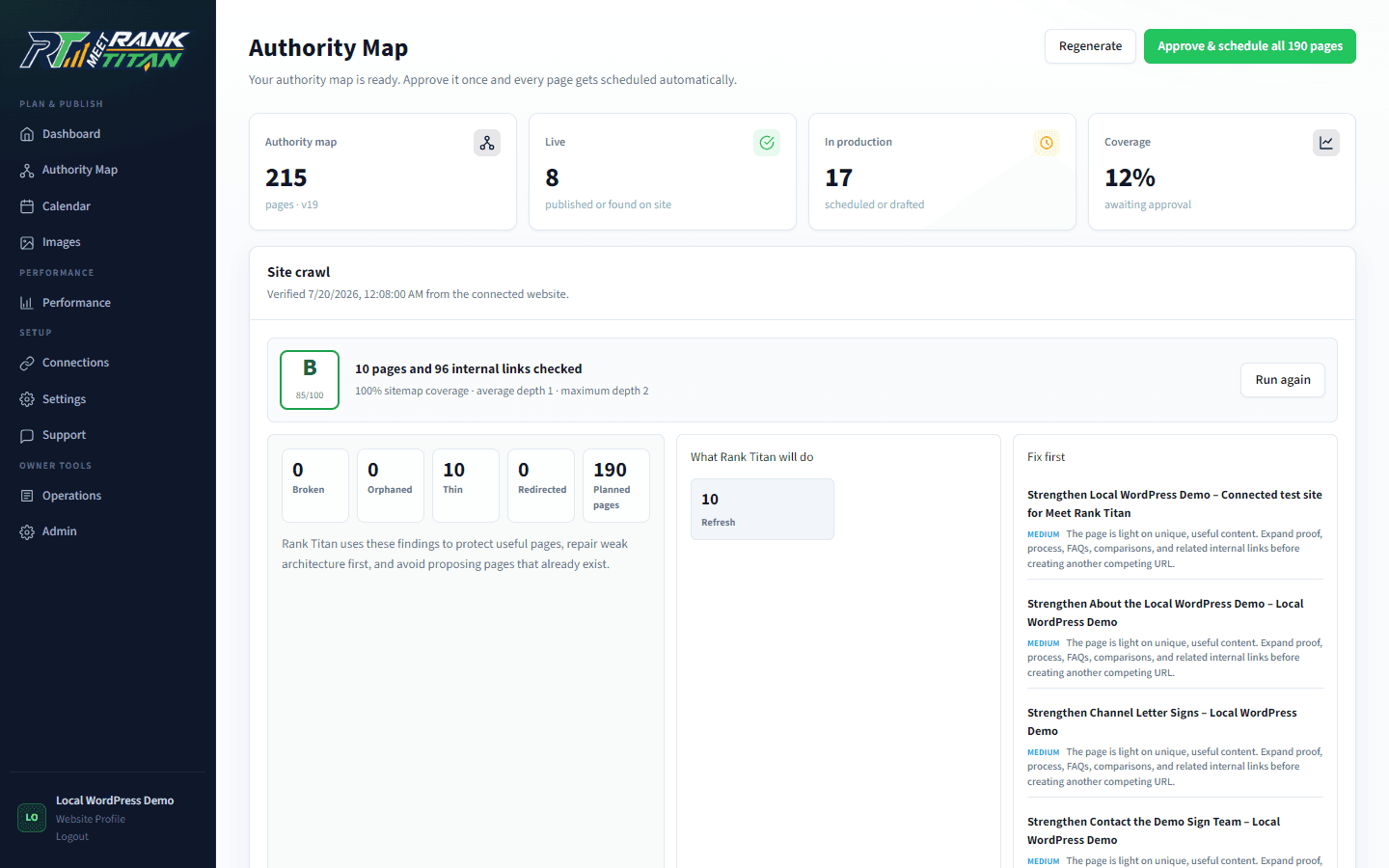
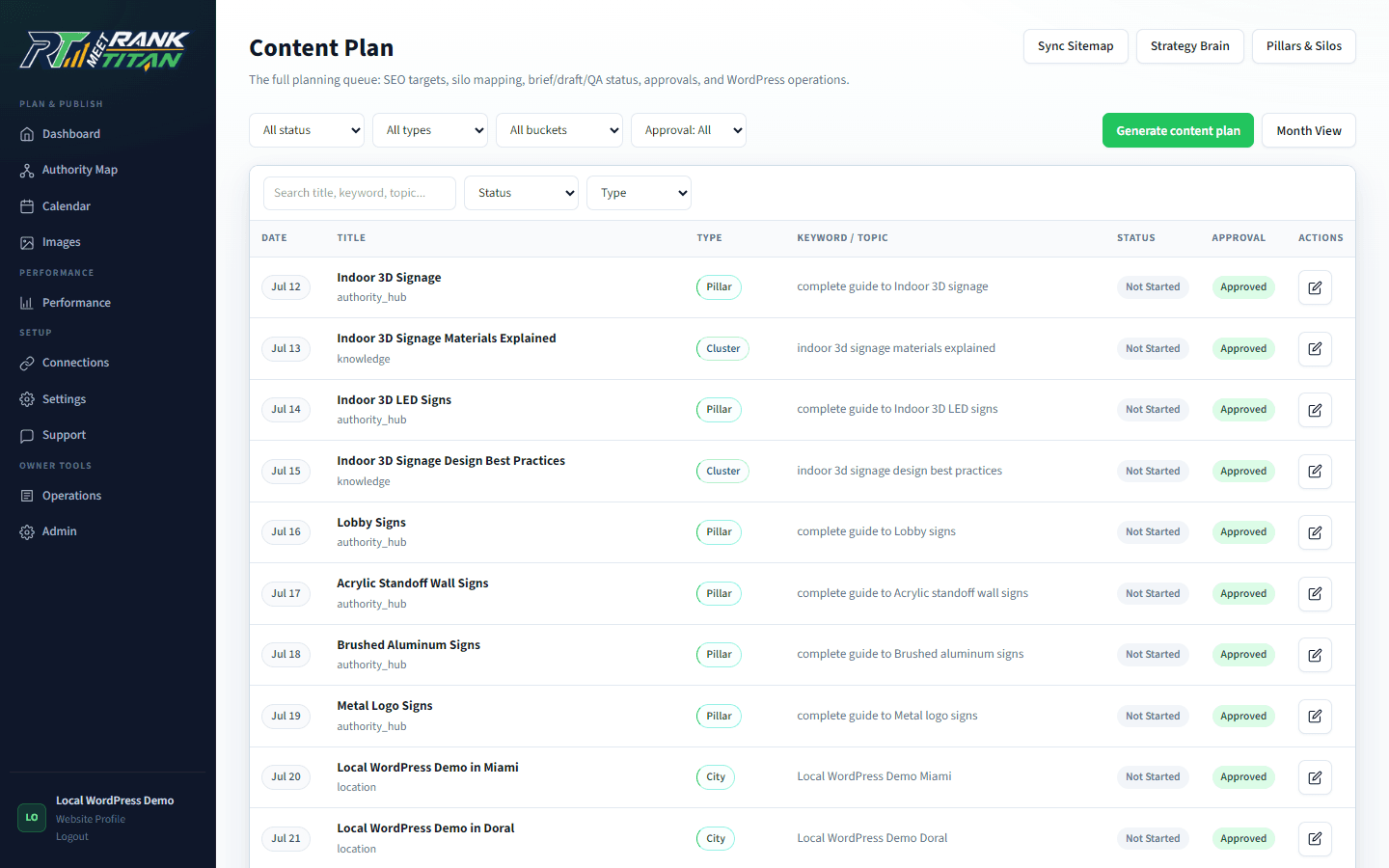
Map the site before generating the next page.
Rank Titan connects crawl evidence, topical architecture, briefs, QA, internal links, and draft-safe publishing in one reviewable workflow.