
SEO content QA checklist: evidence, quality, and release gates
A useful SEO content QA checklist does more than count words and keywords. It proves that the right page was created, the claims are supportable, the package is technically complete, and an accountable reviewer has enough evidence to approve or block release.
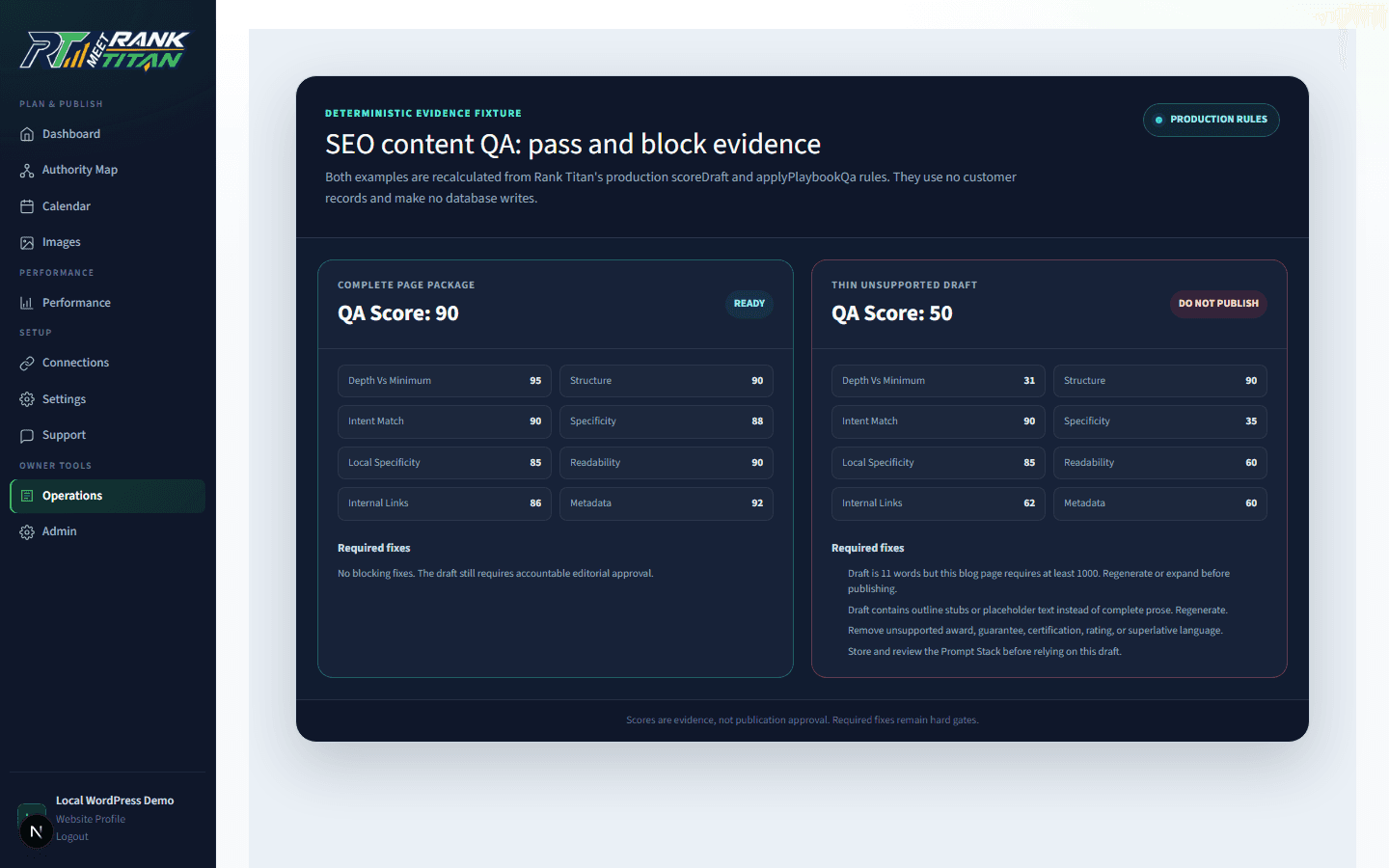
SEO content QA: pass and block evidence
Both examples are recalculated from Rank Titan's production scoreDraft and applyPlaybookQa rules. They use no customer records and make no database writes.
No blocking fixes. The draft still requires accountable editorial approval.
- Draft is 11 words but this blog page requires at least 1000. Regenerate or expand before publishing.
- Draft contains outline stubs or placeholder text instead of complete prose. Regenerate.
- Remove unsupported award, guarantee, certification, rating, or superlative language.
- Store and review the Prompt Stack before relying on this draft.
What is an SEO content QA checklist?
An SEO content QA checklist is a pre-release control that tests page ownership, search intent, factual support, editorial usefulness, metadata, structured data, media, internal links, accessibility, destination safety, and measurement readiness. It produces a documented release decision, not just a score.
Quality assurance begins before the draft. If the page duplicates an existing owner, targets an unverified service or location, or lacks evidence for the claims it would need to make, polished prose cannot make the release safe. The reviewer should be able to trace the draft back to an approved opportunity, brief, source set, page role, and conversion path.
The checklist also distinguishes automated signals from accountable judgment. Software can count headings, inspect metadata, validate links, parse structured data, detect placeholder text, and flag risky language. A person still decides whether the answer is accurate, sufficiently original, helpful for the intended audience, aligned with the business, and ready for a live destination.
How do you QA page ownership and search intent?
Confirm that one canonical URL owns one primary audience task and that the draft fulfills that task without drifting into a parent, sibling, or commercial page's job. Check the current site before approving a new URL, and document why a refresh, consolidation, or new page is the correct action.
- Owner: canonical URL, primary query family, audience, intent, page type, parent pillar, and conversion role.
- Conflict check: existing pages that rank, receive links, or substantially answer the same task.
- Exclusions: adjacent questions, services, comparisons, and locations that another URL owns.
- Answer fit: a direct answer early, a format suited to the query, and sections that advance the reader's decision.
- Unique value: verified experience, product evidence, original analysis, useful examples, a practical tool, or a clearer decision framework.
How should evidence and claims be reviewed?
Classify every consequential statement as a verified business fact, first-party observation, primary-source fact, attributed third-party claim, reasoned inference, or unsupported assertion. Block publication when a product, result, price, location, certification, customer, or comparative claim lacks support.
Google's people-first guidance asks creators to make sourcing, expertise, authorship, and the production method clear where readers would expect that context. Its generative AI guidance also emphasizes accuracy, quality, and relevance. That makes a preserved source ledger and visible limitations more useful than an unexplained confidence score.
Review dates matter for changing facts such as pricing, feature availability, policies, integrations, and comparison criteria. Remove guarantees, awards, ratings, certifications, and superlatives that the source state cannot prove. When evidence is incomplete, state the limitation or narrow the claim; do not use plausible model output as a substitute.
What editorial checks determine whether a page is useful?
Read the page as the intended visitor. It should answer the task directly, explain the important decisions with enough depth, avoid padding and repetition, expose limitations, and offer a sensible next step. A long page can still be thin when its sections add no new information.
- One descriptive H1 and a logical heading hierarchy that is not chosen only for visual styling.
- Plain-language definitions, concrete criteria, examples, limitations, and next actions appropriate to the query.
- No placeholder text, outline stubs, unfinished transitions, duplicated sections, generic city swaps, or hidden prompt language.
- Natural terminology and entities used to clarify the answer, not keyword repetitions inserted for a score.
- A consistent voice, clear attribution, transparent AI assistance where appropriate, and an accountable editorial approval.
Which technical and on-page checks belong before publication?
Validate the page package and the rendered result. The title, description, canonical, robots instruction, sitemap decision, structured data, internal links, images, accessibility behavior, analytics, and final status must agree with the approved page and destination.
Google recommends descriptive titles and meta descriptions, crawlable links with useful anchor text, accessible images with appropriate alternative text, and structured data that represents visible page content. Treat those as separate checks. A valid JSON-LD block does not prove that its claims are true, and a CMS success response does not prove that the public route rendered correctly.
Confirm one self-referencing canonical on the approved host, no unintended noindex, a 200 final response, no internal redirect hops, and at least one relevant inbound crawl path. Validate structured data syntax and eligibility. Check images at their served URLs, social-preview selection, mobile layout, keyboard focus, heading order, and the analytics event on the canonical route.
How should SEO QA scores and hard gates work together?
Use category scores to make review consistent, but let hard failures override the average. Thin or placeholder content, unsupported consequential claims, missing page ownership, broken destinations, unsafe publication settings, and absent required approvals should block release regardless of the total.
The evidence panel on this page uses Rank Titan's production scoring functions with two deterministic fixtures. The complete fixture reaches the configured ready threshold while retaining editorial approval as a separate gate. The thin fixture contains placeholders, unsupported language, missing links, invalid FAQ alignment, and no stored prompt package, so the same rules cap its score and return do not publish.
This is test evidence, not a customer result or a claim that every page scoring 90 will perform in search. Scores should reveal why a draft passed or failed, list required fixes, preserve the raw result, and allow a reviewer to reproduce the decision after a rule change.
What must be recorded at the release gate?
Record the reviewer, review date, source state, approval status, intended destination status, publication job, rollback reference, exact rendered URL, and verification result. Keep generated, approved, delivered, live, indexed, ranking, and converting as distinct states.
- Before delivery: complete package, resolved required fixes, approved claims, approved media, destination permissions, and safe draft or update mode.
- After delivery: returned content identifier, final status, exact URL, rendered title and body, metadata, schema, images, links, and layout.
- After discovery: crawl observation, sitemap state, canonical selection, indexing status, and query-to-page ownership.
- After measurement: qualified impressions and visits, conversions, assisted journeys, AI-answer observations, and the next refresh or consolidation decision.
- On failure: stop reason, preserved evidence, retry safety, responsible owner, and a rollback path that does not overwrite unrelated live content.
Automated checks versus accountable review
| QA area | Automation can verify | A reviewer must decide |
|---|---|---|
| Page ownership | Potential overlap, matching terms, canonical inventory | Whether the page serves a distinct audience task |
| Evidence | Source presence, dates, risky phrases, missing fields | Whether each claim is accurate and sufficiently supported |
| Editorial quality | Length, headings, repetition, stubs, readability signals | Whether the answer is useful, original, clear, and complete |
| Technical package | Metadata lengths, links, schema syntax, image paths | Whether the implementation represents the visible page truthfully |
| Release | Approval state, destination response, rendered checks | Whether the live-site change is authorized and safe |
| Outcome | Crawl, index, query, visit, and conversion records | What to refresh, expand, consolidate, redirect, or retire |
Implementation checklist
- Trace the draft to an approved page owner, audience task, intent, brief, source set, and destination.
- Compare the proposed owner with current URLs and resolve overlap before publication.
- Verify consequential claims against dated evidence and remove unsupported language.
- Review the direct answer, depth, structure, originality, voice, limitations, and next step as a reader.
- Validate title, description, canonical, robots, sitemap decision, links, schema, images, and accessibility.
- Treat required fixes as hard gates even when the average score is high.
- Record accountable approval, destination state, exact-route proof, and rollback information.
- Measure deployed, crawled, indexed, ranking, cited, and converting as separate states.
Frequently asked questions
What is a good SEO content score?
There is no universal score that guarantees rankings or publication readiness. Use a documented rubric calibrated to the page type, and let factual, ownership, safety, and approval failures block release regardless of the average.
Can AI perform SEO content QA?
AI and deterministic checks can accelerate classification, completeness, risk, and consistency review. A person still needs to confirm truth, usefulness, source quality, business fit, and authorization for consequential live-site changes.
Should a draft pass QA before going to WordPress?
Yes, but delivery should still default to a reviewable destination state such as draft unless a separately approved workflow authorizes publishing. The rendered WordPress route must then be verified after delivery.
Does passing SEO QA guarantee indexing or rankings?
No. QA improves release quality and reduces preventable defects. Crawling, indexing, rankings, citations, qualified visits, and conversions are later observations influenced by many factors.
Primary sources and further reading
See the Rank Titan tools used in this workflow
These are current captures from the working Rank Titan application—not conceptual dashboard mockups.
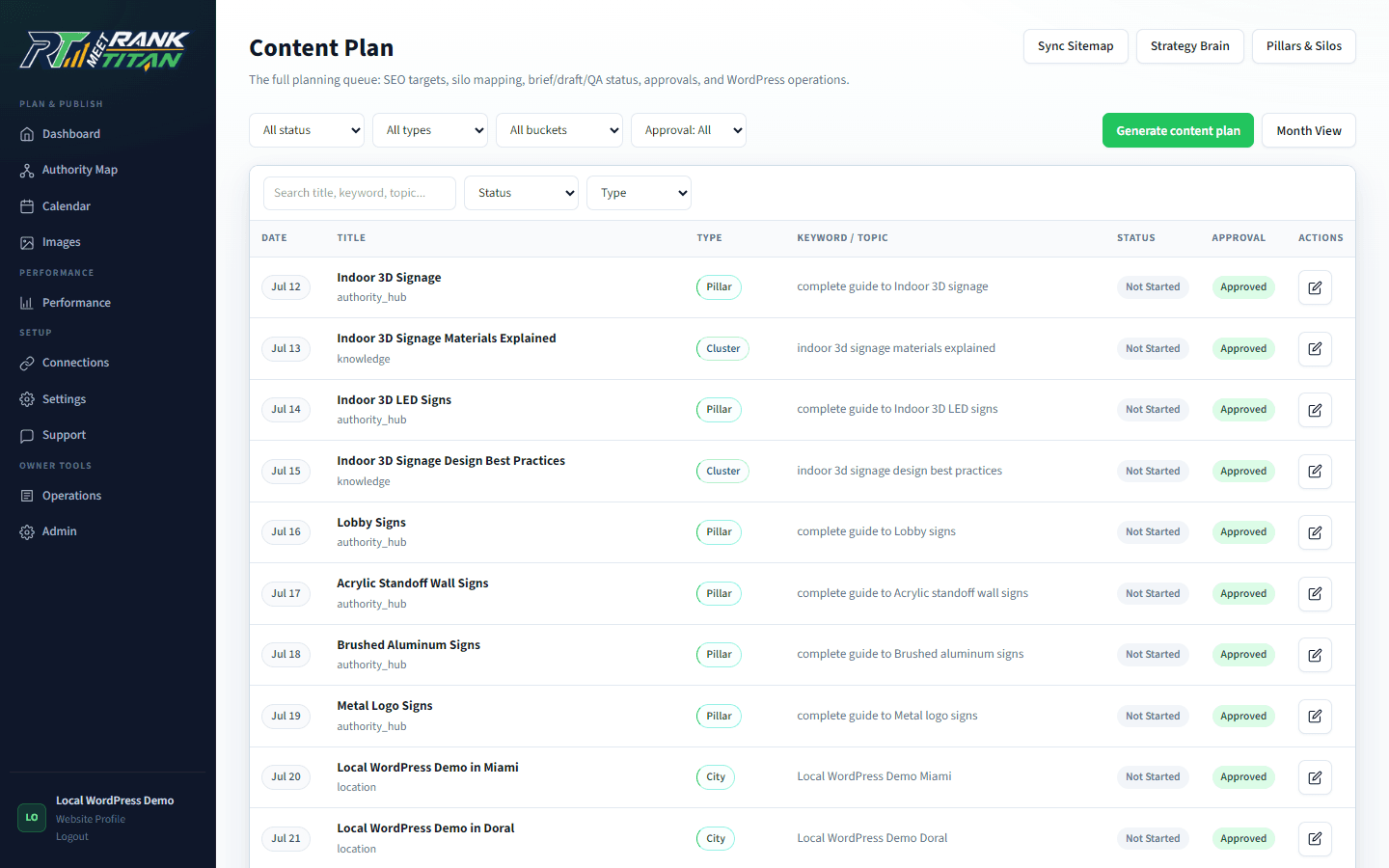
Map the site before generating the next page.
Rank Titan connects crawl evidence, topical architecture, briefs, QA, internal links, and draft-safe publishing in one reviewable workflow.